Showing posts with label story structure. Show all posts

Monday, July 13, 2026

7 Misconceptions of Kishotenketsu


Kishotenketsu is a 4-part narrative structure prevalent in East Asia (specifically China, Japan, Korea, and Vietnam). And in recent years, it has made its way into Western writing communities . . . with, unfortunately, some misconceptions and misunderstandings.

But this is no time to reach for the pitchforks; these don't come from a place of malice, but innocence. Nor does this post come from a place of anger--I just want to clear up some of the confusion. Then we can all understand this structure better.

First, though, we should probably review what kishotenketsu is.

Monday, April 27, 2026

Writing Slice of Life, with Kishotenketsu


When writing slice-of-life scenes, sequences, acts, or whole narrative arcs, it can be tricky to keep them interesting; kishotenketsu story structure can help writers do just that. 


What is Slice of Life?

Slice-of-life moments depict ordinary, everyday life. They can include routines, like walking a dog, making dinner, or even waking up and getting ready for school; or typical social interactions, like hanging out with a friend, asking a spouse about their day, or getting permission from a boss to leave work early. They tend to have low conflict and low stakes, and in fact, they may even have no conflict.

The longer the slice-of-life part is in a story, the trickier it can be to pull off. A bored audience is usually one that won't stick around, and slice-of-life can be rather mundane. 

In a strange way, this often makes slice of life significantly more difficult to write. In a high-stakes, conflict-filled scene, the writer has a lot to work with. If your character is running away from a serial killer, it's innately interesting, and the audience is much more likely to stick around. When a character is doing routine paperwork with little at risk, it can easily, and quickly, turn boring. (And frankly, many unpublished slice-of-life scenes don't contribute enough to the story.)

With that said, what often makes slice of life interesting and enjoyable are the characters and their relationships, and/or the atmosphere and setting. With the "right" characters, a simple trip to the grocery store can be a treat. And if the setting is something like Paris, then everyday experiences there can feel like pleasurable escapism. The target audience may want to linger in a bakery near the Eiffel Tower. 

Many fans of slice of life also cite nostalgia as a draw, and they appreciate reading or watching a story that is actually relaxing. While not a requirement, slice of life tends to be lighthearted. If an entire book or show is slice of life, then often it will be paired with another genre--most commonly comedy or romance. It's typically very difficult to get away with writing something that is pure slice of life (because of some reasons we'll cover below).

Yet, with the rise of slice-of-life vlogs in recent decades, as well as slice of life's close cousin, cozy fiction, it's obvious there is an appetite for "quieter," realistic content.

One of the best ways to handle that content, is to follow kishotenketsu story structure.

Monday, March 9, 2026

Kishotenketsu Story Structure Explained (with Examples, Visuals, Variations)


Kishōtenketsu is a 4-part narrative structure from East Asia, and over the years, it has slowly been making its way into Western writing communities. From Studio Ghibli's Spirited Away, to the award-winning horror film Parasite, to anime and manga like Demon Slayer topping the charts, and the climbing craze for k-dramas, many Westerners have fallen head over heels for the kishotenketsu (pronounced "kee-show-ten-ketsu") storytelling approach (whether they know it or not). Unfortunately, though, there have also been quite a few misunderstandings about what kishotenketsu actually is, and how it works, on its way to the West.

Last year, a student in my writing course asked me to comment on kishotenketsu. And while I will openly admit I'm not an expert on it, or East Asian culture, I'm not completely clueless either. Japan has long held a special place in my heart because my dad, brother, aunt, uncle, and cousins lived there. My best friend's dad did work there. And my other brother's close friend was half-Japanese--he'd sometimes share cool shows with us (fun fact: my first Studio Ghibli film was all in Japanese, no subtitles, thanks to this friend).

I wish I could say these people helped me write this article, but the truth is, they didn't; they haven't studied kishotenketsu or writing in depth . . . and with the research I've done, I know more than them on this topic now. (It probably also helps that I inhaled a lot of anime during my formative years 😉) With that said, I am open to hearing corrections from those who know more than me--I just ask they be given with kindness.

I am not East Asian, but what I am is a professional editor and writing instructor who has studied a lot about stories and their structures. I believe my thoughts on this topic are worth sharing. Also, I did look at sources that were actually East Asian, because I do prefer to learn straight from the originators. My references are listed below.

Let's get into it.

(*Notes: I sometimes use West and East in this article as generic terms; I'm aware they are imprecise, but this allows for simplicity. Based on the content of this article, I'm sure you'll get what I mean. Also, plurals are handled differently in English versus Japanese, so I've coined the word "tens" to reference multiple "ten" for clarity, for my audience--I'm aware this isn't how it's handled in Japanese.

Finally, because this ended up being a longer-than-normal post, I've included a table of contents 😊)

Friday, September 19, 2025

20 Years Later: Dissecting Twilight


Twilight turns 20 this month, so I'm bringing you the story dissection and analysis no one asked me for, but everyone can learn from (with my editorial feedback too 😉). And would you believe it? We all misread this story from the start!

Twilight. As infamous as it is famous. Especially in the writing community. In fact, despite it being one of the biggest bestsellers of modern times, few in the writing community will touch it with anything other than a ten-foot pole. Almost no writer can reference this series without losing some respect. And if you must bring it up, you must do it derisively or at least apologetically; otherwise, no one will take what you say seriously.

So do I dare bring it up? In a whole article dissecting its strengths and weaknesses? On my blog? Apparently.

Say what you will about Twilight, but it has been more successful and the author has earned more from it than any of us could realistically dream of.

Which means, despite its flaws, it must be doing some critical things right. 

How did I get here?

Well, it all started back in January, when the films returned to my local theaters (though apparently they are returning to national theaters later this month). A family member asked me to see them with her, and I love going to movies. Naturally, I said yes--even though I remembered how cringy the films could be. (Why did they cast Kristen Stewart as Bella? Why use a CGI baby? How do they take such amazing music and place it in the most awkward, terrible places imaginable?)

I hadn't watched or read anything Twilight in over ten years, and the first film was as bad as I remembered.

Yet at this time, I was also writing a post on Meet Cutes, and I decided to go back to Twilight to read the Meet Cute--because it has always been memorable to me--and when I retrieved the book, I decided I wanted to also read the Early Glance, so I started at the beginning, feeling unsure what I would think about the text.

I had read the series when it was first getting popular, before I had any kind of professional understanding, training, or classes on writing. And I only read the books once each. So I wondered, would I hate Twilight now? Would I even be able to get to the Meet Cute?

To my surprise, I ended up reading all of Act I.

To my bigger surprise, as we continued attending the films, I . . . well . . . I got teary-eyed in Breaking Dawn, Part I.

Then a lot of things began clicking into place in my writerly brain. Despite its flaws, with my editorial background, I now clearly saw past its imperfect cosmetics to its core--what the series was really about, and even more, the potential for what it could be.

Just after this, I flew out to a writing conference, so I got the first audiobook to listen to.

Considering this was the first novel Stephenie Meyer wrote, ever, and that she didn't write it with intentions to publish, and that its initial request came from an assistant who was also brand new to the industry . . . I was curious how well it followed story structure, or if it even followed it at all.

I discovered some interesting things.

But first, I want to share some thoughts on the book, particularly with those who haven't read it.

***

And because this is a long one, I also wanted to list its sections up front:

Is Twilight “Good”? Or is it “Bad”?

Edward is the Protagonist; Bella is the Viewpoint Character

Character Arcs and Themes (Edward and Bella)

The Relationship Plotline as the Primary Plotline

The Structural “Skeleton” of Twilight

Act I: Moving from Classmates to Friends

Act II, Part I: Moving from Friends to Couple

Act II, Part II: Moving from Couple to (Physically) Separated

Act III: Moving from Separated to Reunited (Rescued and Rescuer)

Editorial Feedback (Improving Twilight)

Plot Points

External Plotline

Bella Swan

Thoughts on Controversial Cosmetics

Extra Diagrams 

Monday, March 10, 2025

Alternative Views of Basic Story Structure


Basic story structure is, well, the foundation of story structure. 

Rising action. 

Climax. 

Falling action. 

You've heard me talk about it all before. 

And if you've followed me for a while, you likely know how I view this shape as a fractal, with smaller versions that exist inside it. One for each act, one for almost every scene. 

Sunday, November 24, 2024

Writing with 3 Equal-sized Acts: The Hunger Games


A while ago, a follower read my article "Variations on Story Structure: A List," and asked me to elaborate on how The Hunger Games (book) doesn't follow the typical beat percentages, and they wondered if I could maybe go over how to pull that off. I wasn't sure when/if I'd get to it, but . . . here we are!

Now, because I know we have a lot of new followers, I want to make sure we are all starting with the same foundation, first. (If you've been following me for a while though and don't want the review, feel free to skip to the section after this next one.)


Typical Story Structure

Most stories follow 3-act structure, with the middle of the story taking up about 50% of the book. Because the middle is so long, most people will split it into two. So, typical stories look like this:

We could argue that because there are four major turns (or "peaks") that this is really a 4-act structure, but to keep with the language most commonly used, we'll call it a 3-act structure, with Act II split into "Part I" and "Part II."

This typically breaks the story down into quarters (more or less). Each section takes up about 25% of the story.

Yes, some writers hate percentages, but percentages are the quickest, easiest way to communicate when something usually happens in a book, so, we'll use them.

Like pretty much anything in writing, though, the percentages are just guidelines. It's what usually works for most audiences. It's what the audience is used to seeing.

The four peaks are plot turns--they turn the direction of the story. A year or so ago, I realized that this also means they shift the protagonist's goal, or their plan to get the goal in some way (for an explanation of that go here.) When a plot turn happens, the goal or plan has changed (at least somewhat).

These plot turns are also called turning points or plot points, and depending on what approach you use, you may know them by other, more specific, names.

In 7 Point Story Structure, they are Plot Point 1, Midpoint, Plot Point 2, and Climax (or "Resolution" (or part of Resolution, anyway)).

In Save the Cat!, they are Break into Two, Midpoint, All is Lost, and Finale (or part of it).

In the Hero's Journey, they are Crossing the Threshold, unstated, The Ordeal, and Resurrection. 

(But if you aren't familiar with any of those names, that's okay too.)

Whether or not you are aware of it, most of the stories you consume follow this basic structure.

To take it a step further, there are usually medium turns in between each of these major peaks (which I didn't draw in that image). These are frequently what people refer to as Pinch Point 1 and Pinch Point 2 (and the inciting incident for Act I, depending on how you view it). Act III's doesn't have one common name, but that doesn't mean it doesn't exist--it's usually the turn that takes us into the climax.

This means that most stories have a turn every ~12% of the story--a big turn every quarter, and a medium turn in between those.

You can learn more about all that in "The 12% Rule of Story Structure."

But of course, while this is by far the most common way to structure a great story, it isn't the only way to structure a story.

Monday, October 7, 2024

Promise, Progress, Payoff--in Stories, Acts & Scenes


When lecturing on plot, New York Times best-selling author Brandon Sanderson often breaks structure down into three parts: promise, progress, and payoff. These fit beginning, middle, and end, respectively. 

While I find this approach too simplistic for what I need to write a great story (hey, I'm not Brandon Sanderson!), it is an excellent foundation to build on. Without these things in place, your story will always be lacking. Without these things in place, you'll run into problems that will lead to bored (or even annoyed) readers.

Lately, I've been thinking about how these principles not only apply to the story as a whole, but how they are useful for smaller structural units as well--acts and scenes.

As always, I'm not going to say using them is vital to every scene or every act of every story.

But I will say, they can be super helpful if this approach resonates with you, your story, your act, or your scene.

Before I explain all that, though, let me give a brief overview of Sanderson's perspective . . . (though I admit to sprinkling in some of my own thoughts along the way). 

Promise, Progress, Payoff

Essentially all stories are made up of beginnings, middles, and ends. And as mentioned, Brandon Sanderson assigns these three different purposes (broadly speaking of course). The beginning makes promises to the audience. The middle shows progress toward those promises. And the end illustrates the payoff of the promises and progress. 


Beginning--Promise

When the reader opens up the book, they want to know what sort of story this is going to be (and if they want to stick around for it). As a writer, it's your job to make promises that convey that. 

Sanderson talks about several promises you need to make:

- Genre (The opening of the book should make it clear the story is science fiction, historical, romance, crime, or whatever it is. However, Sanderson does acknowledge the cover, title, and back cover will likely illustrate this as well.)

- Tone (the feel--will this be comedic? Dark? Whimsical? Cheerful? etc.)

- Plot (Will this be a mystery? Travelogue? A heist? A rivalry? etc.)

- Character (Who is the protagonist and what is he like?)

- There should also be a promise of change or conflict--it's a promise that something will be in motion.


I admit that Sanderson uses the term "promises" a little differently than I have on here in the past, but I think it's fair to call these promises (and Sanderson also admits to wanting the alliteration of three P's: promise, progress, payoff).

I want to mention, too, that you are essentially setting up the story here. You are conveying to the audience where and when the story takes place, who it's about, what's going to happen, and why it matters (the "why" would be the stakes). When you look at Sanderson's list of promises, you see they basically cover all that as well. (But I'm pointing it out for something I will bring up later.)


Middle--Progress

When the reader gets into the middle of the story, you need to keep them reading by showing progress on what you promised. If this story is a mystery, you need to show the characters finding clues. If the story is about traveling to a destination, you need to show the characters traveling. If this story is about a competitive rivalry, you need to show each character striving to outdo the other.

After introducing the protagonist in the beginning, you need to show how she is progressing toward her wants, as well as how that character is progressing through her character arc.

You may also want to show "progression" related to genre. If you introduced a magic system in the beginning, you may want to dig deeper into it in the middle. (And you don't want to introduce magic in the beginning, and then have no magic in the middle (usually).)


End--Payoff

This one is pretty straightforward. As the reader gets to the end, you are going to pay off everything you promised and progressed. The mystery gets solved. The destination gets reached. The rivalry ends with one or the other as the victor.

The character achieves her objective and/or completes her arc.

And you'll probably have the biggest, best illustrations of your genre at the end.

This is all simplistically speaking though. Of course not every story ends with the character reaching her destination or achieving her objective. There are absolutely ways to turn the ending with a surprise, or twist or subvert an expectation, but that's beyond the scope of today's article. 

Basically, the ending is about doing a good, satisfying job of completing what you started. 

As Brandon Sanderson says, ideally you want to give the audience the expected thing (what you first promised), but in a way that is better (read: bigger, more surprising, more powerful) than expected.


Application to Acts

Recently I've been thinking about how these same basic principles can be used to create satisfying acts.

If you've been following me for a long time, you may know that I see basic story structure as fractal

This basic shape has smaller versions of it that live inside it, like a Russian nesting doll.

Not only does the story as a whole take this shape.

But so does each act.

And most scenes.

It's just that, the smaller the structural unit, the less impactful and important the pieces are.


I think I also feel that way with the concepts of promise, progress, and payoff. Yes, they're very important to the story as a whole, but to a smaller degree, for many stories, they are also important to acts. 

If it suits your story, you can likewise view acts as following these principles of promise, progress, and payoff--they just show up a little watered down.

I'm not necessarily saying you have to promise genre, tone, and everything else, all over again. 

But what I mean is, it's this idea that there is a sense of setup and promise for the act. 

Then a sense of progress.

Then a sense of payoff.

If we look at the first act of Harry Potter and the Sorcerer's Stone (which I've been using as an act example lately), you'll see how this works.

The story opens with the Dursleys and then Harry being left on the doorstep before we move forward in time to when he is ten--this has both promises for the story as a whole, and also for the act.

In the middle of Act I, strange things start happening. Harry can make odd things happen, and odd things seem to be happening around him, while the Dursleys continue to hate anything out of the ordinary (including Harry). 

We hit Act I's peak turn, which is when Hagrid reveals Harry is a wizard, and he's been accepted into Hogwarts.

Promise. Progress. Payoff.

Start Act II (Part I).

As Hagrid takes Harry to Diagon Alley, we get promises of what Harry's new life will be like as he gets a wand, and we also see Hagrid take a mysterious package from Gringotts.

Harry starts his new life and begins learning magic. On the train ride to Hogwarts, Ron mentions someone tried to rob Gringotts, and later Harry learns from the paper, that that was the same day he went there with Hagrid.

Harry goes to meet Malfoy for a midnight duel, and then finds the trapdoor with Fluffy. Harry realizes that whatever Hagrid took from Gringotts is now below the trapdoor, being protected. Soon after, someone tries to steal the item (which results in a troll getting loose). The thief is at Hogwarts.

Promise. Progress. Payoff.

No, it's not as big or as obvious as the story as a whole, but I certainly think it can be useful at times to look at acts in this way. 


Application to Scenes

Likewise, it may also be helpful to consider these principles in relation to scenes.

When you open the scene, and set it up, you make promises about what's going to happen in the scene.

Then you show the character taking action toward an objective (progress).

Then you hit the scene's peak, where it often becomes clear if the character did or didn't get their scene-level objective (simplistically speaking). Promise, progress, payoff.

So as a quick example, Harry plays his first quidditch match. . . . 

The start of the scene sets up the time and place and characters involved, and makes the promise that yes, this scene is going to be about a quidditch match. We know Harry's objective is to catch the snitch. We know the stakes.

As the game starts, we get a sense of progress as the characters play, and Harry searches for the snitch. (And there are some other surprises along the way, too.)

The game ends with Harry successfully catching (in his mouth) the snitch.

Promise. Progress. Payoff.

--They can be useful for any structural unit. 😊

***

Recently I attended FanX as a panelist, and it turned out great! Later this month I will be teaching a class on balancing dialogue, description, action, and interiority in scenes, at LDSPMA in Orem, Utah. I'll also have a vendor table while there. (So if it seems like I've been slightly MIA lately, just know I've been busy with these things ☺️)


Tuesday, May 14, 2024

12-Step Checklist for Writing Beginnings (Act I)


Beginnings tend to be the most difficult part of a story to get right, at least for many writers. There is so much Act I needs to accomplish--the hook, the introductions, the turns. 

And if your opening doesn't interest readers, they won't stick around for the "good stuff."

Well, recently I was looking for an Act I checklist . . . and I didn't really find what I wanted, so . . . I decided to make my own (and share it with you, of course). 

For most stories, the beginning--or rather, specifically, Act I--makes up the first quarter of the narrative arc. Let's go through what it should contain.

Sunday, July 23, 2023

What is the Inciting Incident? Definition, Purpose, Examples, Tips


The inciting incident is an event that disrupts the established normal and kicks off the main storyline. It will usually appear as an opportunity or a problem (or both) for the protagonist. And even if the protagonist initially refuses it, he must eventually address it.

For example, the inciting incident in The Hobbit is when Gandalf arrives and invites Bilbo on an adventure. It disrupts Bilbo's ordinary life, and while it is presented as an opportunity, Bilbo views that opportunity as a problem (respectable Hobbits don't go on adventures). He refuses the invitation initially, but later accepts it. If it weren't for Gandalf's invitation, the plot in The Hobbit wouldn't have happened.

The purpose of the inciting incident is to start the main plotline.

The inciting incident is known by a few other names: the "Catalyst" (Save the Cat!), the "Call to Adventure" (The Hero's Journey), and I've also heard it called the "impetus."

Unfortunately--as is somewhat common in the writing community--the term can actually be a little ambiguous, making it difficult to learn about, let alone discern. Not only are there multiple terms for the same event, but there are also disagreements in the community about which event constitutes the "inciting incident." 

So, if you have been confused about this term, I'm not surprised. To minimize confusion, I'll explain the different ways people view the inciting incident, later. For now, the above definition is currently what is generally considered the inciting incident.

Let's break down the inciting incident some more, moving from a basic understanding to an intermediate understanding to an advanced one. I'll go through more examples and even some rule breaks.

Sunday, July 9, 2023

The 12% Rule of Story Structure


Proper structure helps you deliver your story to the audience in a satisfying and familiar way. You wouldn't want to end up with the climactic peak hitting only ~36% into the story. That would make the story feel awkward and the remaining ~64% boring. (Talk about a dissatisfied audience.)

Contrary to what some believe, to me structure is all about organizing and/or timing. When stripped of all the details, beat sheets, and fill-in-the-blanks, it's a matter of organizing your content and timing the delivery of it.

This is one of the reasons you can find successful stories that don't seem to fit your favorite beat sheet. Even though that particular story may not be like others in its details, it can still deliver the content in a satisfying way if it organizes and times it properly.

Today's post is more about the timing.

And I call it the 12% Rule--or perhaps better said, the 12% Rule of Thumb (because even here there are variations, however atypical they may be).

The idea is, at the most basic level, most all successful stories will have a significant turning point every ~12%. A major turn near the end of every quarter, with a medium turn between those.

Monday, January 23, 2023

BIG NEWS: My Online Writing Course!

So, I've been working on a secret project: a live, online writing course. Yay! 🎉 I'm teaming up with My Story Doctor to bring forth a nearly 30-hour class all about developing solid content for stories. And now? It's open for enrollment.


The Triarchy Method of Story: A New Writing Course by September C. Fawkes

The Triarchy Method will help you craft your best book by focusing on what matters most: The “bones” of story. This content-focused course will help you brainstorm better and more relevant material, evaluate what ideas most belong in your story (preventing you from writing hundreds of pages that need to be scrapped), and craft a page-turning plot with compelling characters that sticks with readers long after they’ve closed the book (. . . and hopefully leads them to preorder your next book). The Triarchy Method will illuminate your way to a stronger, solid story.

But only under one condition: You must do the work.

Whether you are in the brainstorming stage, writing stage, or revising stage, and whether you prefer to pants or plan your first draft, strong bones lead to strong stories. So, what are the bones? I call them “The Triarchy of Story,” and they are as follows:


Character

Character is represented by the rib cage—it houses the heart of story. It’s how the audience gains emotional experience from the narrative, through (to some degree) empathy.

Plot

Plot is represented by the backbone—it holds the story upright and together. It’s the curvature that makes up the narrative arc, the spine that runs from beginning to end.

Theme

Theme is represented by the skull—it hosts the intellect of story. It’s how the audience gleans meaning that sticks with them long after the narrative is over. It’s why the story matters.


While some stories and genres may (rightfully) emphasize one bone over the others, it’s the progression of these elements that turns ideas into stories

And if any of this sounds a little familiar to you, it's because I've talked about the triarchy on here before--as the "trinity of storytelling" (but, ya know "bones" and "trinity" don't really work the greatest for branding and marketing, for obvious reasons ✝️🙃).

Nearly every scene, every chapter in your story should be progressing one of these three things. If it’s not, it’s likely filler (even if cleverly disguised filler (painful, I know)). Ideally, the majority of scenes in most stories will actually be progressing all three simultaneously. Don’t worry—I will be digging deep into each element to help you unbury your own story’s bones to accomplish this.

We will be focusing on core principles of each.


For characters, we will talk about your protagonist’s internal wants and backstory, the four basic types of arcs, how to build a balanced cast and make characters complex. We will also talk about agency, archetypes, relationships, and more.

For plot, we will cover the importance of goals, how to pick the right antagonistic forces, how to make conflicts meaningful, and why stakes are critical to keep the pages turning. We will also cover how to create a sense of progress and setbacks, escalate costs, craft turning points, write reveals and twists, and more.

For theme, we will discuss its often misunderstood components, and how to show them effectively through the story. We will also discuss how to replicate the human experience so that your reader comes away wiser, better, and more intelligent—with the story sticking to them long after The End.


We will always keep in mind these are principles, not laws, so there is room for variation (which we will talk about).

Of course, though, simply having a rib cage, backbone, and skull isn’t usually enough—you need to organize them into a coherent structure. They need to be arranged into their proper places, so they look “human” to other humans (i.e. like a “story” to other humans).

This is where structure comes in.


After digging up the bones, we’ll structure them in a way that is familiar and understandable to the audience.

We will structure not only the plot, but the character cast and theme as well. We will cover basic story structure, scene structure, act structure, and narrative arc beats.

Near the end of the course, we will workshop one of your scenes in class. And your final assignment will be to turn in a guided outline of your story for feedback.

Ideally, once the bones are strong and in place, your story will be—more or less—writing itself.

Not only can The Triarchy Method help you with your current story, but it can help you with all future stories.

I’ll give you the tools, you bring the dream—roll up your sleeves for some digging, because together we’re gonna make your story bone-solid.

---

This is a live, online course that will be limited to 10 students.

Classes will be every Tuesday and Thursday at 6:30 pm Mountain Time (8:30 pm EST), starting March 7th and ending on May 25th. If you miss a class, there will be links to the recordings and material so that you can review them later.

Nearly every lesson includes a developmental assignment, which I will give basic feedback on.

Also, if you desire, you can be added to a brainstorming/writing group or partnership to meet with outside of class.

For a full description and details, go here.

---

I love sharing my enthusiasm for writing, and I think it's no secret I like thoroughly dissecting the craft. I also enjoy teaching. So this will be an exciting new venture. If you've been following me for a while, you'll likely notice the course covers some familiar concepts I've talked about on my blog. I'm excited to dig deep into those concepts and cover new ones, while also explaining how they all connect (which is certainly too difficult and massive to fit into a single blog post (or blog series)).

Whether you register or not, thanks for being here and sharing this special milestone with me--it's kind of a big deal to me. (I'd also appreciate it if you spread the word 😉) May all your writing dreams come true🙏

- September C. Fawkes


Monday, April 25, 2022

The 5 Commandments of Storytelling According to The Story Grid


The Five Commandments of Storytelling come from The Story Grid approach to writing, which was created by Shawn Coyne, who has worked in the publishing industry for over thirty years now and has edited hundreds of books. Drawing from the influence of Robert McKee (best known for writing Story) as well as from his vast experience, Coyne came up with concrete ways to measure and understand story. His work has helped thousands of writers find success, and I've personally turned to his approaches several times.

Which brings me to today's article. I recently had some questions that led me back to his work, and specifically to The Five Commandments of Storytelling. Now, I admit, I don't love the name "Five Commandments of Storytelling" because all five elements have to do mainly with plot and structure, and not the other elements of storytelling. But as I've talked about time and again on here, what we call it doesn't really matter, as long as you understand the concept. Coyne also says on his site that it's comparable to the ten commandments Moses got, in that, when boiled down, these are the five things you absolutely need to guide you when getting started in storytelling. 

Some of these items will sound familiar because we've talked about them from other angles before, but I'm covering them from Coyne's angle today, while also throwing in my own thoughts and approaches (don't worry, I communicate which is which).

First off, these five elements are structural elements, and like most structural elements, they work within any structural unit: scene, sequence, act, or the global story. Each of these units really have the same basic parts. For an explanation of how that works, read my post, "Scene vs. Sequence vs. Act."

Monday, March 14, 2022

Pacing Within the Narrative Arc


When it comes to writing stories, pacing really happens at three levels:

- in the overall story (the "narrative arc")

- in the scenes

- in the lines (passages and paragraphs)


Back in January, I taught an online class about pacing--a lot of you probably remember because I mentioned it a few times prior. Before, during, and after, I realized I had more to say on the topic than I could possibly fit into my thirty-minute session, so I thought I would do a few posts exploring it in more depth.

Often when people are talking about pacing, they are talking about it at a scene or line level, but the overall story has its own pacing too. Some sections will have faster, tighter, and more intense pacing, while other sections will have slower, looser, or more leisurely pacing. 

It's also important to acknowledge that--especially when it comes to narrative arc--this is somewhat relative. What might be "fast pacing" in a drama, probably wouldn't be considered "fast pacing" in a thriller. To some degree, what's "fast" or "slow" relates to the pace the story sets up initially.

Nonetheless, any story of any genre can be in danger of speeding sections up too fast or slowing them down too much.

So let's dig into more about pacing within the narrative arc.


Pacing and Structure

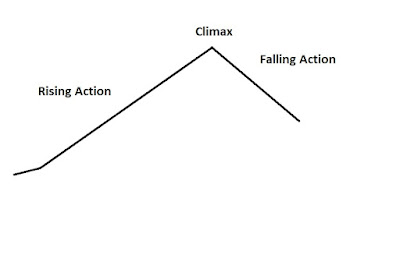
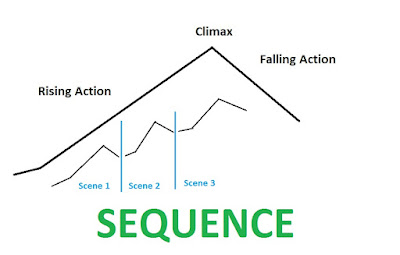
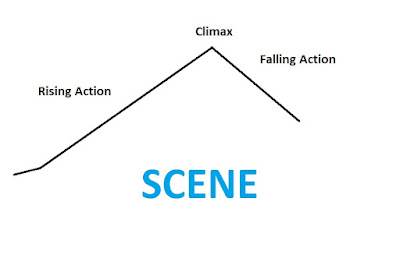
In the past, I've talked about how all structural segments really fit into this basic shape:


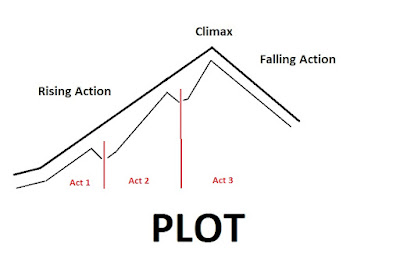
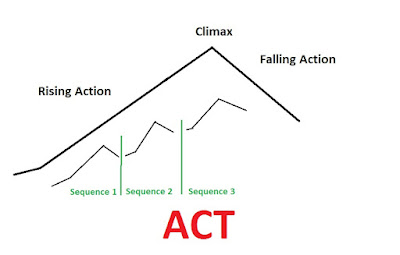
Whether it's a scene, sequence, act, or whole story. This shape is like a nesting doll or fractal--it fits smaller versions of itself inside:


This means that generally speaking, ideally, each of these structural units has its own climactic moment. This is also called a "turning point," because it turns the direction of the story.

The bigger the structural segment, the bigger the turning point--meaning an act's turning point is going to have more ramifications than a scene-level turning point.

This is a great way to start understanding structure. 

Essentially, each of these units has:

- Opening/Setup

- Rising Action

- Climax

- Falling Action/Resolution


Typically, the pacing is going to get faster, tighter, or more intense the closer it gets to the climactic peak.

Afterward, it will get looser and slower with the falling action.

In some situations, the writer may cut off most, if not all, of the falling action, but generally speaking, the pacing is going to slow down into a "valley." And if you are working with a smaller unit than the whole plot, this shape then repeats itself, so you then hit the opening or setup of the next segment.

Ideally, each segment will open with a hook to grab the audience, but after that, the pacing may be a little calmer as we get to the setup and before it really hits the rising action, where the main conflicts happen and develop.

Again, remember this is somewhat relative. You can give yourself a good headache if you overthink or misunderstand how this works, mainly because smaller shapes repeat inside bigger shapes. The smaller shapes have the same parts, but are small scale (read: less intense). 

Typically, the falling action of the segment is more reactionary. It's the character or characters reacting to the turning point. Because the turning point changed the direction of the story (and usually in an unexpected way), the character now needs to take that in, process it, and decide what to do next. 

Think of this on the large scale. At the climactic peak of the narrative arc, the conflict with the antagonist comes to an end. The character (and the audience) needs a moment to process emotionally and mentally what just happened. Then the protagonist must decide what to do next. The falling action usually hints at a "new normal," or at least the next path the protagonist takes, whether that's happy-ever-after or preparing for the next adventure or something else.

Many think that pacing mainly comes from the word count, and certainly word count plays into pacing. But when it comes to the narrative arc or even within scenes, structure often has to do more with pacing. For example, we wouldn't necessarily want to "speed up" the climax of the whole story by making it extremely short. Making it only a few pages doesn't necessarily make it extra intense. Just as you wouldn't want to make the falling action way longer than the climax, thinking that will make it better. In almost all stories, the falling action will have fewer words than the climax. Technically, someone could sustain a fast pace of a segment for more pages than the slow part of the segment. It's not strictly tied to word count. However, it's possible to make a segment too fast or too slow through word count.

Basically:

Word count --(influences)--> Pacing

But not:

Word count = Pacing

Along with structure, hooks, tension, stakes, suspense, and conflict play critical roles in pacing. More of them make the pacing feel tighter, and less of them make the pacing feel looser. We hook the audience at the beginning to get them to stick around through the setup and the start of the rising action. The conflicts and stakes should get bigger as they develop and become more complicated--they escalate. This makes the pacing feel more intense. After the turning point, those things hit an outcome (for better or for worse) and the conflict ends (if only temporarily). Because it ended, the pacing gets calmer and slower--how calm and how slow often depends on what structural unit you are working with. Obviously, in the plot as a whole, it will be calmer and slower in THEE falling action, than it would be in a scene. Nonetheless, it still gets calmer and slower compared to the climax, regardless of what unit you are working with.

When looking at the narrative arc as a whole, it's obvious how these things apply. We want the climax to be fast and intense, and if we handle plotting and structure right, this will happen naturally to some degree, because all the conflicts will be hitting their high points around that time. When they are resolved, it slows down and we tie up the story. 

And in the beginning of the story, we must work to hook the audience so they'll want to stick around long enough to get to the main conflict. 

But what about everything else in between?

This is when it's helpful to go down to the next structural unit: acts.

An act follows the same shape. This means that the beginning, middle, and end will each get a big climactic turning point. 


So what are these big moments?

In Act I, this will be what's called "Plot Point 1," "Crossing the Threshold," or "Break into Two," depending on what structure you use (7 Point Story Structure, The Hero's Journey, and Save the Cat! respectively. They all have different names for essentially the same moment.).

We open Act I with a hook, which will hopefully also be big enough to be THEE hook for the whole narrative arc. We spend time with setup: Who is this story about? Where does it take place? When does it take place? And we also establish a sense of normalcy.

Then the inciting incident hits (this is also called the "Call to Adventure" and the "Catalyst," depending upon your structural preference), which kicks off the story, both for the narrative arc as a whole and for Act I. This is something that disrupts the established normal, and it can either be a problem or an opportunity for the protagonist. 

This arguably starts the rising action, in the whole narrative arc, and especially in Act I.

(While it is possible for Act I to have its own separate "inciting incident" for an act-level problem or opportunity, let's keep this simple for now. I might do more posts specifically on acts in the future. But, if you feel you have multiple "inciting incidents," that might be part of what's happening.)

The protagonist is now having to deal with this problem or opportunity and what to do about it.

On the act level, this comes to a head at Plot Point 1(/Crossing the Threshold/Break into Two), where the protagonist chooses to accept the opportunity or chooses to try to address the problem, and engages with the main conflict. Often this is marked with a big moment--such as a parental figure dying (like in Star Wars) or discovering your birth dad is in New York City and on the naughty list (like in Elf). Whatever it is, it's essentially a moment that helps push the protagonist through a Door of No Return. 

What follows is usually a transitional segment where the protagonist "journeys" (literally or figuratively) to a new "world" (literally or figuratively). Both Luke and Buddy literally travel to a new place, but in many stories, this may be seen to be more of a new state of being (such as a character taking on an old lady persona as in Mrs. Doubtfire). The character gains a new goal as they accept the "adventure."

Know that I'm simplifying this a bit, as this is meant to be a post more about pacing than about structure. 

But that big moment and decision to engage with the main conflict is the climactic moment of Act I, and what follows is often the character reacting to that moment.

This means the pacing gets tighter at that moment, and a bit slower after that moment. 

The climactic moment of Act II, is Plot Point 2, which is also known as "The Ordeal" or "All is Lost." This is usually a part in the story where the protagonist engages with the main conflict, which leads to a loss or "death" (literally or figuratively). This is the biggest engagement with the main conflict so far. Meaning, it's bigger than the high point of Act I, and bigger than anything that came in the middle. So the pacing gets tighter and more intense here.

It's also followed by the biggest lull of the story--Plot Point 2's falling action. Usually, the protagonist fails or loses or "dies" from this engagement and falls into a "Dark Night of the Soul" moment. (Alternatively, the protagonist may succeed in the external conflict, but something isn't right, something is missing or wrong--it's a hollow victory, and this also leads to a lull.)

This is also followed by a transitional segment that takes us into Act III, when the protagonist gains something (whether plot-driven or theme-driven) that enables him to head toward THEE climax. This gives him a new act-level goal for the ending.

Finally, the climax of Act III is also simultaneously THEE climax, and same goes for the falling action.

When you have structure handled, pacing will often come with it--at least to an extent. But looking at the story this way, you can see where you want the pacing to be faster, more intense, and tighter, as well as when you probably want it slower, calmer, and looser.

There are just two variations I want to mention in regards to acts . . . 

Often in the writing community, we refer to stories as having three acts: beginning (Act I), middle (Act II), end (Act III), and I try to (more or less) talk about story in this way, just to keep confusion to a minimum. 

But personally, I feel acts have more to do with this structural shape than they have to do with beginnings, middles, and endings.

Another key moment in the narrative arc is the midpoint, which happens at the middle. This is often where the protagonist gains a bigger understanding of what's really going on with the antagonist and the main conflict, which then enables them to become more proactive in addressing the problem (they sort of go into "attack mode"). This is also often marked by a big event--either a victory or a failure (or at least a seeming victory or a seeming failure).

In stories that have big midpoints, I actually think it's helpful to think of them as having four acts:


This means the pacing will be tight and intense at the climactic moment that comes at the midpoint. 

After the high point, there is usually a bit of a lull as the protagonist processes and decides what to do with the new insight they've gained. This also may have a bit of a transitional segment that leads to a new goal about how to go on the attack for the second part of the middle.

Don't forget, though, that sometimes the falling action gets shortened or cut off or may simply not be on the page. And again, this is a post intended to be more about pacing than structure, so I'm trying not to get too detailed.

The other variation that sometimes happens is that the highest climactic peak of some stories actually hits at Plot Point 2 (The Ordeal or All is Lost moment), with the whole ending showing how the protagonist then applies what he learned from that experience to resolve the remaining conflict and wrap the story up (the film Old is an example of this).

For what it's worth, I actually picture these stories as having only two acts, since there are only two really high points:


In any case, understanding act structure will help you see where you will naturally want intensity and where you will naturally want lulls.

Long ago, I used to get confused when I felt like I needed to have a lully scene, worried that it was boring or would kill the pacing. I didn't understand that on the narrative level, the story should have lully scenes. I didn't understand that pacing happened on such a large level. 

Lully scenes are important in giving not only the protagonist a chance to process and react to what's going on, but also the audience. If there are no lulls, there is no time to digest what just happened. We don't get to react to what just happened. Or wonder about what to do next. We don't have a chance to catch our breath or let our worry fester or our hope build.

It can shortchange a lot of emotional breadth.

Then again, how much time and space you spend on the lulls may be determined by the kind of story you are telling. In a thriller, you will probably want to keep the lulls shorter than average. If you are writing literary fiction, you may want to draw out the lulls longer. 

It all gets down to your story and the effect you want on the audience.

If you are having problems with overall narrative pacing, check act structure.


Pacing and Proportions

Also long ago, I used to hate when instructors talked about percentages. Statements like "X needs to happen at 25% into the story" felt so stifling to creativity! 

. . . but after wandering around the pits of Writing H-e-double-hockey-sticks, I started to think that maybe . . . there was something to all that percentage junk . . . 😕

Well, present-me is here to tell you, there is!

However, that doesn't mean there isn't wiggle room or times to break the rules; it's just that, like with anything in writing, you need to know what you are doing first.

Like it or not, we humans are subconsciously conditioned to expect big moments (*cough cough* major turning points *cough cough*) to happen at certain places in a story.

I would even argue that it goes deeper than conditioning. For one, if there aren't big turning points at the right places, it's more likely that what is currently happening in the story is going to start feeling repetitious. Like, imagine if Harry Potter spent an even bigger part of the story trying to get his Hogwarts letter. How long can you really play around with that conflict before it gets boring? Before the audience is aching for some kind of change or progress? The big turning point ("Yer a wizard, Harry") is the change and progress. And if it takes until 40% into the story to get to that turning point, you can bet your bottom dollar that the audience has already bailed or is snoring. A conflict about trying to get a letter that doesn't really change, isn't sustainable.

I would also argue that turning points are archetypal and even a reflection of how our human minds work. We go along our lives until--bam--a problem or opportunity disrupts us. We wonder about what to do, debate about what to do, maybe resist what we should do, until we eventually come to a decision about it. Or, we take on goals, and as we try to pursue them, we face obstacles, and when it doesn't turn out in our favor, we react and try to decide what to do next, then we make a new plan and come up with a new goal. We don't sit there and react to it for the rest of our lives (or if we do, we need to get some therapy to move past it).

In any case, in the narrative arc, problems with pacing can arise if it takes too long to get to certain turning points (nothing kills pacing quite like repetition and stagnation). Or, if you get to them too quickly, which means there wasn't proper escalation or build-up (rising action).

Percentages are helpful as guidelines.

And here are a few to go with our acts.

- Plot Point 1 should happen around 25% into the story.

- The midpoint should happen around 50% into the story.

- Plot Point 2 should happen around 75% into the story.

As always, you can find examples of variations.

But having this as a baseline gives us the capacity to talk about timing as well as variations.

Generally speaking, if your story doesn't get close to this, it's disproportional. 

If the midpoint doesn't happen until 62% in, then it takes too long for the protagonist to become more proactive and go on the attack. This likely means the section before this is becoming repetitious and stagnant. Likewise, we now don't have as much time to properly build up to the climactic moment of Plot Point 2, for best impact. 

If Plot Point 1 is hitting at 31%, the setup is probably taking too long and getting boring.

Again, these are just general guidelines--I'm not saying no story can't ever play around with these any time or anywhere. 

For example, some stories start in narrative in medias res, which can change this approach. Some rare stories are structured so that the beginning, middle, and end are all the same length, which definitely changes the percentages. 

But if you are having pacing problems at the narrative level, consider looking at the percentages and checking the proportions.


Pacing in the Document

Outside of structure and percentages, there are a few other ways to affect pacing at the narrative level. And this has to do with how the story is actually presented to the audience. 

Chapter lengths can influence how fast or how slow the audience feels the story is going. Short chapters make the audience feel like they are tearing through the book faster. Long chapter makes it feel "meatier." 

This sort of thing can also happen with viewpoint characters. When working with multiple viewpoint characters, some writers will shift between them quicker near the climax of the story. This makes the moment feel tighter, more intense, and more dramatic--assuming, of course, all the viewpoint characters are active participants in the climax. (And it should be mentioned, you can also use this effect at other climactic moments, like within acts).

When it comes to printing, you can also use page and font size in similar ways you use chapter lengths. Reading a "chapter book" feels much faster, not only because the book itself is shorter, but because there are fewer words on a page and it has bigger font. My Lord of the Rings omnibus, on the other hand, has tiny font on big, thin, pages.

Depending on how you plan to publish your book, that may or may not be relevant to you, but I wanted to mention it nonetheless. 

Whew! That's about it for pacing on the narrative level. Next time, I'll talk about pacing on the scene level, then follow up with the line level (which is probably what most people think about when it comes to pacing).

Happy writing!


Read What Others have Written on Pacing

Pacing in Writing by Reedsy

What is Pacing in Writing? by Now Novel

How to Master Pacing by Master Class


Monday, February 7, 2022

The 8 Points of Progress in Plot


In a lecture series on Youtube, #1 New York Times best-selling author Brandon Sanderson talks about the three P's of plot structure: Promise. Progress. Payoff. 

Promises are particularly important in the beginning of the story, as they draw in the audience. 

Progress keeps the audience invested, particularly through the middle of the story. If there is no sense of progress, then the reader feels as if the plot isn't going anywhere. 

Payoff is what fulfills the promises of progress. It rewards the audience for sticking around, and if done properly, creates a feeling of satisfaction at the end of the story. 

While all three can be tricky in their own right, many writers struggle to create a proper sense of progress, which can lead to saggy middles. 

Luckily, Dramatica Theory breaks plot down into eight story points that essentially encapsulate progress.

If you apply them to your stories, your writing will always have progression through the middle.


1. Goal - Every story has a goal. It may be a goal of aspiration, such as becoming a top chef. Or it may be a goal of thwarting something, such as stopping a murderer. Whatever the case, a story's goal is what enables us to measure progress. If there is no goal, then what one does, doesn't really matter. We have no orientation or purpose, so there is no sense of moving forward or backward. The goal allows progress to happen. 

2. Requirements - In order to achieve the goal, something is required. This can be broken down into two variations. In one, the characters must follow an order of steps, like following a set of directions. In the other, the characters must do or obtain things in any order, like a shopping list. The characters in Jumanji, for example, have the goal to restore the world to normal. The requirement is to win the game. But they must do this in a proper order--they can't skip turns.

3. Consequences - Consequences are what happen if a goal isn't achieved or hasn't yet been achieved. In some stories, the protagonist is trying to prevent the consequences, but in others, the protagonist is trying to stop the consequences that are already happening. Consequences might be thought of as overall stakes. In Ralph Breaks the Internet, if Ralph and Vanellope don't buy a new steering wheel for Sugar Rush, then its characters will be homeless. 

4. Forewarnings - Forewarnings convey that the consequences are getting closer, becoming worse, or becoming permanent (depending on the story). If a dam is in danger of breaking, then a forwarning may be a crack that shoots out water. In Back to the Future, Marty's family slowly disappearing from a photograph works as a forewarning. 

5. Dividends - Characters will likely receive small rewards for little successes along the journey to the goal. These are dividends. For example, on her journey to fight in the war in her father's place, Mulan is rewarded honor and a place in the military when she is able to retrieve an arrow from a wooden post that none of the men could get down.

6. Costs - Just as the journey may include dividends, it also entails costs. These have negative impacts on the protagonist's well-being. In order to win The Hunger Games, for example, one must be willing to kill others, which also includes psychological trauma. In order for Frodo to get to Mount Doom to destroy the Ring, he must suffer a loss of innocence. This is a cost. 

7. Prerequisites - There are often certain essentials one must have, to pursue the goal at all. These are prerequisites. Prerequisites on their own don't bring the goal closer. This is why they aren't requirements. In Interstellar, a spaceship, equipment, and astronauts are needed to travel space to find a new home (goal). But simply having those things doesn't necessarily mean the characters are closer to discovering a liveable planet. 

8. Preconditions - Preconditions do not directly relate to the goal. They are "non-essential constraints or costs placed on the characters in exchange for the help of someone who controls essential prerequisites." In Karate Kid, a prerequisite is that the protagonist must receive extra lessons from a master, but the master adds the precondition of doing chores. One does not technically need to do chores to do karate.


Some of these points are more direct--like requirements--while others are more indirect--like preconditions. The direct points will usually be more intense than the indirect. As you apply these elements to your stories, you'll create a sense of progress--especially through the middle, which will help make any story more satisfying. 

***

This May, I will be teaching a class on "Structuring Your Cast of Characters" at the Storymakers Conference in Provo, Utah. This is my favorite writing conference that I've been to. The guests and instructors are great. Those running it are amazing. The attendees are wonderful. It will be taking place May 12th - 14th (and my class is scheduled for the 13th). If you can't attend in person, Storymakers now sells virtual tickets, so you can still have access to almost all the classes (some are only available in person). Mine will be available online as well as in person. To learn more or register, visit StorymakersGuild.org
Also, this Wednesday (Feb. 9th), I will be on The Rebel Author Podcast with Sacha Black talking about voice. Here is the link if you want to tune in: https://sachablack.co.uk/the-rebel-author-podcast/


Monday, January 17, 2022

What is a B Story? 6 Key Qualities of B Stories


A "B Story" is a secondary plotline that unfolds, more or less, alongside the "A Story," the primary plotline. Lately, I've been thinking about B Stories more and wishing there were more resources on them. So I decided to help out by putting together this article on the six key qualities a B Story should have--things I wished I'd understood earlier in my writing journey. 

But first, we need to make our usual pit stop to talk about definitions--because (somewhat ironically) these tend to be a little ambiguous in the writing community.

The A Story is the primary plotline--this definitely includes the struggle between the protagonist and antagonist, which means it's the biggest, most predominant conflict. Many people break down the protagonist's journey into an inner journey and an outer journey. While I consider these two different types of plotlines, they usually weave together to make up what many consider the A Story. This means that typically the A Story is made up of the biggest external conflict and the most intimate internal conflict. 

The B Story is the secondary plotline. Many argue that the B Story must be a relationship plotline--this is almost always between the protagonist and the Influence Character. I personally feel it doesn't have to be. It's simply the secondary plot. But if it isn't a relationship plotline, there will still usually be a relationship plotline somewhere in the narrative arc.

These arguments for whether or not the B Story must be the relationship plotline may be more about how writers slice and dice stories and define their elements. It may be more of a matter of perspective, than anything.

Sometimes the term "B Plot" is used instead of "B Story."

So what makes a B Story work? Here are some qualities to keep in mind (while also acknowledging, there is always room for exceptions).

Monday, December 13, 2021

Myth: "Keep Your Character Failing until the End."


Sometimes in the writing community, people say things like, "Keep your protagonist failing until the end"--in fact, I've probably said this more than once. But like a lot of writing "rules," it's sort of a half-truth . . . or even a quarter-truth, especially if you are writing a long story like a novel. 

What people really mean is that almost always, the protagonist's main conflict shouldn't be fully resolved until the end. I mean, that's pretty much how story works. 

Still, there are a couple of exceptions even to this, such as if you are writing a story that comes across as more biographical or episodic, so that we are following the protagonist through sequential conflicts, where each gets resolved within its appropriate section. 

With that aside, however, it's still important to not take this advice too literally. 

Reading a story where the protagonist is quite literally constantly failing is as boring as reading a story where the protagonist is quite literally constantly succeeding. In fact, it may even be more boring, because at least the latter has a sense of progress. 

Monday, November 15, 2021

How "In Medias Res" Actually Works (& When to Use It)


I haven't ever done an article on in medias res in part because it's been covered so much in the writing world already, what could I really add to it that you probably haven't heard? Well, after looking around online . . . it turns out, quite a few things. I sometimes feel that in medias res gets misunderstood, and overused.

As most people who teach about in medias res will tell you within four seconds, "in medias res" is Latin that translates to "in the midst of things." In some ways, this is pretty straightforward: Instead of starting a story with exposition or setup, you start with the action or conflict. Most people will cite that this will grab the reader and draw them into the story.

As someone who has read thousands of unpublished manuscript openings though, I'll tell you that a lot of times, it doesn't. But I'm getting ahead of myself, let me backtrack a bit (speaking of starting something in the "middle of things" 😉)

Back when I was a "young" writer, when the topic came up of how to start a story, it was often, if not almost immediately, followed up by talking about in medias res. "If you don't know how to start the story, start in medias res"--I was told time and again. 

So like many people, I thought that if I had bombs going off or someone dying in the first paragraph, that it would for sure hook the audience and get them to keep reading--and it'd be a great opening too! 

Years later, when navigating submission piles, it soon became apparent to me that this often wasn't the best way to start. I could only handle so many "bombs going off" (metaphorically or literally) and "war battles" (metaphorically or literally), and I could only handle them for so long . . . before they got boring. (And to add to it, often newer writers, in their efforts to make it "exciting," make it unnecessarily graphic to the point of being grotesque.)

In contrast to what many people teach, in medias res can actually get rather boring within paragraphs or pages if it isn't done well. Because in medias res means cutting off the exposition and setup, it also means cutting off the context. If I have no clue who to care about, how we got here, and why what is happening matters, it can be really difficult to get invested in the story. After reading several paragraphs of people being run through with swords, I start wondering, Why does this matter? And why do I care?

And immediately teaching about in medias res when someone asks how to start a story often isn't a great way to teach how to start a story. After all--you're actually cutting off the starting of the story.

Of course, like anything, beginning in medias res can be great when done well and for the right effect. But in order to do that, you need to understand how it actually works and what that effect is. 

For starters, it's helpful to not think of in medias res as only being used for story openings. You can use in medias res for any scene at any point in the story. So let's talk about how this works on the scene level, and then talk about it on the narrative level.


In Medias Res in Scenes

Typically, a scene is defined as a unit of action that takes place in a single location and continuous time. But this definition is certainly not perfect and the boundaries can get blurry fast with the right examples. However, I think most can agree that a scene is one of the smallest recognized structural units in a story.

And all structural units--whether they're a scene, sequence, act, or whole story--fit into this shape:

A scene will usually start with a hook and setup, followed by rising action (conflict), a climax, and a falling action. In some cases, some of these may be left out, but scenes almost always contain these things.

You can find slightly different approaches to scene structure from different sources. 

For example, recently, I talked about scene structure according to Dwight V. Swain, who is famous for his approach. (In fact, his approach may arguably be the most famous.)

He recognizes two types of the smallest structural unit: scene and sequel (you can learn about them in more detail in "Scene Structure According to Swain" and "Sequel Structure According to Swain.")

The scene is made up of three parts: goal, conflict, and disaster. And the sequel is also made up of three parts: reaction, dilemma, decision. But regardless, both still fit into the structure above.

In medias res means "in the midst of things," so instead of starting with the hook and setup, you drop the audience right into the rising action, or in some cases, even climax. (And the conflict or climax often becomes the hook.)

The setup portion is used to ground the audience in the scene--it conveys when and where the scene takes place, who is in the scene, the character's goal, may lay out the stakes, and if there are multiple viewpoint characters, will clue the audience into whose viewpoint they are in. (For more on all this and scene openings, see "4 Key Elements of Scene Openings.") This orients the reader and gives context for what is about to happen. It gives meaning to the rising action.

When you start in medias res, the audience lacks this context.

In this way, beginning in medias res is a lot like writing a teaser, which also works off a lack of context. In a teaser, the whole point is to tease the audience through a lack of context. The teaser promises that if the audience keeps reading, they will get more context to understand what just happened. This is often a great way to use in medias res.

But just like a teaser, the audience won't stick around if context is withheld from them for too long. Like me going through submission piles, they start wondering, Why does this matter? And why should I care? Teasers only work well when they are short. 

So, when you start in medias res, the audience can only handle so much of being "in the midst of things" before getting antsy for information. Contrary to what many writing instructors might advise, I would argue that starting in medias res is often harder, because the writer must fill the audience in on everything they are missing--and they must do it sooner rather than later. And often for newer writers, this leads to big dumps of information, setting, worldbuilding, characterization, stakes, goals--and whatever else--in the middle of conflict and action. Or, it might lead to the dreaded flashback. This is a tough situation to be in, even for the best of us, because one small reason that stuff is in the setup is so it doesn't clutter and kill the pacing of the conflict. It's so we can focus on the conflict.

Sure, some context will be easy to squeeze into the rising action. For example, you can convey the viewpoint character rather quickly. In fact, you can slip in most information in a line or two if you are well-practiced. But the problem is, it's often a line or two per thing: goal, character, stakes, setting, motive, and any other background info. That's a tall order.

Now, with all that said, you may think I'm against starting in medias res. I'm not. I'm just pointing out how difficult it can be, especially for newer writers, and yet we are often telling them to do it. I mean, no wonder beginning writers have so many flashbacks and info-dumps in their openings--they're being (indirectly) led to do that.


In medias res can work great in a few situations:

As a teaser: As stated above, starting in medias res is a lot like writing a teaser. The audience doesn't know the full context, and that's the point. The promise is that they will get more information if they keep reading, so instead of being drawn into the story because of the goals, stakes, and conflict, they are drawn into the story because of mystery, intrigue, and curiosity. The tone of the story is often conveyed, cluing the audience into what sort of emotions they can expect if they stick around. The audience won't stick around for long without important context, so the scene either needs to be brief, or the text needs to start filling the audience in after teasing them.

The setup information doesn't really matter: Sometimes how the character got to the rising action of the scene isn't really important to the story. For example, a story may open with a sword fight in medias res, but the fight doesn't really matter that much to the actual plot. It might instead be used to showcase the protagonist. Reading about a sword fight with no context can get boring. Reading about a sword fight told through a strong viewpoint character can be fascinating. And if he does a lot of sword fighting and is skilled in it, this might be an excellent way to illustrate that. You will of course still need to fill in some setup. But because the conflict itself isn't vital, you won't need to struggle explaining everything that led to this moment. 

Other times the conflict does matter because the result kicks the plot in a new trajectory by affecting what happens next, but the setup isn't important because it's simple, mundane, obvious, or easily implied. It doesn't really need to take up that space to set the stage. For example, say we have a scene where some kids are playing hide-and-seek in the woods and one finds a treasure chest. The setup (which would involve starting the game) may not be very important. So instead, we might start with the "seeker" already finding one or two kids. Finding the treasure will be the scene's turning point, and change the direction of the plot as the kids decide what to do with the coins and jewels.

The audience already knows the setup: If you are writing about a famous event, such as 9/11 or Lincoln's assassination, you may not need to include the setup--the audience already knows what led to the conflict or climactic moment. 

Other than that, if the in medias res scene isn't the opening scene, then it's possible a prior scene already established enough of the setup. The audience knows the goal and stakes, the time and place, because it was stated or implied. So instead, we can cut right to the action.

With all this said, almost no scene requires you start in medias res. So rather than stress if a scene should start in medias res, ask yourself if starting in medias res is more effective for the story you want to tell.


In Medias Res in Narrative Arcs

Because all structural units follow the same shape . . . 


. . . you can essentially do this to the story as a whole.

The setup of a whole story covers about everything prior to the inciting incident. The inciting incident is a disruption that kicks off the plot of the story and is either a problem or an opportunity for the protagonist. The setup introduces us to the characters, setting, and establishes a sense of what's normal. 

While uncommon, it's not impossible to start the story with the inciting incident. It's even technically possible to start a story after the inciting incident. However, I hesitate to go too deep into that, because I think the terminology and definition can get blurry and gray pretty fast. Nonetheless, it wasn't uncommon in literature of the past to cut the beginnings and endings off short stories, with the idea that a strong middle will imply both the beginning and the ending. 

If your opening scene includes the inciting incident or takes place after the inciting incident, you'll likely need to introduce the characters, setting, goals, motives, and stakes afterward as the story progresses--unless most of that prior to the inciting incident isn't really important to the story (which rarely is the case). This information can be filled in through flashbacks, dialogue, and narration. Like with scenes, this can be a tall order, because we don't want to lose the sense of immediacy or slow down the story with info-dumps. With that said, you often have to fill in some backstory regardless of where the story opens in the narrative arc. It's just that in medias res, you'll likely need to fill in more and be more careful and clever about it.

A more common approach is to take a scene from the rising action or climax of the story and insert it at the beginning, creating a flashforward (which one may then argue if it's truly in medias res or simply a flashforward). This works as a sort of teaser for the audience. An obvious example of this happens in Twilight, where Stephenie Meyer takes a passage from the climax and puts it at the beginning of the story as a short preface. The story will then go back and start the setup. The teaser draws the audience in, and as they get to the setup, they wonder how the character ends up in the later situation.

Sometimes the scene is strictly plot-driven, such as someone finding a dead body, a victim who was clearly murdered. When the story goes back to the setup, the audience wonders what led to that moment. Who killed that person? And why? They'll now be watching for "clues" as the story goes back to the beginning.

In order to pull this off well, the teaserly scene should not spoil the actual story. I've heard of a t.v. show that did just that--actually spoiled the whole build up in the first episode. Of course, you didn't realize that until you got closer to the climax--and by then, what's the point if you already know the answer to the questions being posed?

In any case, just as with the other section, starting a story with any narrative in medias res can create a sense of mystery and intrigue, by stirring up curiosity. This is because the audience lacks full context. Like with teasers, they'll now be watching and waiting for the context.

However, unlike with in medias res scenes, in narrative in medias res, the audience is willing to wait longer for the context of the story as a whole. They understand the moment comes from later in the narrative. As long as they have scene-level context quickly--so they can actually enjoy and follow the story--they'll be willing to take the journey to get narrative-level answers.

To be honest, I don't see many novels or short stories that open in narrative in medias res. It's something I feel is more common in film. 

Just like scene-level in medias res, narrative in medias res is rarely required. Ask yourself if starting in medias res is more effective for your story.


Opening in Medias Res (Among Other Things)

As stated above, when people talk about in medias res, it's usually in reference to the opening of a story. This is done either on the scene level or on the narrative level. 

Your opening scene may skip its setup and start right with the conflict.

Or, the opening scene may come directly from the rising action of the whole story.

Arguably, you can look at in medias res in other ways as well--just as there are scene-level and narrative-level ways to execute it, there are arguably sequence-levels and act-levels.

Also, like with many writing terms, not everyone views in medias res the exact same way. There are slightly different definitions and interpretations of it floating around. But hopefully this article gave you a more defined understanding of how it actually works and when to use it.