Showing posts with label scene structure. Show all posts

Monday, April 27, 2026

Writing Slice of Life, with Kishotenketsu


When writing slice-of-life scenes, sequences, acts, or whole narrative arcs, it can be tricky to keep them interesting; kishotenketsu story structure can help writers do just that. 


What is Slice of Life?

Slice-of-life moments depict ordinary, everyday life. They can include routines, like walking a dog, making dinner, or even waking up and getting ready for school; or typical social interactions, like hanging out with a friend, asking a spouse about their day, or getting permission from a boss to leave work early. They tend to have low conflict and low stakes, and in fact, they may even have no conflict.

The longer the slice-of-life part is in a story, the trickier it can be to pull off. A bored audience is usually one that won't stick around, and slice-of-life can be rather mundane. 

In a strange way, this often makes slice of life significantly more difficult to write. In a high-stakes, conflict-filled scene, the writer has a lot to work with. If your character is running away from a serial killer, it's innately interesting, and the audience is much more likely to stick around. When a character is doing routine paperwork with little at risk, it can easily, and quickly, turn boring. (And frankly, many unpublished slice-of-life scenes don't contribute enough to the story.)

With that said, what often makes slice of life interesting and enjoyable are the characters and their relationships, and/or the atmosphere and setting. With the "right" characters, a simple trip to the grocery store can be a treat. And if the setting is something like Paris, then everyday experiences there can feel like pleasurable escapism. The target audience may want to linger in a bakery near the Eiffel Tower. 

Many fans of slice of life also cite nostalgia as a draw, and they appreciate reading or watching a story that is actually relaxing. While not a requirement, slice of life tends to be lighthearted. If an entire book or show is slice of life, then often it will be paired with another genre--most commonly comedy or romance. It's typically very difficult to get away with writing something that is pure slice of life (because of some reasons we'll cover below).

Yet, with the rise of slice-of-life vlogs in recent decades, as well as slice of life's close cousin, cozy fiction, it's obvious there is an appetite for "quieter," realistic content.

One of the best ways to handle that content, is to follow kishotenketsu story structure.

Monday, July 22, 2024

Then vs. Now Scenes


Recently I did an article on types of scenes that have little to no conflict, and it seemed like the proper time to write up a little post on another pair of scenes: Then vs. Now scenes.

This topic has been sitting in my "draft queue" for quite a while, but I haven't covered them yet because . . . frankly, they don't need much of a word count to explain. Nonetheless, they are worth going over. So, let's go over Then vs. Now scenes in a short post today.


Then vs. Now scenes are pretty much what they sound like. They are usually a pair of scenes, one at the beginning of the story and one at the end, that illustrate how things have changed (or less commonly, haven't changed). So for example, there could be a scene at the beginning of the story that shows a depressed protagonist missing the bus to work. Then, there could be a similar scene at the end that shows the protagonist happy as she arrives at the bus stop early. This blatantly shows how the story has transformed her.

When people talk about Then vs. Now scenes, they typically reference how the protagonist has changed, but as I mentioned, you can technically use them to show how the protagonist has remained the same. I could have the end scene show the protagonist once again depressed and missing the bus. This communicates that, despite all that has happened through the middle of the story, the protagonist remains (or has gone back to) the same state.

Then vs. Now scenes are commonly used to showcase the protagonist's character arc. Perhaps the protagonist started the story believing that she had to take advantage of others to get ahead. Perhaps we showed her in the opening stealing money from the panhandling homeless. In one of the closing scenes, we show her giving money to them instead. This clearly illustrates she has a new worldview: It's better to help others.

As you've probably guessed, Then vs. Now scenes can be used to show an infinite number of things--how a character has aged, how a character has mastered a skill, how an occupation is the same, how a setting has changed, how a best friend continues to be a scoundrel.

When we think of these scenes, we usually think of being obvious, but you can implement them subtly as well. Maybe we don't show the protagonist giving money to the same homeless people. Instead, we show her pulling her car over to help someone change a tire. This still illustrates "It's better to help others," but it's less obvious.

It's also possible to have more than a pair of scenes. Perhaps you have three that build off each other--one at the beginning, one in the middle, and one at the end. In the first, the protagonist steals from the homeless, in the second she ignores them, and in the third she donates to them.

These scenes also don't have to strictly show up at the beginning and end. One could be at the beginning of Act I and at the close of Act I, or at two different places in the middle.

In any case, I think you get the idea of how these work.

There really isn't much more to say about them, but they are a great way to show what has (and what has not) changed through the story. And just to follow up with what I covered last time, these scenes may or may not have conflict--they may be structured as a typical scene, or an incident, or a happening, or whatever. It's not unusual for the first one to be a typical scene in the opening of the story, and the second to be an incident at the close of the story. 

In Coco, we see how Miguel's interest in The Day of the Dead has changed.


Monday, July 8, 2024

Writing Scenes Without Conflict: Incidents, Happenings, Sequels, & More


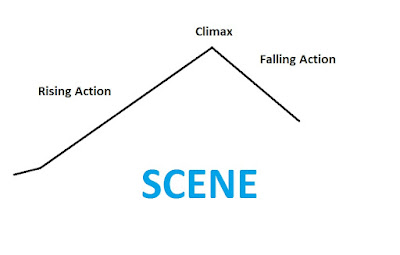
Ideally, nearly every scene in a story will have conflict, because nearly every scene should have these primary plot elements: goal, antagonist, conflict, and consequences. And nearly every scene should have a turning point, which will be its climactic moment. With these things in their proper places, nearly every scene will follow basic structure:


In writing, all of these elements work in fractals. Yes, the overall narrative arc should have these things, but so should each act, and so should each scene.

. . . Generally speaking, anyway, because every rule is made to be broken.

As long as you know why and how you are breaking it.

With that in mind, sometimes you may have a scene that has no conflict.

Or no important goal, or antagonist, or consequences.

And on rare occasions, no turning point (though almost always there should at least be a turning point).

But these are exceptions, and the writer should implement them intentionally, not out of laziness or ignorance.

And when I say that most scenes should have conflict, I'm not saying they need shouting matches or flying fists. Conflict is simply what happens when a character runs into and deals with resistance (antagonistic forces). 

In any case, let's go through some types of scenes that don't require much, if any, conflict.

Monday, March 21, 2022

Pacing within Scenes


Previously, I talked about pacing according to narrative arc--the whole story. Today, we are going to talk about scene-level pacing.

Pacing really happens at three levels:

- in the overall story (the narrative arc)

- in the scenes

- in the lines (passages and paragraphs)

We often think that the way to control pacing is to add or subtract words (probably because many of us were told that). But that's only a partial truth. Word count contributes to pacing, but it's not the sum of pacing. 

Word count --(influences)--> Pacing

But not:

Word count = Pacing

Just like with the overall narrative arc, many problems that come up with pacing at the scene level actually stem from underlying structural issues.

Pacing and Scene Structure (Proper Beats and Proportions)

As a quick recap:

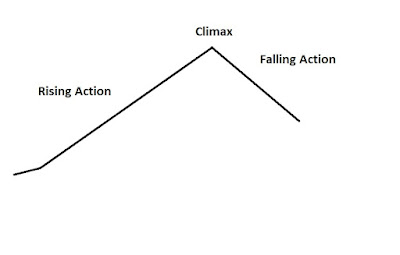
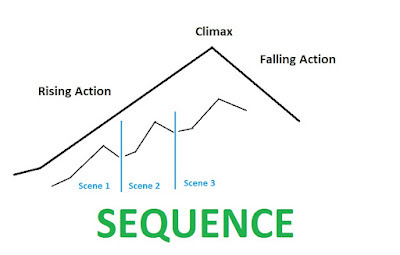
All structural segments really fit into this basic shape:

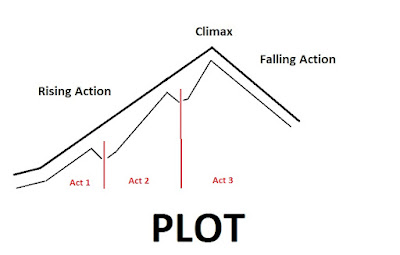
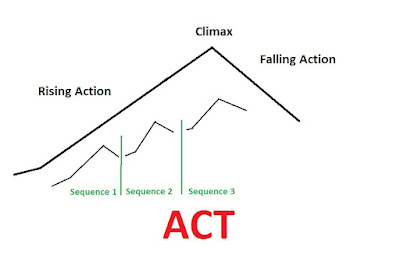
Whether it's a scene, sequence, act, or whole story. This shape is like a nesting doll or fractal--it fits smaller versions of itself inside:


This means, that ideally, most scenes will follow this same structure, just on a smaller scale. So, the climactic moment (also called a "turning point" because it turns the direction of the story) will be something smaller than THEE climactic moment of the whole story.

A turning point can only be one of two things (well, or both of them): a revelation, or an action. 

Why? Because these are the only ways to turn a story. Either significant information is revealed. Or a significant action is taken.

Sometimes it's helpful to keep this in mind:

Revelation = Information

Action = Event

(. . . just because that sounds a little broader.)

It's also possible a revelation leads to an action. Or an action leads to a revelation.

And it's worth noting that a choice can lead to gaining more information or taking action.

Nonetheless, in most scenes, there should be a significant turn in the direction of the story--this means the outcome of the scene affects what happens next. Sometimes that effect is only internal, but often it's external. 

This is largely what makes the scene matter. If nothing changes in the character or plot (or, in some cases, theme), then the scene probably isn't contributing enough to the story, because the character, plot, and theme would be the same without it.

This means that there is a chance that this scene is actually slowing down the story in general--and not in a good, let-me-digest-and-catch-a-breath way, but in a bad, slightly boring-if-not-really-boring way. No change means nothing significant really happened, and there wasn't a strong climactic moment. 

Imagine reading a whole story where there isn't a climax. It'd be a letdown, right? Fortunately, because a scene is smaller, the lack of a turning point won't be as dramatic, but it can still make a scene feel "off."

Additionally, if there is no turning point, then there also may not be any rising action, or falling action for that matter. And if there somehow still is, it's not as defined nor as satisfying.

So if you are having pacing problems at the scene level (or even sequence level), make sure your scenes have turning points.

A scene should generally have the same beats as overall structure:

Opening/Setup

Rising Action

Climax

Falling Action/Resolution

And like overall structure, this can help us get an idea of when to speed up or slow down in a scene.

Usually the closer we get to a climactic moment, the tighter, more intense the pacing gets.

After the climax, the pacing can be a little looser. Sometimes you may want to cut some or all of the falling action--this gives the scene an abrupt ending.

In contrast, the longer you draw out the falling action, the more the story slows down. Stories that have scenes with long falling actions often feel slower or more leisurely. For example, thrillers typically have short falling actions in scenes, while literary fiction tends to have longer falling actions.

Another way to look at this is that the left side of the climax is the proaction part of the scene and the right side is the reaction part of the scene. The focal character of the scene takes action toward a goal, which creates the rising action when they encounter obstacles to that goal (conflict). The turning point is the outcome of that conflict. Because it changes the direction of the story, the focal character reacts to it in the falling action. They need to digest the change that just happened (and often the audience needs to as well). 

Like with the starting of the story, ideally, we want to hook the audience at the starting of a scene. This will help them stick around through the setup and prepare them for the climb.

A hook works by getting the audience to look forward to a future moment.

However, many writers have the tendency to want to look backward at a past moment, in scene openings. They may want to talk about how the character came to be in this situation, they may want to talk about backstory, they may want to reflect on a past event through introspection (or worse, go straight to a flashback), or plop a long chunk of worldbuilding history straight in the text. While all of these things have a place within story, they usually don't belong in the opening of a scene. This often creates problems with scene-level pacing (it makes the scene feel too slow).

The past has already happened and can't be changed. Rather than look back at what already happened, the audience wants to look forward and anticipate what's going to happen next. They want to anticipate the possible outcome of this scene. Not loiter in the past.


Structurally speaking, there are a couple of things that can work well as hooks:

1. Convey the character's goal for the current scene

2. Convey the stakes involved for the current scene

Just as the character should have a goal in the overall story, she should have a mini-goal for the scene. And just as there are stakes in the overall story, there should be smaller stakes in the scene. This means the scene matters, because there are consequences tied to the outcome of what is about to happen. 

Getting these on the page quick helps the audience lean into the scene, instead of lean back from the scene (by focusing on the past). 

Now, it should be said that sometimes the goal and the stakes for the scene have already been implied from previous scenes. And it should also be said that there are plenty of other ways to hook the audience. But if your plotting and structure are tight, then these are two things you should almost always have available to use as hooks.

This also isn't to say you can never start a scene by referencing the past or looking back on something. Just that for most scenes, you don't want to do that. Sometimes referencing the past is a necessity, in which case, often you'll want to do it quickly and tie it to the present or near future. Usually the past is only interesting if it's presently important to the plot or character arc, or the audience can see it will affect the near future.

After the hook, we have setup. This is where we communicate to the audience when and where the scene takes place and who is in it. From there, the character pursues the goal and hits obstacles, which creates the conflict of the rising action.

If we don't spend enough time to set the scene up properly, it can feel disorienting, which can lead to people complaining the pacing is too fast.

If we skip the setup and start in medias res (in the conflict of the rising action), the scene feels faster (and a little disorienting), and we run into the danger of having to slow down the scene too much to explain what was skipped (which almost always includes looking back at the past). So this can be a little clunky, but it can be useful in the right situations.

If we spend too much time setting up the scene--especially if there isn't a hook--the audience can get antsy and bored, so the pacing feels too slow.

After the setup, the character (generally speaking) should pursue the goal and run into opposition. Just as in overall story structure, the conflict should escalate--it should either get bigger or it should get more personal, or both. So, if you have multiple ideas for conflict in a scene, ideally, you want to arrange them so that the bigger conflicts are toward the end of the rising action, if you can. This creates the rising action.

If there isn't really a conflict, or there isn't really any escalation, that may come across as a pacing problem. For example, you may have only given your character one brief obstacle, and that shortchanged the build-up to the climax. Or maybe you tried to repeat the same type of obstacle over and over, and the lack of escalation, alongside the repetition, made the audience get annoyed or antsy. It's taking "too long" to get to the good stuff.

The climax is usually the sharpest moment in a structure.

Often after you hit it, the audience needs a second to digest it and react. This typically happens right alongside the character. So it's a good time to slow things down again, relatively speaking. And because it's a safe place to slow, it's often a good place to slide in any necessary backstory, introspection, flashbacks, or other "past" information. Whenever you can, put that stuff in after a turning point. But remember, it should be relevant to the present. So maybe when a character is reacting to the fact she just got fired from her dream job (which was the turning point), she starts remembering all the times her mom told her she'd never make it in life. That's something in the past that's relevant to her reaction.

Basically, if you have scene-level pacing issues . . . 

1. Make sure you have each piece of the structure.

Often I see pacing issues that come from missing elements. No hooks. No stakes. No goals. Not enough conflicts or escalation (but the scene still has a long middle). No climax. These will make a scene feel too slow. Often the problem or solution has little to do with lines or word count. We simply need more plot elements (which might entail more brainstorming for the writer.) No setup. Shortened rising action. No falling action. These may make a scene feel too fast. 

2. Make sure your proportions are correct.

Sometimes issues come up because the beats are disproportional. I know for me, I naturally want to spend too much time in the setup, and I often don't brainstorm enough rising action. So that's something I know to watch for when I'm working on a scene. It's just a tendency I have.


Beyond Structure

Outside of structure, there are a few things to pay attention to . . . 

Tension: Sometimes there are scene-level pacing problems when there isn't enough tension. Conflict is problems happening. Tension is the potential for problems to happen (again, it relates to anticipating what could happen).

Subtext: Reading a story with no subtext gets slow and boring. The reader wants to be a participator in the story, not a spectator. Subtext draws them in.

Predictability: If the reader easily guesses what's going to happen, and then still has to sit through the whole scene to get to that moment, that can get boring. The audience wants to anticipate and wants to be teased, but they don't want predictability. Multiple outcomes must seem plausible. 

Misunderstanding What's Significant: Sometimes the writer spends too much time (or words) on things that don't merit that kind of attention. Other times they may not spend enough on what deserves more. They are misunderstanding what is significant in the story. This is a case where cutting or adding words may be a solution. Just make sure in adding, you aren't simply repeating the same thing.

Worth noting is that to some degree, what is significant may depend on the genre. Audiences watch Jurassic Park to see dinosaurs, and specifically, dinosaurs on the attack. If there was a movie in the franchise that focused more on a romance story, audiences would probably get antsy and wonder where the dinosaur terror is.

Too Repetitive: Hitting the same story element over and over doesn't make it more powerful, it makes it less. And in the worst-case scenario, it makes it not only boring, but annoying. Contrast and variety make a good story.

Comedies that only try to be funny won't hold an audience for long. It's why comedy movies are short and usually have a life lesson weaved in. The audience craves variety. And variety strengthens pacing.

Scenes that Should be Summaries: Sometimes information is important for the audience to know, but not important enough for them to experience in a full scene. This is when it is a great idea to use summary. 

Next time we will talk about pacing at the line level. 


Read What Others have Written on Pacing

7 Quick Tips for Mastering Pacing by Writer’s Edit

7 Tools for Pacing a Novel by Writer’s Digest

Book Writing 101: Pacing by Payton Hayes


Monday, October 4, 2021

Sequel Structure According to Swain


Last time, I started breaking down scene structure according to Dwight V. Swain, as found in his book, Techniques of the Selling Writer. In my previous article, I talked about the components of scene: goal, conflict, and disaster. Today, I’ll explain what Swain calls "sequel." A sequel is what connects scenes. It also has three components: reaction, dilemma, and decision. 

But first, let’s review Swain’s components of scene, because they directly affect sequels.

Goal—the focal character of the scene should have a measurable, scene-level goal, and this should (usually) be clear to the audience at the beginning of the scene. The audience needs to know what the goal is, so they can measure progress and setbacks—otherwise, they are just watching (or reading) stuff happening. It also helps them get invested in the story.

Conflict—the focal character runs into opposition on their way to the goal. This opposition can be obvious and direct, or it can be less obvious and more indirect. Whatever it is, it needs to pose opposition to achieving the goal. This creates conflict. Conflict is the rising action of a scene, and should develop and escalate to a climactic moment or turning point.

Disaster—the conflict leads to an outcome. Either the character reaches the goal or she doesn’t. Whatever the case, something unanticipated—a “disaster”—enters the story and gives the character a new problem. (This is essentially the “No, and . . .” and “Yes, but . . .” technique.) Not all disasters need to be earth-shattering; they just need to be significant (have ramifications). But nearly all scenes should end on a "disaster," though Swain acknowledges that some scenes don’t.

Now we get to sequels.


Part Two: Sequel

"A sequel is a unit of transition that links two scenes. . . . It sets forth your focal character's reaction to the scene just completed, and provides him with motivation for the scene next to come." - Dwight V. Swain

The sequel will transition from the disaster to a new goal. In sequel, we follow a natural chain of logic. 


Reaction

Our character just encountered a disaster. Naturally, the first thing he’s going to do is react to it. This is another great opportunity to reveal character. Is he angry? Crying? Self-defeating? Getting drunk? How does he cope with the situation? As the focal character tries to make sense and deal with what happened, we convey to the audience his state of mind. This is a moment to focus on the character's emotions. 

In the story's timeline, this reaction may be brief--especially if the character doesn't have much time to react. Or, it may take place over days, months, or even years--maybe he just can't move on after the disaster. 

Sequels are often where summary comes in handy. If a character is reacting to a disaster for weeks, the reader doesn't really want a play-by-play of that, and getting a play-by-play of that probably isn't important to the story (because there are no legit goals or conflicts during the reaction phase usually). And sometimes what the character does physically doesn't actually really matter, what matters is his reaction. So maybe the text summarizes him going to the bar every night to drink away his pain, but the summary is more focused on conveying his state of mind than anything that happens at the bar.

It's also worth mentioning that the focal character may not be the only person reacting to what happened. Swain says that not only is the reaction about the state of the mind, but about the state of affairs. For example, if a love interest died at the disaster, then the reaction segment may also lay out how that affects other characters, society, or the setting. Maybe now her child is going to have to move to another city with his other parent, and the focal character is never going to see him again--maybe they were developing a strong bond. Maybe the love interest's will needs to be dealt with. Or maybe with her dead, no one knows how to defeat the antagonist, since she was a key player on their journey. Maybe it looks like they've already lost to the antagonist. 

What is the character going to do now? This leads us into "dilemma."


Dilemma

The character needs to consider what to do next. Often none of his choices sound promising. And as the character goes through different options, the reader also gets to consider which road she'd probably take if she were in that situation.

While the reaction phase is more focused on emotion, the dilemma is more focused on logic. The character tries to work out logically what the best course is forward. It's usually a good idea if there is a stake in play that prevents him from quitting the situation altogether--I mean, we still want to have a plot for the story. 

Basically, the character is considering different paths to take and their potential outcomes, so this is a place for him to recall or recognize different stakes. What does he have to lose, and what does he have to gain? And which path is most feasible and likely to best balance that? Depending on the character, the situation, and the length of the sequel, he may turn to other sources to help him make up his mind. For example, he might get advice from friends or do some research online. 


Decision

Eventually, the character comes to a decision. Sometimes he logically or rationally works his way to a new path--maybe by himself, or maybe with advice from others. Other times he has a revelation that makes the decision clearer. This might come as an epiphany, or it might be that his research uncovers something. Anyhow, new information enters, and he now knows what to do. 

His decision, of course, needs to be somewhat believable. This is why we spent time with reaction and dilemma. Even if he chooses something ridiculous, the audience needs to believe--given his emotions and thought process--that he'd make that decision. 

This decision gives him a new goal, which takes us into the next scene.


Example: Chihiro passes to the spirit world in Spirited Away

Reaction: Terrified that she's turning transparent and spirits are appearing, Chihiro runs away to a dark, lonely area, and begins rocking back and forth in shock, crying.

Dilemma: Haku arrives and offers some options of action. He says she needs to eat this berry, so she doesn't disappear. She resists at first, unsure if she wants to go that route, but it's either that or disappear. She wonders about her parents and what to do about them. We get a glimpse of an antagonistic force, and Haku explains that the antagonist is looking for her, and she can't stay here (stakes). 

Decision: Chihiro eats the berry and returns to normal. She stands to follow Haku to the bath (admittedly, he sorta pulls her along, but she does choose to stand). Haku explains Chihiro must get a job at the bathhouse (new goal), and lays out more stakes. 


Some Points to Keep in Mind with Sequels

- Sequels help control pacing. In a fast-paced sequence or story, the sequels will typically be shorter. To slow down the overall pacing of a story, make the sequels longer.

- Swain points out that sequels help reinforce plausability. I think this is in part because you are taking time to render the emotions and logic that lead to the next goal (motivation). Stronger or longer sequels generally lead to more plausibility (within reason).

- In many stories, the longest sequel happens at the "Dark Night of the Soul" beat. 

- A sequel may be extremely brief, as a character may be forced to make a quick decision. She might not even have time to fully react to what just happened or really think out her choices. Her emotional reactions may be addressed more later, and she might think back on the decision she made and wonder if it was the best choice. This will happen when she has the chance to "catch her breath."

- I've regularly seen beginning writers try to start a story with sequel. While it can be done, this is rather tricky. Since the sequel is about reaction, this means the story starts with the character reacting to something that happened in the past, off page, which is rarely as interesting as following a character about to hit conflict. 

- Passages of introspection, characters recalling past incidences, and (mild 😉) dumps of info usually fit best in sequels rather than scenes. In scenes they risk slowing pacing too much. In sequels, the audience doesn't mind a slower pace--they are still recovering from the scene.


Scenes & Sequels and Basic Structure

Some in the industry feel that scenes and sequels are actually two types of scenes. I know, it sounds confusing. But basically the SCENE as a structural unit can be either Swain's "scene" or Swain's "sequel." Swain doesn't actually say this in his book. However, I don't think that the claim is wrong. Like many things in structure, it depends on how you slice and dice it and what angle you look at it. I also think it depends on the story itself. 

A sequel can be very brief, or it can be rather long. If it's brief, it might be tagged on to the end of the "scene." If it's long, it may seem to make up its own SCENE. 

Most people define SCENE as a unit of action that takes place in a single location and continuous time. With this definition, a sequel could follow a scene without a break in time or a change in location, and thus it could be argued that together the parts make up one SCENE.

Alternatively, the sequel could happen in a different time and place, and by that definition, would be its own SCENE.

This is one of the reasons why learning about Swain's approach can be confusing to so many people. The sequel may or may not be a continuation of time and place, and it may be extremely brief or it may be rather long. It may be mostly summary, or it may be rendered in real time.

How you slice and dice and categorize it isn't super important though--what matters is that you understand each and their (usual) order: goal, conflict, disaster; reaction, dilemma, decision. 

We started this discussion with basic structure, so let's end this article by looking at that again. 

One might say that the sequel is really the falling action of the structure--especially if it is tagged on to the scene. In Techniques of the Selling Writer, Swain speaks as if sequel is the "valley" and scene is the "peak," but yet doesn't actually say that.

Alternatively, if the sequel seems to be its own SCENE, one may view it as having its own basic structure, with the climactic moment being the decision; the sequel is building up to that moment, and that moment turns the story. 

And of course, if this is all confusing to you, feel free to throw it out the window and just focus on the parts themselves and their order. I'm just explaining some things I wish someone would have explained to me when I was trying to learn this (and I still have more to learn).

Like any writing advice, don't get married to this. It's possible to take it to an extreme. Some pieces can get skipped or rearranged or may even overlap, depending on the needs of the story. (And I mean, to some degree, the character is constantly "reacting" to what's happening as it happens, and making small "decisions" along the way to the disaster). Swain says that as you learn the order and gain experience, you'll be able to "break the rules" to the right effect. Nonetheless, his approach can certainly come in handy when working on a scene . . . or SCENE--it all depends on how you look at it.


Read more articles on Swain's scene and sequel:

Writing Patterns Into Fiction: Scene and Sequel

How To Write A Gripping Scene

The Basics of Scene Structure: Action and Reaction

How to Structure Scenes in Your Story


Monday, September 27, 2021

Scene Structure According to Swain


While I've talked about scene structure on here before, I haven't covered one of the most famous approaches to scene structure, which comes from Dwight V. Swain, who categorizes the unit into "scenes" and "sequels." I've been introduced to this approach from various resources, but I wanted to wait until I read it straight out of Swain's book, Techniques of the Selling Writer, before covering it on here.

In the past, I've talked about how all structural segments really fit into this basic shape:

Whether it's a scene, sequence, act, or whole story. Nearly every scene should have a climactic moment, which is also called a "turning point." The bigger the structural segment, the bigger the turning point--meaning an act's turning point is going to have more ramifications than a scene-level turning point.

This is a great place to start understanding scene structure. 

But I've found that sometimes it doesn't feel specific enough to meet my needs. That's when I turn to Swain's approach.

The term "scene" can be a bit ambiguous in the writing world--people define it in slightly different ways (something worth keeping in mind whenever someone talks about scene structure). Typically, a scene is defined as a unit of action that takes place in a single location and continuous time. But this definition is certainly not perfect and the boundaries can get blurry fast with the right examples. However, I think most can agree that a scene is one of the smallest recognized structural units in a story. 

In his book, Techniques of the Selling Writer, Swain recognizes two types of the smallest structural unit. The first he calls "scene" and the second he calls "sequel."

"Scene" is where action takes place.

And "sequel" is where reaction takes place. 

And if you are already confused, don't fret. I'm going to break down each part. And if you don't get everything the first time, you're probably normal. I had to revisit this approach several times before it finally clicked. 

Let's talk about Swain's "scene."


Part One: Scene

"A scene is a unit of conflict lived through by the character and reader" - Dwight V. Swain, Techniques of the Selling Writer

Earlier I talked about how a scene changes the direction of the story with a turning point. Swain echoes this assertion by saying the purpose of a scene is to move the story forward. 

He then breaks scene down into three pieces: goal, conflict, and disaster. 


Goal

Everyone pretty much wants something all of the time, and so does your character. We usually think of our character's goal as being overarching and taking the whole story to achieve--and while that's often certainly the case, the character should also have scene-level goals. Often the scene-level goal fits into the overarching plot goal. 

For example, in Spirited Away, Chihiro has the plot goal of saving her parents and returning to the human world. But within that goal, there are smaller goals along the way. In order to succeed in doing that, she has to get a job at the bathhouse first. After she gets hired, she has to prove herself worthy to stay. And to do that, she must succeed in cleaning a bath and serving a client. In order to clean the bath, she has to get an herbal soak token.

Sometimes the scene goal isn't obviously linked to the overarching goal, and a character may want multiple things. For example, in a later scene, Chihiro has the goal of remembering Haku's real name. While that's important to the relationship and thematic plotlines, it doesn't really affect her main goal of saving her parents and getting home, but it is another want she has.

In any case, I'll say that the goal should have significant stakes. This means that obtaining or not obtaining the scene goal affects the direction of the story--it has ramifications. It shouldn't be a goal whose outcome doesn't really change anything (generally speaking, as all rules have exceptions). Because Chihiro is able to remember Haku's name, Haku is able to leave the bathhouse himself. So meeting that goal still has significant consequences. However, if remembering his name didn't help him or change any outcomes, then it wouldn't be important and would probably be cut from the story.

Goals are important because they give the audience context for the plot. If there isn't a goal, then the audience can't measure whether what happens is progress or a setback. They are just watching things happen. Or, perhaps as the Cheshire Cat says, if you don't know where you want to go, then which way you go doesn't really matter. 

Because of this, almost always the audience should have a sense of the character's goal in the beginning of the scene. In some cases, the goal may be implied, because of what happened in previous scenes. Of course, there are situations where you may want to break this rule, such as when you want to write a teaser or create a sense of mystery, but let's keep this simple today.

Goals should almost always be concrete and specific. For example, cleaning a bath and getting an herbal soak token are things the audience can "see," and therefore measure the success of. If the goal is abstract, it should (usually) have concrete manifestations. For example, if a character wants to prove he loves someone (abstract), he may decide to send flowers and write a love letter (concrete). Successfully doing this is a smaller goal within a larger goal.


Conflict

Now that the character has a goal, he'll run into some form of opposition, which creates conflict. This makes up the middle or rising action of the scene. I emphasize "opposition" because the conflict isn't just any problem, it's something in the way of the goal.

The opposition may be obvious and direct. For example, Wonder Woman may be confronting Ares, who is fighting directly against her goal of saving humans. Or perhaps, Frodo may be trying to escape the Ringwraiths, who want to take the Ring.

Other times it may be unobvious and somewhat indirect. It might be that a character wants to confess his love, but keeps getting interrupted by phone calls, his dog, or a wild wind that seems to steal his words. The opposition isn't necessarily trying to make him fail; it's just something in the way. But notice that it's still something that impedes his goal.

There are eight types of conflict, and any of them can be used to create opposition: person vs. self, person vs. person, person vs. society, person vs. nature, person vs. god, person vs. fate, person vs. the supernatural, person vs. technology. (Though of course, you need to use good judgment and pick what best suits your scene.) 

Because this makes up the rising action of basic structure, it's usually best if the conflict escalates. There needs to be complications and developments. Have the opposition get bigger and stronger as the scene progresses. Rehashing or lengthening the exact same thing isn't interesting. In our example of a character trying to confess his love, having his phone disrupt him the exact same way over and over gets boring (and annoying). Instead, it's more interesting if his phone disrupts him, then his dog jumps up and starts kissing his love interest, and then when he finally starts breaching the confession, a wild wind blows away his words, so he has to bring himself to say them again. Escalation.

Swain points out that conflict is important because it tests the character's dedication to the goal. It shows the audience how bad the character wants the goal. If the character gave up right away, he obviously doesn't want it very badly. But if he's willing to fight and struggle for it--that's much more interesting. And whatever is that important to him, is usually important to the story--it helps make up the plot. 


Disaster

Eventually, the conflict comes to a close (if only on the scene level), and disaster strikes. 

While it's called "disaster," it need not always be earth-shattering. It just needs to be significant (i.e. the potential to change important future outcomes, meaning it has stakes). This is (almost) always something unanticipated. 

I admit that the way Swain himself describes "disaster" sounds a little vague. While his book is amazing and I recommend it, he has the tendency to explain concepts primarily through examples rather than by giving actual explanations. In any case, the disaster part is essentially what others refer to as "No, and . . . " and "Yes, but . . ." If you've never heard those terms, let me explain.

The character has a goal.

He faces conflict.

Does he get the goal?

If the answer is "no," then we add to the problem.

If the answer is "yes," then we add a new problem.

For example, say our character tries to confess his love. The wind steals his words, and in fact, it gets so wild that it completely ruins the moment, and they have to seek shelter. The character doesn't get the goal, and now he has another problem--a "disaster"--which is he needs to find shelter for himself and his love interest. 

Alternatively, say the wind steals his words, but he succeeds in his next attempt, confessing his love and winning the person of his dreams. Suddenly, the love interest's ex pulls up, gets out of his car, and aims a gun at him. New problem. Disaster. 

These might not sound like the most amazing examples, but they prove the point. A disaster throws the character toward a loss. The audience wonders, What will the character do now? Translation: The audience will want to keep reading. 

The disaster is essentially the outcome. But whatever the disaster is should (once again) have stakes/ramifications. In my "success" example, a wild wind may not be the greatest choice unless the wind actually threatens a serious outcome. Maybe it threatens to ruin something valuable that the love interest needs to deliver. Now getting out of the wind becomes more important. Obviously, an ex pointing a gun at the character has big stakes.

Swain acknowledges that not every scene needs to end in disaster. Sometimes the potential or promise for a disaster to come, is enough. He also says it's possible for the character to end the scene on a positive note . . . to set her up for a disappointment that's coming next. However, the tricky thing with doing that, is that the audience is now waiting for the antagonistic force to make its move, rather than anticipating what the focal character is going to do next. And waiting for something to happen isn't as interesting as having to deal with a new problem.

The main idea is that you want the conflict to end with a hook--something that makes the reader look forward to a near-future point in the story (probably the next scene) and keep reading.  


Example: Chihiro passes to the spirit world in Spirited Away

Goal: Chihiro must get across the river before nightfall (or she'll be stuck in the spirit world). 

Conflict: Chihiro runs back to her parents, but only finds pigs. Confused, she begins running around trying to find them, but the spirits are starting to come out. She tries to go back toward her car as the sun is setting, but the river has seemingly flooded.

Disaster: With the river flooded, she has no way to get across, and night falls ("No . . . ); she looks at her hands and realizes she's turning transparent ("and . . .")

Next we will talk about the second part of this, what Swain calls the "sequel." It also has three pieces: reaction, dilemma, and decision. Read about it here.


Read more articles on Swain's scene and sequel

Writing Patterns Into Fiction: Scene and Sequel

How To Write A Gripping Scene

The Basics of Scene Structure: Action and Reaction

How to Structure Scenes in Your Story


Monday, October 5, 2020

2 Tricks for Scene Transitions

As novelists and short story writers, we probably don't think about scene transitions too much. Don't get me wrong, we may take a long time seeking out the perfect hook or the most-intriguing opening, and we may write and rewrite the end of the scene to get it just right. But when it comes to moving from one scene to another . . . it's probably something we feel more rather than really think about. 

And that's okay, and you can be totally successful that way. 

But last year I learned about two scene transition techniques that have stuck with me. Unsurprisingly, they come from film, a medium where scene transitions are more obvious and more touchy. 

Lately I've been more and more mindful of them in my writing and have found they can be quite helpful when trying to get the flow between passages just right.

They come from the book Story by Robert McKee.

In it, McKee explains that when it comes to successful scene transitions, you really have two options:

Monday, March 30, 2020

Positive and Negative Scene Values


A well-constructed scene should work like a mini-story. But often when we are learning to write a book, we don't think of them as such.

In reality, a scene follows the same basic story structure--you know, the one I did a whole post on, about how it seems to permeate everything? Even things not writing related? (You can see that post here.)

I've also already done a post where I talk about how to structure that shape in a scene specifically. I focus on hook, setup, rising action, climax, and (possibly) a denouement.

But one of the key elements of writing a successful scene, is that change needs to happen. And not just any change, but significant change. Which (once again) means:

1 - It has important personal consequences, or
2 - It has far-reaching, broad consequences