Showing posts with label pacing. Show all posts

Monday, August 10, 2026

Character-driven vs. Plot-driven: Pacing Differences


Lately I've been comparing and contrasting character-driven and plot-driven stories. While most stories will be, to some extent, both, some stories lean far one way or another.

In a very character-driven story, the focus is on the character's internal journey. The stakes are personal, often tied to the character's identity—who he will or won't become (his character arc). In a very plot-driven story, the focus is on the external journey. The stakes are broad, tied to society or the world.

Sunday, February 11, 2024

The "Bathtub Story": Why It's a Problem, How to Fix It, When to Use It


Writing a "bathtub story" is rarely a good idea. It often fits right up there with flashbacks; most of the time you shouldn't use them, but in certain circumstances, you can get away with them. Bathtub stories lack immediacy and as such, often bring the narrative to a grinding halt. 

Yet they are common for new writers to write. So let's go over them, why they're a problem, how to fix them, and when to use one (if you dare 😉).


What is a "Bathtub Story"?

The term "bathtub story" originates from author Jerome Stern, who talks about them in his book, Making Shapely Fiction. He writes:

In a bathtub story, a character stays in a single, relatively confined space . . . While in that space the character thinks, remembers, worries, plans, whatever. Before long, readers realize that the character is not going to do anything. . . . The character is not interacting with other people, but just thinking about past interactions. Problems will not be faced, but thought about.

A bathtub story is essentially a story that takes place in introspection.

While most novels won't literally be an entire bathtub story, many new writers have bathtub scenes or chapters, where the character simply reflects and doesn't do anything meaningful. While Stern likens this to someone in a confined tub, I would argue these can happen even when the character is moving. The character may be taking a walk or washing the dishes, but the story elements only exist in her head.

Monday, March 28, 2022

Pacing within Lines

When people talk about pacing in stories, they usually turn to the lines--how to make a passage or paragraph feel faster or slower.

Recently, I've been sharing how pacing happens at three levels: 

- Within the Narrative Arc

- Within Scenes

- Within Lines

And it only seems right to finish up the series by visiting pacing within lines. Issues come up when a passage or paragraph feels too slow or too fast, and while line-level pacing can overlap in places with scene-level pacing, it's a little different. This is more about the way the story is written on the page.

And as I touched on in my prior posts, there is more to pacing than adding or subtracting words, even when we get clear down to the line level. 

Because I've already talked about line-level pacing on here before, I thought I'd simply review a few things.

Monday, March 21, 2022

Pacing within Scenes


Previously, I talked about pacing according to narrative arc--the whole story. Today, we are going to talk about scene-level pacing.

Pacing really happens at three levels:

- in the overall story (the narrative arc)

- in the scenes

- in the lines (passages and paragraphs)

We often think that the way to control pacing is to add or subtract words (probably because many of us were told that). But that's only a partial truth. Word count contributes to pacing, but it's not the sum of pacing. 

Word count --(influences)--> Pacing

But not:

Word count = Pacing

Just like with the overall narrative arc, many problems that come up with pacing at the scene level actually stem from underlying structural issues.

Pacing and Scene Structure (Proper Beats and Proportions)

As a quick recap:

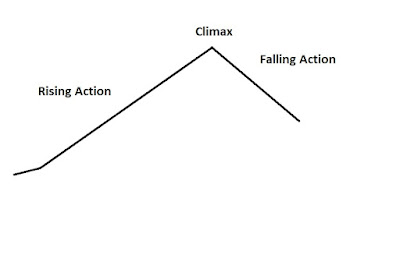
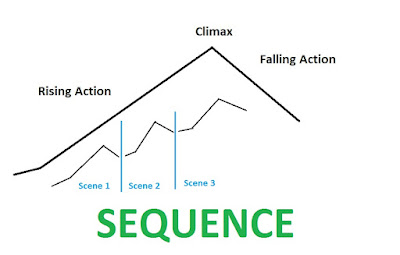
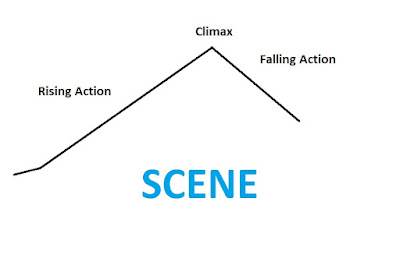
All structural segments really fit into this basic shape:

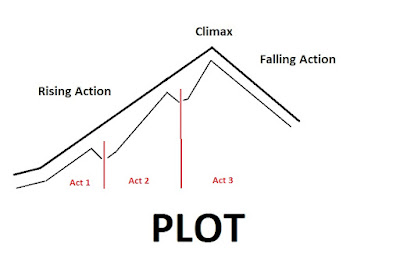
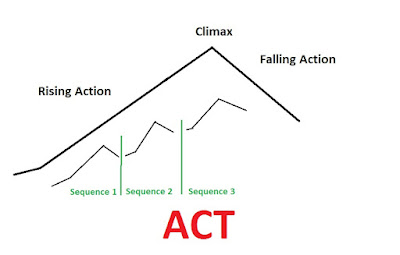
Whether it's a scene, sequence, act, or whole story. This shape is like a nesting doll or fractal--it fits smaller versions of itself inside:


This means, that ideally, most scenes will follow this same structure, just on a smaller scale. So, the climactic moment (also called a "turning point" because it turns the direction of the story) will be something smaller than THEE climactic moment of the whole story.

A turning point can only be one of two things (well, or both of them): a revelation, or an action

Why? Because these are the only ways to turn a story. Either significant information is revealed. Or a significant action is taken.

Sometimes it's helpful to keep this in mind:

Revelation = Information

Action = Event

(. . . just because that sounds a little broader.)

It's also possible a revelation leads to an action. Or an action leads to a revelation.

And it's worth noting that a choice can lead to gaining more information or taking action.

Nonetheless, in most scenes, there should be a significant turn in the direction of the story--this means the outcome of the scene affects what happens next. Sometimes that effect is only internal, but often it's external. 

This is largely what makes the scene matter. If nothing changes in the character or plot (or, in some cases, theme), then the scene probably isn't contributing enough to the story, because the character, plot, and theme would be the same without it.

This means that there is a chance that this scene is actually slowing down the story in general--and not in a good, let-me-digest-and-catch-a-breath way, but in a bad, slightly boring-if-not-really-boring way. No change means nothing significant really happened, and there wasn't a strong climactic moment. 

Imagine reading a whole story where there isn't a climax. It'd be a letdown, right? Fortunately, because a scene is smaller, the lack of a turning point won't be as dramatic, but it can still make a scene feel "off."

Additionally, if there is no turning point, then there also may not be any rising action, or falling action for that matter. And if there somehow still is, it's not as defined nor as satisfying.

So if you are having pacing problems at the scene level (or even sequence level), make sure your scenes have turning points.

A scene should generally have the same beats as overall structure:

Opening/Setup

Rising Action

Climax

Falling Action/Resolution

And like overall structure, this can help us get an idea of when to speed up or slow down in a scene.

Usually the closer we get to a climactic moment, the tighter, more intense the pacing gets.

After the climax, the pacing can be a little looser. Sometimes you may want to cut some or all of the falling action--this gives the scene an abrupt ending.

In contrast, the longer you draw out the falling action, the more the story slows down. Stories that have scenes with long falling actions often feel slower or more leisurely. For example, thrillers typically have short falling actions in scenes, while literary fiction tends to have longer falling actions.

Another way to look at this is that the left side of the climax is the proaction part of the scene and the right side is the reaction part of the scene. The focal character of the scene takes action toward a goal, which creates the rising action when they encounter obstacles to that goal (conflict). The turning point is the outcome of that conflict. Because it changes the direction of the story, the focal character reacts to it in the falling action. They need to digest the change that just happened (and often the audience needs to as well). 

Like with the starting of the story, ideally, we want to hook the audience at the starting of a scene. This will help them stick around through the setup and prepare them for the climb.

A hook works by getting the audience to look forward to a future moment.

However, many writers have the tendency to want to look backward at a past moment, in scene openings. They may want to talk about how the character came to be in this situation, they may want to talk about backstory, they may want to reflect on a past event through introspection (or worse, go straight to a flashback), or plop a long chunk of worldbuilding history straight in the text. While all of these things have a place within story, they usually don't belong in the opening of a scene. This often creates problems with scene-level pacing (it makes the scene feel too slow).

The past has already happened and can't be changed. Rather than look back at what already happened, the audience wants to look forward and anticipate what's going to happen next. They want to anticipate the possible outcome of this scene. Not loiter in the past.


Structurally speaking, there are a couple of things that can work well as hooks:

1. Convey the character's goal for the current scene

2. Convey the stakes involved for the current scene

Just as the character should have a goal in the overall story, she should have a mini-goal for the scene. And just as there are stakes in the overall story, there should be smaller stakes in the scene. This means the scene matters, because there are consequences tied to the outcome of what is about to happen. 

Getting these on the page quick helps the audience lean into the scene, instead of lean back from the scene (by focusing on the past). 

Now, it should be said that sometimes the goal and the stakes for the scene have already been implied from previous scenes. And it should also be said that there are plenty of other ways to hook the audience. But if your plotting and structure are tight, then these are two things you should almost always have available to use as hooks.

This also isn't to say you can never start a scene by referencing the past or looking back on something. Just that for most scenes, you don't want to do that. Sometimes referencing the past is a necessity, in which case, often you'll want to do it quickly and tie it to the present or near future. Usually the past is only interesting if it's presently important to the plot or character arc, or the audience can see it will affect the near future.

After the hook, we have setup. This is where we communicate to the audience when and where the scene takes place and who is in it. From there, the character pursues the goal and hits obstacles, which creates the conflict of the rising action.

If we don't spend enough time to set the scene up properly, it can feel disorienting, which can lead to people complaining the pacing is too fast.

If we skip the setup and start in medias res (in the conflict of the rising action), the scene feels faster (and a little disorienting), and we run into the danger of having to slow down the scene too much to explain what was skipped (which almost always includes looking back at the past). So this can be a little clunky, but it can be useful in the right situations.

If we spend too much time setting up the scene--especially if there isn't a hook--the audience can get antsy and bored, so the pacing feels too slow.

After the setup, the character (generally speaking) should pursue the goal and run into opposition. Just as in overall story structure, the conflict should escalate--it should either get bigger or it should get more personal, or both. So, if you have multiple ideas for conflict in a scene, ideally, you want to arrange them so that the bigger conflicts are toward the end of the rising action, if you can. This creates the rising action.

If there isn't really a conflict, or there isn't really any escalation, that may come across as a pacing problem. For example, you may have only given your character one brief obstacle, and that shortchanged the build-up to the climax. Or maybe you tried to repeat the same type of obstacle over and over, and the lack of escalation, alongside the repetition, made the audience get annoyed or antsy. It's taking "too long" to get to the good stuff.

The climax is usually the sharpest moment in a structure.

Often after you hit it, the audience needs a second to digest it and react. This typically happens right alongside the character. So it's a good time to slow things down again, relatively speaking. And because it's a safe place to slow, it's often a good place to slide in any necessary backstory, introspection, flashbacks, or other "past" information. Whenever you can, put that stuff in after a turning point. But remember, it should be relevant to the present. So maybe when a character is reacting to the fact she just got fired from her dream job (which was the turning point), she starts remembering all the times her mom told her she'd never make it in life. That's something in the past that's relevant to her reaction.

Basically, if you have scene-level pacing issues . . . 

1. Make sure you have each piece of the structure.

Often I see pacing issues that come from missing elements. No hooks. No stakes. No goals. Not enough conflicts or escalation (but the scene still has a long middle). No climax. These will make a scene feel too slow. Often the problem or solution has little to do with lines or word count. We simply need more plot elements (which might entail more brainstorming for the writer.) No setup. Shortened rising action. No falling action. These may make a scene feel too fast. 

2. Make sure your proportions are correct.

Sometimes issues come up because the beats are disproportional. I know for me, I naturally want to spend too much time in the setup, and I often don't brainstorm enough rising action. So that's something I know to watch for when I'm working on a scene. It's just a tendency I have.


Beyond Structure

Outside of structure, there are a few things to pay attention to . . . 

Tension: Sometimes there are scene-level pacing problems when there isn't enough tension. Conflict is problems happening. Tension is the potential for problems to happen (again, it relates to anticipating what could happen).

Subtext: Reading a story with no subtext gets slow and boring. The reader wants to be a participator in the story, not a spectator. Subtext draws them in.

Predictability: If the reader easily guesses what's going to happen, and then still has to sit through the whole scene to get to that moment, that can get boring. The audience wants to anticipate and wants to be teased, but they don't want predictability. Multiple outcomes must seem plausible. 

Misunderstanding What's Significant: Sometimes the writer spends too much time (or words) on things that don't merit that kind of attention. Other times they may not spend enough on what deserves more. They are misunderstanding what is significant in the story. This is a case where cutting or adding words may be a solution. Just make sure in adding, you aren't simply repeating the same thing.

Worth noting is that to some degree, what is significant may depend on the genre. Audiences watch Jurassic Park to see dinosaurs, and specifically, dinosaurs on the attack. If there was a movie in the franchise that focused more on a romance story, audiences would probably get antsy and wonder where the dinosaur terror is.

Too Repetitive: Hitting the same story element over and over doesn't make it more powerful, it makes it less. And in the worst-case scenario, it makes it not only boring, but annoying. Contrast and variety make a good story.

Comedies that only try to be funny won't hold an audience for long. It's why comedy movies are short and usually have a life lesson weaved in. The audience craves variety. And variety strengthens pacing.

Scenes that Should be Summaries: Sometimes information is important for the audience to know, but not important enough for them to experience in a full scene. This is when it is a great idea to use summary. 

Next time we will talk about pacing at the line level. 


Read What Others have Written on Pacing

7 Quick Tips for Mastering Pacing by Writer’s Edit

7 Tools for Pacing a Novel by Writer’s Digest

Book Writing 101: Pacing by Payton Hayes


Monday, March 14, 2022

Pacing Within the Narrative Arc


When it comes to writing stories, pacing really happens at three levels:

- in the overall story (the "narrative arc")

- in the scenes

- in the lines (passages and paragraphs)


Back in January, I taught an online class about pacing--a lot of you probably remember because I mentioned it a few times prior. Before, during, and after, I realized I had more to say on the topic than I could possibly fit into my thirty-minute session, so I thought I would do a few posts exploring it in more depth.

Often when people are talking about pacing, they are talking about it at a scene or line level, but the overall story has its own pacing too. Some sections will have faster, tighter, and more intense pacing, while other sections will have slower, looser, or more leisurely pacing. 

It's also important to acknowledge that--especially when it comes to narrative arc--this is somewhat relative. What might be "fast pacing" in a drama, probably wouldn't be considered "fast pacing" in a thriller. To some degree, what's "fast" or "slow" relates to the pace the story sets up initially.

Nonetheless, any story of any genre can be in danger of speeding sections up too fast or slowing them down too much.

So let's dig into more about pacing within the narrative arc.


Pacing and Structure

In the past, I've talked about how all structural segments really fit into this basic shape:


Whether it's a scene, sequence, act, or whole story. This shape is like a nesting doll or fractal--it fits smaller versions of itself inside:


This means that generally speaking, ideally, each of these structural units has its own climactic moment. This is also called a "turning point," because it turns the direction of the story.

The bigger the structural segment, the bigger the turning point--meaning an act's turning point is going to have more ramifications than a scene-level turning point.

This is a great way to start understanding structure. 

Essentially, each of these units has:

- Opening/Setup

- Rising Action

- Climax

- Falling Action/Resolution


Typically, the pacing is going to get faster, tighter, or more intense the closer it gets to the climactic peak.

Afterward, it will get looser and slower with the falling action.

In some situations, the writer may cut off most, if not all, of the falling action, but generally speaking, the pacing is going to slow down into a "valley." And if you are working with a smaller unit than the whole plot, this shape then repeats itself, so you then hit the opening or setup of the next segment.

Ideally, each segment will open with a hook to grab the audience, but after that, the pacing may be a little calmer as we get to the setup and before it really hits the rising action, where the main conflicts happen and develop.

Again, remember this is somewhat relative. You can give yourself a good headache if you overthink or misunderstand how this works, mainly because smaller shapes repeat inside bigger shapes. The smaller shapes have the same parts, but are small scale (read: less intense). 

Typically, the falling action of the segment is more reactionary. It's the character or characters reacting to the turning point. Because the turning point changed the direction of the story (and usually in an unexpected way), the character now needs to take that in, process it, and decide what to do next. 

Think of this on the large scale. At the climactic peak of the narrative arc, the conflict with the antagonist comes to an end. The character (and the audience) needs a moment to process emotionally and mentally what just happened. Then the protagonist must decide what to do next. The falling action usually hints at a "new normal," or at least the next path the protagonist takes, whether that's happy-ever-after or preparing for the next adventure or something else.

Many think that pacing mainly comes from the word count, and certainly word count plays into pacing. But when it comes to the narrative arc or even within scenes, structure often has to do more with pacing. For example, we wouldn't necessarily want to "speed up" the climax of the whole story by making it extremely short. Making it only a few pages doesn't necessarily make it extra intense. Just as you wouldn't want to make the falling action way longer than the climax, thinking that will make it better. In almost all stories, the falling action will have fewer words than the climax. Technically, someone could sustain a fast pace of a segment for more pages than the slow part of the segment. It's not strictly tied to word count. However, it's possible to make a segment too fast or too slow through word count.

Basically:

Word count --(influences)--> Pacing

But not:

Word count = Pacing

Along with structure, hooks, tension, stakes, suspense, and conflict play critical roles in pacing. More of them make the pacing feel tighter, and less of them make the pacing feel looser. We hook the audience at the beginning to get them to stick around through the setup and the start of the rising action. The conflicts and stakes should get bigger as they develop and become more complicated--they escalate. This makes the pacing feel more intense. After the turning point, those things hit an outcome (for better or for worse) and the conflict ends (if only temporarily). Because it ended, the pacing gets calmer and slower--how calm and how slow often depends on what structural unit you are working with. Obviously, in the plot as a whole, it will be calmer and slower in THEE falling action, than it would be in a scene. Nonetheless, it still gets calmer and slower compared to the climax, regardless of what unit you are working with.

When looking at the narrative arc as a whole, it's obvious how these things apply. We want the climax to be fast and intense, and if we handle plotting and structure right, this will happen naturally to some degree, because all the conflicts will be hitting their high points around that time. When they are resolved, it slows down and we tie up the story. 

And in the beginning of the story, we must work to hook the audience so they'll want to stick around long enough to get to the main conflict. 

But what about everything else in between?

This is when it's helpful to go down to the next structural unit: acts.

An act follows the same shape. This means that the beginning, middle, and end will each get a big climactic turning point. 


So what are these big moments?

In Act I, this will be what's called "Plot Point 1," "Crossing the Threshold," or "Break into Two," depending on what structure you use (7 Point Story Structure, The Hero's Journey, and Save the Cat! respectively. They all have different names for essentially the same moment.).

We open Act I with a hook, which will hopefully also be big enough to be THEE hook for the whole narrative arc. We spend time with setup: Who is this story about? Where does it take place? When does it take place? And we also establish a sense of normalcy.

Then the inciting incident hits (this is also called the "Call to Adventure" and the "Catalyst," depending upon your structural preference), which kicks off the story, both for the narrative arc as a whole and for Act I. This is something that disrupts the established normal, and it can either be a problem or an opportunity for the protagonist. 

This arguably starts the rising action, in the whole narrative arc, and especially in Act I.

(While it is possible for Act I to have its own separate "inciting incident" for an act-level problem or opportunity, let's keep this simple for now. I might do more posts specifically on acts in the future. But, if you feel you have multiple "inciting incidents," that might be part of what's happening.)

The protagonist is now having to deal with this problem or opportunity and what to do about it.

On the act level, this comes to a head at Plot Point 1(/Crossing the Threshold/Break into Two), where the protagonist chooses to accept the opportunity or chooses to try to address the problem, and engages with the main conflict. Often this is marked with a big moment--such as a parental figure dying (like in Star Wars) or discovering your birth dad is in New York City and on the naughty list (like in Elf). Whatever it is, it's essentially a moment that helps push the protagonist through a Door of No Return. 

What follows is usually a transitional segment where the protagonist "journeys" (literally or figuratively) to a new "world" (literally or figuratively). Both Luke and Buddy literally travel to a new place, but in many stories, this may be seen to be more of a new state of being (such as a character taking on an old lady persona as in Mrs. Doubtfire). The character gains a new goal as they accept the "adventure."

Know that I'm simplifying this a bit, as this is meant to be a post more about pacing than about structure. 

But that big moment and decision to engage with the main conflict is the climactic moment of Act I, and what follows is often the character reacting to that moment.

This means the pacing gets tighter at that moment, and a bit slower after that moment. 

The climactic moment of Act II, is Plot Point 2, which is also known as "The Ordeal" or "All is Lost." This is usually a part in the story where the protagonist engages with the main conflict, which leads to a loss or "death" (literally or figuratively). This is the biggest engagement with the main conflict so far. Meaning, it's bigger than the high point of Act I, and bigger than anything that came in the middle. So the pacing gets tighter and more intense here.

It's also followed by the biggest lull of the story--Plot Point 2's falling action. Usually, the protagonist fails or loses or "dies" from this engagement and falls into a "Dark Night of the Soul" moment. (Alternatively, the protagonist may succeed in the external conflict, but something isn't right, something is missing or wrong--it's a hollow victory, and this also leads to a lull.)

This is also followed by a transitional segment that takes us into Act III, when the protagonist gains something (whether plot-driven or theme-driven) that enables him to head toward THEE climax. This gives him a new act-level goal for the ending.

Finally, the climax of Act III is also simultaneously THEE climax, and same goes for the falling action.

When you have structure handled, pacing will often come with it--at least to an extent. But looking at the story this way, you can see where you want the pacing to be faster, more intense, and tighter, as well as when you probably want it slower, calmer, and looser.

There are just two variations I want to mention in regards to acts . . . 

Often in the writing community, we refer to stories as having three acts: beginning (Act I), middle (Act II), end (Act III), and I try to (more or less) talk about story in this way, just to keep confusion to a minimum. 

But personally, I feel acts have more to do with this structural shape than they have to do with beginnings, middles, and endings.

Another key moment in the narrative arc is the midpoint, which happens at the middle. This is often where the protagonist gains a bigger understanding of what's really going on with the antagonist and the main conflict, which then enables them to become more proactive in addressing the problem (they sort of go into "attack mode"). This is also often marked by a big event--either a victory or a failure (or at least a seeming victory or a seeming failure).

In stories that have big midpoints, I actually think it's helpful to think of them as having four acts:


This means the pacing will be tight and intense at the climactic moment that comes at the midpoint. 

After the high point, there is usually a bit of a lull as the protagonist processes and decides what to do with the new insight they've gained. This also may have a bit of a transitional segment that leads to a new goal about how to go on the attack for the second part of the middle.

Don't forget, though, that sometimes the falling action gets shortened or cut off or may simply not be on the page. And again, this is a post intended to be more about pacing than structure, so I'm trying not to get too detailed.

The other variation that sometimes happens is that the highest climactic peak of some stories actually hits at Plot Point 2 (The Ordeal or All is Lost moment), with the whole ending showing how the protagonist then applies what he learned from that experience to resolve the remaining conflict and wrap the story up (the film Old is an example of this).

For what it's worth, I actually picture these stories as having only two acts, since there are only two really high points:


In any case, understanding act structure will help you see where you will naturally want intensity and where you will naturally want lulls.

Long ago, I used to get confused when I felt like I needed to have a lully scene, worried that it was boring or would kill the pacing. I didn't understand that on the narrative level, the story should have lully scenes. I didn't understand that pacing happened on such a large level. 

Lully scenes are important in giving not only the protagonist a chance to process and react to what's going on, but also the audience. If there are no lulls, there is no time to digest what just happened. We don't get to react to what just happened. Or wonder about what to do next. We don't have a chance to catch our breath or let our worry fester or our hope build.

It can shortchange a lot of emotional breadth.

Then again, how much time and space you spend on the lulls may be determined by the kind of story you are telling. In a thriller, you will probably want to keep the lulls shorter than average. If you are writing literary fiction, you may want to draw out the lulls longer. 

It all gets down to your story and the effect you want on the audience.

If you are having problems with overall narrative pacing, check act structure.


Pacing and Proportions

Also long ago, I used to hate when instructors talked about percentages. Statements like "X needs to happen at 25% into the story" felt so stifling to creativity! 

. . . but after wandering around the pits of Writing H-e-double-hockey-sticks, I started to think that maybe . . . there was something to all that percentage junk . . . ðŸ˜•

Well, present-me is here to tell you, there is!

However, that doesn't mean there isn't wiggle room or times to break the rules; it's just that, like with anything in writing, you need to know what you are doing first.

Like it or not, we humans are subconsciously conditioned to expect big moments (*cough cough* major turning points *cough cough*) to happen at certain places in a story.

I would even argue that it goes deeper than conditioning. For one, if there aren't big turning points at the right places, it's more likely that what is currently happening in the story is going to start feeling repetitious. Like, imagine if Harry Potter spent an even bigger part of the story trying to get his Hogwarts letter. How long can you really play around with that conflict before it gets boring? Before the audience is aching for some kind of change or progress? The big turning point ("Yer a wizard, Harry") is the change and progress. And if it takes until 40% into the story to get to that turning point, you can bet your bottom dollar that the audience has already bailed or is snoring. A conflict about trying to get a letter that doesn't really change, isn't sustainable.

I would also argue that turning points are archetypal and even a reflection of how our human minds work. We go along our lives until--bam--a problem or opportunity disrupts us. We wonder about what to do, debate about what to do, maybe resist what we should do, until we eventually come to a decision about it. Or, we take on goals, and as we try to pursue them, we face obstacles, and when it doesn't turn out in our favor, we react and try to decide what to do next, then we make a new plan and come up with a new goal. We don't sit there and react to it for the rest of our lives (or if we do, we need to get some therapy to move past it).

In any case, in the narrative arc, problems with pacing can arise if it takes too long to get to certain turning points (nothing kills pacing quite like repetition and stagnation). Or, if you get to them too quickly, which means there wasn't proper escalation or build-up (rising action).

Percentages are helpful as guidelines.

And here are a few to go with our acts.

- Plot Point 1 should happen around 25% into the story.

- The midpoint should happen around 50% into the story.

- Plot Point 2 should happen around 75% into the story.

As always, you can find examples of variations.

But having this as a baseline gives us the capacity to talk about timing as well as variations.

Generally speaking, if your story doesn't get close to this, it's disproportional. 

If the midpoint doesn't happen until 62% in, then it takes too long for the protagonist to become more proactive and go on the attack. This likely means the section before this is becoming repetitious and stagnant. Likewise, we now don't have as much time to properly build up to the climactic moment of Plot Point 2, for best impact. 

If Plot Point 1 is hitting at 31%, the setup is probably taking too long and getting boring.

Again, these are just general guidelines--I'm not saying no story can't ever play around with these any time or anywhere. 

For example, some stories start in narrative in medias res, which can change this approach. Some rare stories are structured so that the beginning, middle, and end are all the same length, which definitely changes the percentages. 

But if you are having pacing problems at the narrative level, consider looking at the percentages and checking the proportions.


Pacing in the Document

Outside of structure and percentages, there are a few other ways to affect pacing at the narrative level. And this has to do with how the story is actually presented to the audience. 

Chapter lengths can influence how fast or how slow the audience feels the story is going. Short chapters make the audience feel like they are tearing through the book faster. Long chapter makes it feel "meatier." 

This sort of thing can also happen with viewpoint characters. When working with multiple viewpoint characters, some writers will shift between them quicker near the climax of the story. This makes the moment feel tighter, more intense, and more dramatic--assuming, of course, all the viewpoint characters are active participants in the climax. (And it should be mentioned, you can also use this effect at other climactic moments, like within acts).

When it comes to printing, you can also use page and font size in similar ways you use chapter lengths. Reading a "chapter book" feels much faster, not only because the book itself is shorter, but because there are fewer words on a page and it has bigger font. My Lord of the Rings omnibus, on the other hand, has tiny font on big, thin, pages.

Depending on how you plan to publish your book, that may or may not be relevant to you, but I wanted to mention it nonetheless. 

Whew! That's about it for pacing on the narrative level. Next time, I'll talk about pacing on the scene level, then follow up with the line level (which is probably what most people think about when it comes to pacing).

Happy writing!


Read What Others have Written on Pacing

Pacing in Writing by Reedsy

What is Pacing in Writing? by Now Novel

How to Master Pacing by Master Class


Monday, February 17, 2020

When Descriptions Turn Boring . . . (and How to Fix Them)


One time, years ago, I went to a writing conference, and while there, one group of people decided to organize a "first chapter" critique meet-up in the evening, where anyone could come and get feedback. It was great. But one of the people leading it brought up regularly that he hated description. Whenever someone read a description that was longer than two sentences, he commented that he hated description. Seemed a bit erroneous to me. I sort of worried that someone there would take his opinion to heart.

You see, I don't believe that most people hate description.

I believe that most people hate boring description.

A lot of people today blame technology for making readers unable to sit through a passage of description, and they argue that instant gratification has dulled their patience. This is only a half-truth.

Yes, technology plays a role in the way description should be written today, but not because we are all more lazy. Because of accessibility. You see, back in the day, the average person didn't have access to all the information we have now. A reader might not have actually known what a bayou in the South looked, smelled, and sounded like. They might never have been to the desert. They maybe had never tasted wasabi. Or seen a giraffe. Or heard an Irish accent.

Technology has made information and descriptions on these things all more accessible. And yes, more than technology has done this--I mean, I can go to any Japanese restaurant to experience wasabi--it's always there.

This is one of the reasons writers nowadays are sometimes discouraged from writing dialects like Mark Twain did; today, we all know what that accent sounds like. Instead, we just tell the reader they have an accent and then we sprinkle in some regional phrases here and there.

Technology didn't make us lazy (well, maybe it did in some sense); it made us more knowledgeable.

Which means . . .

Monday, June 25, 2018

How Structure Affects Pacing


https://fineartamerica.com/featured/hamilton-burr-duel-1804-granger.html


Last week I talked about 8 Common Problems with Pacing and discussed pacing overall. Today I'm going to get more technical and talk about how structure affects pacing, and how and when to use structure to speed up or slow down, and then follow up with an example.

How fast and how slow you go in a chapter, scene, or paragraph depends on the content, story, and the effect you want the reader to experience. 

Speed Up

When:

Speed up when you want a moment to feel more intense, snappy, energetic, or even the obvious one, quick.

Often (not always) you want to speed up moments of action, especially fights. Intense scenes, quick thinking, and arguments can work well too.

How:

Speed up the story in these ways.

Shorten - Shorten the chapter, scene, paragraphs, sentences, or even words. This makes the moment feel faster (for obvious reasons).

Short Syllables - Use words that have few syllables. Choose the word "dance" over "promenade," for example.

Familiar > Unusual - Choose words and concepts that are more familiar or common to the audience. For example, choose "guess" instead of "hypothesize."

Simple > Complex - Similarly, choose words and concepts that are simpler. The more technical you get, the more the audience needs to slow down and digest.

The field that Steve stumbled upon was prodigiously verdigris with anthophilia circumnavigating every inflorescence.

vs.

The field that Steve stumbled upon was largely green with a love of flowers sailing around every floral arrangement.

Use More Telling - Telling is faster than showing. Tell what's happening when a quick pace is absolutely needed. Showing always takes more time.

Note: Often beginner writers will write action blow-by-blow, which might work in some entertainment mediums, but can be boring in the writing medium. It slows the pacing down, especially if the action is too complicated and technical. Sure, some writers know how to break this rule well, but as a generality, you usually don't want to write blow-by-blow passages. Instead, simplify and shorten the moment, and make sure to infuse it with your character's thoughts and emotions.

Note: Fast doesn't mean sloppy.

Slow Down

 When:

Slow down to create a more dramatic effect; to take time to be more serious, weighty, intellectual, technical, or leisurely; to give the audience important details; and to let them catch their breath and digest.

How:

You would think that slowing down would be most effective by doing everything opposite of what it says above and some of that is true, but it depends on the situation. Yes, writing longer sentences will help slow a passage down, but if you simply do the opposite of everything listed above, you can easily run into The Purple Prose problem.

Often the best way to slow down is to add more showing, details, and/or concepts.

It's like watching slow motion in a movie. The audience can see more detail. We get specific shots. Time itself seems to slow or even stop.

Slowing down in a story can work in the same way.

Notice how this moment (from an action scene) in Harry Potter slows down by getting more specific and more detailed. Up to this point there has been fighting and action, and then something important happens, so it slows down and gets detailed.

It seemed to take Sirius an age to fall. His body curved in a graceful arc as he sank backward through the ragged veil hanging from the arch.

And Harry saw the look of mingled fear and surprise on his godfather's, wasted, once-handsome face as he fell through the ancient doorway and disappeared behind the veil, which fluttered for a moment as though in a high wind, then fell back into place.


But here's the thing about slowing pacing way down for dramatic effect, and an aspect that I see writers get a bit mixed up on a lot. Do not try to slow it down by repeating the same information the same way or even the exact same information in the same way.

That doesn't slow the pacing, it positively kills it to a dead, annoying stop. Instead, add more ideas, images, and concepts, as I explained in more detail in the second half of this article here.  (I'll also touch more on this in the example below).

Sometimes you can slow down in a novel simply by the content of the scene. Two characters trying to figure out what just happened through a dialogue exchange will help the audience digest it themselves and catch their breath.

If there is something complicated the audience needs to understand, you may need to slow down, just a bit. (Just make sure it doesn't turn into an info-dump.)


Example: Hamilton

The duels in Hamilton are a perfect example of when to speed up and when to slow down, and the effects of each.

The first duel has what I'll call an establishing, even pace. It explains to the audience how duels work, but in an even enough pace so that it doesn't feel like a boring info-dump (the information is balanced by the quickness of the actual music.)

Notice the song is 1:47


In the second duel, the pacing is quick and the duel itself is only about 20 seconds long (starting at 2:30) . We understand how duels work now. Not only do we not need them re-explained, but because it's so short, it emphasizes the speed at which the action happens, and likewise emphasizes how quick life can change or be taken.

As another note, notice that one of the shooters only waits until seven to shoot instead of ten. (I'm not sure if this is historically what actually happened or just an artistic choice.) This increases the speed even more.


The final duel is more important and dramatic, and it slows waaaaaay down. In fact, you get like an entire song as the bullet is coming toward Hamilton (notice this duel is about 4:30 minutes long).

Now, imagine for a second if  Miranda wrote that song and it really did just sing literally about a bullet coming closer to Hamilton, over and over, for an entire song. It doesn't work. It's boring. It feels slow. It feels melodramatic.

Yet this is the mistake I see writers make when trying to heighten drama by slowing pacing. It's one of the aspects of purple prose that new writers slip into. They understand that a "slow-motion" moment can make the scene more dramatic, but all they literally do is slow down the bullet--they repeat the same information over and over, with or without different words. But, as I talk about in that post, it's the ideas, images, and concepts that are important.

So when the bullet is coming towards Hamilton, it becomes dramatic and significant because of all the culminating ideas, images, and concepts within that moment. It ties back to everything--his childhood, his family, his political journey, and perhaps most importantly the theme--how he will be remembered. It resonates with everything that's been established and builds off it for more power (both in content and in the actual music).

When you need to slow down for a dramatic moment, you do the same thing.

How much you slow down depends on how much drama the moment merits. In this Hamilton example, this is the climax of the story, so it merits a lot of attention to fulfill its significance. But if you tried to slow that much down elsewhere, it might come across as melodramatic because it's more than the moment deserves. It hasn't gotten the same level of build up. It's not as important.

So, make the moment dramatic by getting detailed, but make it more dramatic by adding more concepts and resonating with what came before. Everything should either be significant or contribute to the significance of whatever you are slowing down.

Then, notice also in this example how everything else seems to stop, including the music itself. It's quiet. It's only Hamilton and the bullet. All the focus is on that moment, nothing else detracting from it.

Finally, notice how something similar happens again with Burr. We get details. There's wailing in the street. He's getting a drink. He's told he "better hide." The music isn't fast and snappy, it's slower.


And that, my friends, is pacing according to Hamilton.

Monday, June 18, 2018

8 Common Pacing Problems


"Pacing" refers  to how fast or slow a scene, chapter, or overall novel is relayed to the audience. It essentially refers to the speed of the story. Some stories have more of a leisurely pace. Others may be fast-paced. In most stories, you will have slower paced scenes and faster paced scenes. When to use what depends on the story you are telling, but one thing is clear, pacing can have problems just like any other writing element.

When I started working in this industry, I figured that problems with pacing mainly related to how many words were being used to convey something--too much or too little. And surely (I thought) fixing slow pacing meant we should always "cut to the chase" (as they would say when making movies in Hollywood), or if it was too fast, we needed to add words to slow it down, but I soon learned that pacing has a lot more layers to it than that, and while that's not always a wrong way to deal with pacing . . . it's more of a beginner's way.

And even then, it sometimes doesn't fix the problem.

Sometimes the problem with pacing is that it's too "fast," but almost always, I've found for the majority of writers, the problem is that it's too "slow." (Why are these terms in quotes? Because they may not necessarily deal with strictly adding or cutting words to change reading speeds.)

But here are some of the reoccurring problems I've discovered and how to fix them.


Problem 1: Not Enough Potential Conflicts To Feed Enough Tension

Pacing actually has a lot to do with tension. And tension and conflict are two different things. However, they work together, because tension is the anticipation or potential for conflict to happen. Conflict is the actual problem happening.

Dealing with one conflict (or potential conflict) at a time is rarely enough to hold the audience through a whole story. Sure, in some scenes, there may be one overarching conflict, but there should be multiple types of conflict--however small, however subtle--in each scene. It might be the viewpoint character having an inner conflict about how to deal with the overarching conflict. It might be the protagonist and his best friend having some tension between them--a disagreement that wants to surface. It might the heroine worrying she won't get through the desert without dying from dehydration, while the main conflict is trying to rescue her sister from some outlaws. But in a scene, there should almost always be multiple potential conflicts in order to create tension (which is the anticipation of conflict).

Sometimes you can have multiple important conflicts at once. Other times you only need small, tiny micro-tensions.

But because tension is often so important to pacing, you need enough of it to pull it tight. Lack of potential conflicts and tension often mean the pacing feels too slow and boring. So brainstorm how to add more, even if they are subtle.

Note: In some cases, rather than adding tension, you can add intrigue, or something intellectually stimulating, or make wonderful promises to the reader, or appeal to particular emotions more powerfully, but usually you should still have potential for more than one conflict.

Problem 2: No Hooks

Someday I'm going to do a post just on hooks, but today is not yet that day. Hooks can relate a lot to tension and even everything in that "Note" above. They can often relate to how those potentials are actually written or addressed on the page. It's sort of what I talk about in this post "Mastering Stylistic Tension"

Often (not always) hooks work by giving the audience something to dread or hope for. They may offer promises (at the line level). Like the note above, they may be intriguing and intellectually stimulating. They may promise if the reader keeps reading, they'll experience a particular emotion.

Sometimes the writer has the right concepts and content for the scene, but there aren't any lines that are actually written in a hooking way. Work on mastering hooks to keep the pacing tight.

Problem 3: No Subtext

I was once editing a manuscript that had all the right beats and emotional draws and even the plotting was turning out to be pretty good. But it felt slow and boring. As I paid attention, I discovered it was because it had next to no subtext, and therefore, as a reader, I wasn't intellectually invested in understanding and figuring out the text, and though the emotion was on the page, I didn't feel it because it was so direct.

In this case, subtext needs to be understood, mastered, and added. You can study all about subtext and how to write it here.

Problem 4: Showing AND Telling

Another problem happens when the writer explains everything and doesn't trust the audience to "get it." They might "show" something and then write sentences or paragraphs "telling" the audience what they already put together. They don't need the author to spell out that Suzy loves Donald--they saw their interactions, and it was clear that Suzy loves Donald, so to repeat that with a long explanation slows the pacing down. If you are going to tell about it after showing it, the telling needs to add new information and value and meaning, not just restate what the audience already knows.

You can learn more about showing and telling in this post: Breaking Writing Rules Right: "Show, don't Tell."

Problem 5:  The Audience comes to the Right (Obvious) Conclusion Long Before the Characters

This is not to be confused with suspense, where the audience knows both what the protagonist and antagonist plan to do and are anticipating, sitting on the edge of their seat, wondering how that's going to play out.

This is often a problem of using a common, overused trope without changing it in any way. One of the most common ones is the "prophecy" story line, where the protagonist discovers there is a prophecy about him defeating the antagonist, but even though the audience has seen this story line a dozen times, the author still writes it as if it were the first. They might make the prophecy a main focus in the plot, then drag it out so that the protagonist discovers the "shocking" truth at the climax. (This isn't to say you can never use any kind of cliche in your writing. You can, but you need to do it right.)

If the audience has figured something out, and the characters are still acting like it's a mystery for pages longer, it's going to slow down the pacing.

Problem 6: Misunderstanding What's Significant 

Sometimes the writer spends too much time (or words) on things that don't merit that kind of attention. Other time they may not spend enough on what deserves more. They are misunderstanding what is significant in the story.

The more words you spend talking about something, the more the weight of the story shifts in that direction. If you are putting a lot of "weight" where it doesn't belong, it can make the story feel too slow. If you are skipping over things that deserve more weight, the pacing may feel too fast in those spots.

This is a case where adding and cutting words can be the solution to your pacing problem. Just make sure in adding, you aren't simply repeating the same thing, but expanding or deepening the subject.

More on this and how it actually works here. And more on discerning what's significant here.

Problem 7: Misunderstanding What the Target Audience Came for and/or Cares About

Imagine a Jurassic movie where the main plot centered on two characters working at the theme park falling in love, with no dino terror until the end.

For most people who go to that movie, it's going to feel slow. Really slow. They'll walk out at after and say, "Nothing happened until the end!"

This is one of the reasons it's important to keep your target audience in mind. It's also worth keeping in mind that you can't please everyone. Someone who likes a lot of magical action may not actually like Harry Potter, which is more of a slice-of-life magic mystery. Why is your target reader reading your book? Are you delivering on what was promised?

This can happen on a small scale. For example, when editing last week, I came across some nice descriptions of a side character, and while well written, realized the audience doesn't care enough about that character to get that much description in that moment. They care about what's about to be revealed in the plot.

Putting in what your audience doesn't really care about slows the pacing down in all the wrong ways. Speeding over something your audience picked the book up for can make pacing seem too fast.

Problem 8: Not Enough Variety

Hitting the same story element over and over doesn't make it more powerful, it makes it less. And in the worst-case scenario, it makes it not only boring, but annoying. Contrast and variety make a good story.

Comedies that only try to be funny won't hold an audience for long. It's why comedy movies are short and usually have a life lesson weaved in. If it's always trying to be funny, it's not funny. It will start to feel long and slow and bloated. Make sure your story is balanced out. If it's funny, weave in something serious. If it's about love, weave in some heartache. If it's about dinosaurs terrorizing people, weave in moments of dinosaurs looking beautiful and amazing.

Variety strengthens pacing.


Intuition

The thing with pacing is that I think many writers eventually learn it intuitively. Often we can tell when pacing is off and sometimes even what to do to fix it, before we can consciously explain what's going on. This is one of the reasons why reading both published and unpublished fiction can be really helpful, because your subconscious will gain a better sense of pacing if you consciously can't put it to words.

I remember working on a short story in college, and cutting lines for pacing. I liked the lines, and they weren't bad, but I just knew that it would make the pacing better, even if I couldn't explain why.

Hopefully, though, this post will help by jump-starting the conscious part of your mind on what to watch for.

On Cutting

One of the reasons cutting is a good beginner's tool is because usually beginners write too much about the less significant stuff anyway, and you can cut and cut and it brings back tension into the story because there is less space between each tension line, each hook, and each moment of conflict. Therefore, you are getting more of all that on a page and condensing the story to the most significant, meaningful components.

More on Pacing

Today I talked about the overall problems of pacing, but you can break pacing down in more structural ways: chapters, scenes, sentences. Next time I'll talk about how structure affects pacing and how to use that to your advantage.