Showing posts with label Structure. Show all posts

Monday, July 27, 2026

Where to Actually End a Chapter (5 Best Places)


Back in college, when I started taking writing more seriously, I sometimes wondered when to end a chapter. I sought guidance, and found little to no real help. I wasn't sure exactly how to create that little oomph at the end of a chapter or that satisfying beat of (temporary) closure.

Today, you can find many resources on how, when, or where to end chapters. In truth, though, you don't need a long list of ideas. You don't even need to necessarily rack your brain for a killer cliffhanger or a satisfying conclusion. Nor are chapter breaks a mystery you have to guess at.

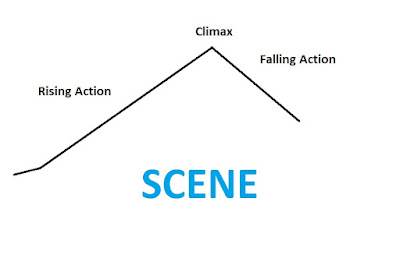
The reality is, when you understand plot, structure, and scenes at a foundational level, it will become consistently clear where the best places are for chapter endings. Usually the best place is one of five. Really.

In order to explain those places, though, we need to briefly cover those foundational elements.

Monday, April 27, 2026

Writing Slice of Life, with Kishotenketsu


When writing slice-of-life scenes, sequences, acts, or whole narrative arcs, it can be tricky to keep them interesting; kishotenketsu story structure can help writers do just that. 


What is Slice of Life?

Slice-of-life moments depict ordinary, everyday life. They can include routines, like walking a dog, making dinner, or even waking up and getting ready for school; or typical social interactions, like hanging out with a friend, asking a spouse about their day, or getting permission from a boss to leave work early. They tend to have low conflict and low stakes, and in fact, they may even have no conflict.

The longer the slice-of-life part is in a story, the trickier it can be to pull off. A bored audience is usually one that won't stick around, and slice-of-life can be rather mundane. 

In a strange way, this often makes slice of life significantly more difficult to write. In a high-stakes, conflict-filled scene, the writer has a lot to work with. If your character is running away from a serial killer, it's innately interesting, and the audience is much more likely to stick around. When a character is doing routine paperwork with little at risk, it can easily, and quickly, turn boring. (And frankly, many unpublished slice-of-life scenes don't contribute enough to the story.)

With that said, what often makes slice of life interesting and enjoyable are the characters and their relationships, and/or the atmosphere and setting. With the "right" characters, a simple trip to the grocery store can be a treat. And if the setting is something like Paris, then everyday experiences there can feel like pleasurable escapism. The target audience may want to linger in a bakery near the Eiffel Tower. 

Many fans of slice of life also cite nostalgia as a draw, and they appreciate reading or watching a story that is actually relaxing. While not a requirement, slice of life tends to be lighthearted. If an entire book or show is slice of life, then often it will be paired with another genre--most commonly comedy or romance. It's typically very difficult to get away with writing something that is pure slice of life (because of some reasons we'll cover below).

Yet, with the rise of slice-of-life vlogs in recent decades, as well as slice of life's close cousin, cozy fiction, it's obvious there is an appetite for "quieter," realistic content.

One of the best ways to handle that content, is to follow kishotenketsu story structure.

Monday, April 13, 2026

Turning Point vs. Plot Point vs. Plot Turn


Plot turns, turning points, and plot points work to turn the direction of the story, but few writers fully understand what they actually are.

And when I was learning the writing craft, I sometimes wondered what the difference was between turning points and plot points. And plot turns for that matter.

At the time, I couldn't find any clarity online. So . . . here is the post that past me needed. 😉

Monday, March 9, 2026

Kishotenketsu Story Structure Explained (with Examples, Visuals, Variations)


Kishōtenketsu is a 4-part narrative structure from East Asia, and over the years, it has slowly been making its way into Western writing communities. From Studio Ghibli's Spirited Away, to the award-winning horror film Parasite, to anime and manga like Demon Slayer topping the charts, and the climbing craze for k-dramas, many Westerners have fallen head over heels for the kishotenketsu (pronounced "kee-show-ten-ketsu") storytelling approach (whether they know it or not). Unfortunately, though, there have also been quite a few misunderstandings about what kishotenketsu actually is, and how it works, on its way to the West.

Last year, a student in my writing course asked me to comment on kishotenketsu. And while I will openly admit I'm not an expert on it, or East Asian culture, I'm not completely clueless either. Japan has long held a special place in my heart because my dad, brother, aunt, uncle, and cousins lived there. My best friend's dad did work there. And my other brother's close friend was half-Japanese--he'd sometimes share cool shows with us (fun fact: my first Studio Ghibli film was all in Japanese, no subtitles, thanks to this friend).

I wish I could say these people helped me write this article, but the truth is, they didn't; they haven't studied kishotenketsu or writing in depth . . . and with the research I've done, I know more than them on this topic now. (It probably also helps that I inhaled a lot of anime during my formative years 😉) With that said, I am open to hearing corrections from those who know more than me--I just ask they be given with kindness.

I am not East Asian, but what I am is a professional editor and writing instructor who has studied a lot about stories and their structures. I believe my thoughts on this topic are worth sharing. Also, I did look at sources that were actually East Asian, because I do prefer to learn straight from the originators. My references are listed below.

Let's get into it.

(*Notes: I sometimes use West and East in this article as generic terms; I'm aware they are imprecise, but this allows for simplicity. Based on the content of this article, I'm sure you'll get what I mean. Also, plurals are handled differently in English versus Japanese, so I've coined the word "tens" to reference multiple "ten" for clarity, for my audience--I'm aware this isn't how it's handled in Japanese.

Finally, because this ended up being a longer-than-normal post, I've included a table of contents 😊)

Monday, December 22, 2025

Writing Try/Fail Cycles: Strengths vs. Weaknesses


What is the Try/Fail Cycle? 

The try/fail cycle is a writing approach where a character attempts to achieve a goal multiple times and fails at least twice before succeeding.

For example, our child protagonist may have the goal to own a bike. She goes to a neighbor who has outgrown hers, and asks if she can have it (try), and the neighbor says no (fail). So, then she decides to do a bake sale on her sidewalk to earn money to buy a new one (try), but it rains, so no one shows up (fail). She learns about a contest that has a new bike as a prize, so she competes (try), and wins (success). She now has her own bike.

This is a very simple example, but the try/fail cycle is simple in and of itself (which is simultaneously a strength and a weakness).

The try/fail cycle approach was common in the 1950s, and taught by author, editor, and critic Algis Budrys. Unfortunately, though, no one seems to know who originated it, since it wasn't Budrys himself. I first learned about it from David Farland, who was mentored by Budrys, but I've never been able to track down the original source (though David talks about it in his book, Million Dollar Outlines). David himself mentored many writers who went on to become best-selling authors (like Brandon Sanderson and Dan Wells, to name two). And in more recent times, some of those writers (and others) have evolved the concept. For example, Mary Robinette Kowel pairs it with the "No, and" vs. "Yes, but" rule. And I've seen others relate it to Orson Scott Card's M.I.C.E. quotient

In its initial form, though, the try/fail cycle is that simple. The character tries and fails at least twice, before succeeding.

Monday, September 22, 2025

Why You Should be Cautious with Beat Sheets


Beat sheets are amazing tools that can guide you to write a great story, but unfortunately, they also have their pitfalls. For those unfamiliar with the term, a beat sheet is like a story template, and it can help you brainstorm and/or map out a sturdy structure for your story--generally speaking, anyway. Some of the most famous beat sheets are Save the Cat!, The Hero's Journey, and 7 Point Story Structure (depending on the version you are using). There are also beat sheets for writing romance (Romancing the Beat by Gwen Hayes has a great one).

These guides walk you through the beats--the moments that move the story forward--so that you can use them to shape your own more-likely-to-be-successful story.

Though, I must admit, the term "beat" is a bit of an ambiguous one in the writing community, as it gets used both for parts of the whole narrative arc, and for tiny parts that exist in scenes, and people define the term in different ways (which isn't very helpful when you are learning). Some people argue beats are plot points, others say they are shifts in emotions or tone. And sometimes in a screenplay, the word is used to denote a pause. So yes, another ambiguous writing term to add to the list. But anyway . . . 

Beat sheets can also be useful when learning about story structure, what happens when and how (and sometimes, why).

And some people are rather religious about beat sheets in the writing community. There are many people who will speak as if every story needs to follow this specific beat sheet, and they will try to fit every story that's been successful into that beat sheet.

While many successful stories will--actually--fit multiple beat sheets, not all of them will fit a popular beat sheet.

Beat sheets are super helpful, but I also feel like they have damned a lot of stories, writers, and to some degree, even the writing community itself.

Monday, August 11, 2025

Goals: the REAL Framework of Plot


Often in the writing community, people define plot by conflict. "Story = conflict"--or so they say. In reality, goals, not conflict, are the true foundation and framework of plot. It's by changing and evolving the protagonist's goal that you truly progress the plot, not by how much or how little conflict you have.

This isn't to say conflict isn't important; it most certainly is. I still consider it a critical element (most of the time). But more important than that, is actually the goal, which is where true plot starts, anyway.

You can't have conflict, until you have an antagonistic force. The antagonistic force is a form of opposition--it's something in the way of the protagonist's pathway. In other words, it's something in the way of the goal. So, you can't have a real antagonist, until the protagonist has a goal.

Okay, already some of you who are new around here, are chomping at the bit to tell me I'm wrong. You want to tell me you can think of great stories where the protagonist wasn't pursuing a goal. She was just enjoying her life, until something interesting happened.

And that's one of the problems with talking about goals in the writing community: most of us have a narrow idea of what a goal is. Too many of us envision big or aspirational goals, but that's actually only one type of goal.

At the most basic level, there are, in fact, three types of goals: to obtain something, to avoid (or stop) something, or to maintain something.

Monday, July 14, 2025

Writing 2 Distinct Turns at the End of an Act


Several months ago, I wrote an article on "Writing with 3 Equal-sized Acts," where I used The Hunger Games as an example, since Suzanne Collins writes all of these books with that structure. In it, I said this:

I was originally going to avoid bringing this up, but since we are here. . . . Sometimes . . . act-turns can be broken down into two parts--one major moment that ends the previous act, and another that starts the next act. I'll probably do a post breaking that idea down later.

Guess what? Today is that day!

And this isn't something that only applies to working with three equal-sized acts. It applies to any type of structure that is long enough to use acts, including the most common approach, which divides the story into quarters, like this:


One of the reasons I've put off writing this post, is because you have to have a bit of an understanding of story structure and specifically acts. So if you are new here, I'll very briefly catch you up to speed (doesn't hurt for the rest of us to review this either, so we start this explanation with the right mindset (but if you want, you can skip to the next section)).

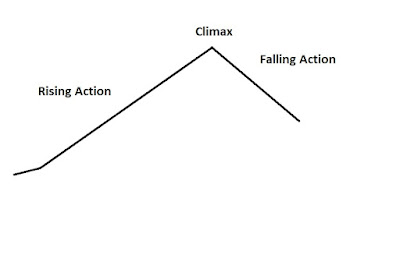
An act follows the same basic shape as the whole narrative arc. This shape:

The "climax" is also called a "plot turn," "turning point," or "plot point." Because it turns the direction of the story. It's just that an act's "climax" is going to be smaller than the actual climax of the whole narrative arc (overarching story).

At that turn, the character's goal and/or plan to get the goal somehow changes; this helps create the turn--it's what "progresses the plot."

An obvious example of this is the story's climax itself. At the climax, the protagonist and antagonist face off, and the protagonist either gets or doesn't get what she wants, then we hit the falling action.

If you are familiar with other story structure approaches, you may know the act-level turns by other names:

In 7 Point Story Structure, they are Plot Point 1, Midpoint, Plot Point 2, and Climax (or "Resolution" (or part of Resolution, anyway)).

In Save the Cat!, they are Break into Two, Midpoint, All is Lost, and Finale (or part of it).

In the Hero's Journey, they are Crossing the Threshold, unstated, The Ordeal, and Resurrection. 

(But if you aren't familiar with any of those names, that's okay too.)

Whether or not you are aware of it, most of the stories you consume follow this basic structure.

Let's talk more about goals. A character should have a concrete goal, of which there are three basic types: obtain something, avoid (or stop) something, or maintain something as is.

An antagonistic force of some sort will come along and oppose that, creating obstacles. The character dealing with those, creates the rising action of conflict.

At a turning point (or plot point, or plot turn--whatever term you prefer), the goal or plan to get the goal, will somehow shift.

There are several ways that can happen.


Goal Shifts:

- The character gets the goal (and therefore soon needs a new one)

- The character gains an additional goal (he can have more than one)

- The character abandons the current goal (maybe he fails or quits)

- The character swaps goals (this could be a change in priorities)

- The character gets part of the goal (some goals can be broken down into pieces)

- The character's goal gets more detailed and specific (ex. he wanted to graduate, but now he wants to graduate with honors)


Plan Shifts:

- The character forms a new plan

- The character abandons the current plan

- The character changes or swaps out the plan

- The character's plan gets more detailed and specific


Let's quickly look at some of my go-to examples.

In The Hunger Games (book version), Katniss's overarching goal is to win (or survive) the Games. But her specific plan (or route) of how to do that, shifts with each act. (And we may even argue, these are smaller goals that fit within the big goal.) For Act I, she's focused on preparing for the Games. In the first half of Act II, she focused on basic survival--find water and food sources, shelter, etc. After the midpoint, that shifts, and her focus is working with Rue to strike at the Careers. For Act III, she wants to win with Peeta.


Some characters don't have one overarching goal for the story, but their goal changes with each act.

So in contrast to Katniss, we have Luke Skywalker, whose goal simply changes for each quarter in A New Hope. First, he aims to get off the farm and go to academy. Then he wants to go with Obi-Wan and become a Jedi (which entails going to Alderaan), then he wants to rescue Leia, and finally, in Act III, he aims to destroy the Death Star.


In both stories, between each of these shifts, is a plot point. For example, the reason Luke's goal changes at the end of Act I, is because stormtroopers attack the farm, killing his aunt and uncle. This is Plot Point 1, and it leads him to choose to go with Obi-Wan.

When the plot point happens--that act's "climax"--the goal or plan shift.


2 Distinct Turns at the End of an Act

Sometimes, an act's plot point is essentially made up of two separate, distinct, significant moments, not one.

One moment closes the previous act.

And another moment kicks off the next act.

Let's start with the example I used originally, when I first brought this up. Here is what I said:

In Act I, [Katniss's] current plan or "route" is to prepare for the Games. This makes up the rising action.

The crowning moment of preparation is when Caesar Flickerman interviews Katniss and Peeta. This is the last major moment to "prepare." It clearly ends that phase. It is Katniss's last chance to make an impression before going into the arena.

Based on the actual act break in the book, Suzanne Collins views this as Plot Point 1, essentially (that first peak of the story). 

However, I want to point out that the start of the next chapter is the Cornucopia bloodbath, which kicks off the Games. This kicks off Katniss's new focus, which is basic survival in the arena.

So one moment ends Act I (the interview), and another event starts Act II (the bloodbath).

The interview completed that "plan." The bloodbath leads to Katniss's new plan. Once she checks what she's got from the cornucopia, she needs to move forward with the next phase: basic survival.

A similar thing happens at the end of Act II.

Katniss successfully blows up the Careers' stash, but Rue dies.

This ends her current plan/route (or we could say, smaller goal). She no longer needs to strike at the Careers with Rue, because she got that goal (though it came with a high cost--Rue's life). 

She mourns Rue.

And then an additional turn gives her a new plan/route for Act III: the Gamemakers announce there can be two victors if they are from the same district. New plan: win the Games with Peeta.


I've been listening to Hamilton lately, and a similar thing happens at the midpoint.

But let's back up a sec.

At Plot Point 1, "Right Hand Man," Washington asks Hamilton to be his right-hand man during the war, and Hamilton quickly accepts. This is the major turn of the first quarter, and it takes us into the second quarter.

Notice this is one key moment: Washington asks, and Hamilton accepts.

This changes Hamilton's objective. His focus for the second quarter is to win the war by helping Washington (specifically, he wants to do this by being in command). 

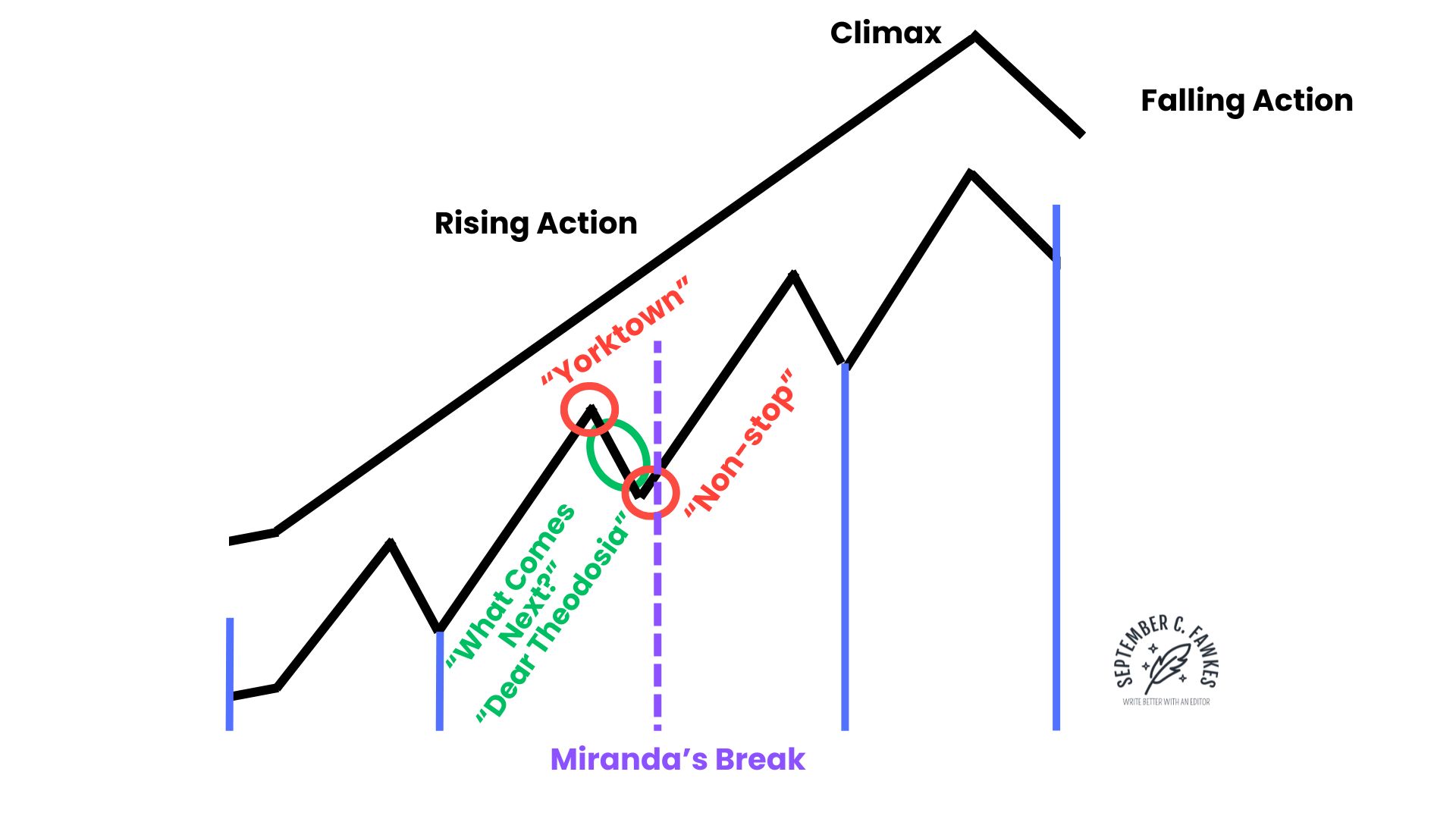
As we get to the middle, the midpoint, there are two separate and distinct key moments.

Hamilton successfully leads men to win the war--completing that objective--in "Yorktown."

This "ends" that quarter.


But his new goal for the third quarter doesn't show up until "Non-stop," where Washington asks him to be the Secretary of the Treasury--this kicks off the next quarter. Hamilton will be focused on doing this job, while Jefferson and Madison act as his (act-level) antagonists.

One moment ends the previous quarter.

And two songs later, another moment starts the next.

Lin-Manuel Miranda decided to slice the play after "Non-stop" for the intermission. Notice this is in contrast to my Hunger Games example, where Collins sliced it at Plot Point 1. (But it's similar to where she sliced it after Plot Point 2.) See below:


VS.


It's simply a matter of where the writer chose to put in the break (and I'm betting percentages had something to do with it 😉).

In these examples, both Katniss and Hamilton have completed their objectives, and there is a space, an "interlude" (the falling action in these cases) before their new objectives form. In these examples, these spaces are rather noticeable--as they have scenes in between.

In other stories, this sort of thing can still happen, but they just happen more closely together, and less obviously.

At the midpoint of Star Wars: A New Hope, Obi-Wan and Luke go to Alderaan. But it's gone.

This arguably officially ends the second quarter. The goal is abandoned, because the planet no longer exists.

A tractor beam pulls the Millennium Falcon onto the Death Star, and Luke learns the princess is here.

This kicks off the next quarter. Luke's goal for the third quarter is to rescue Leia.

The space between these moments in A New Hope is more intense and exciting, so it's easier to lump them together when talking about the midpoint--and I don't think that is a problem at all.

But I want to point out these are two different moments.

In contrast, Plot Point 1 of Hamilton happens in one moment, in one scene.

Both approaches are acceptable. 

Often when there are two distinct moments, spread apart by scenes, what's actually happening is this: a falling action is getting extra attention as it splits up these moments. (As shown in my diagrams above.)

And it's worth keeping in mind, that the falling action is often where character reactions happen. The character reacts to whatever major moment happened that shifted her current objective.

In my first example, Katniss's--well, and Peeta's--crowning moment of preparation is their interviews.

After this, Katniss reacts to what just happened, then she gets ready to enter the Games.

The bloodbath kicks us off.

At the end of Act II, the Careers' supplies have been attacked, and Katniss is unable to save Rue--this is that peak "climax." In the falling action, she reacts. She mourns Rue.

The announcement about two victors is made, and this snaps her out of it, giving her a new objective--this kicks off the next rising action.

The midpoint of Hamilton is the same way.

Hamilton leads his men to victory--the revolution is a success.

Then characters react. There are church bells ringing, people singing drinking songs, King George gets his own song with his reaction, followed by Hamilton and Burr singing about building a new country to their children--this is all falling action. The "valley," so to speak.

"Non-stop" has the turn that primes us for the next climb.


It may not always map out perfectly this way.

Luke and Obi-Wan barely have a moment to react to Alderaan (and the Death Star), before the tractor beam hits. This leads to a more intense "interlude," that works just as well. So I'm not necessarily saying we always need "downtime" between these two distinct moments.


Where This Most Commonly Happens

Some of these concepts may sound vaguely familiar to some of you. . . .

This is because many approaches teach writers to give Plot Point 2 a noticeable falling action, frequently referred to as "The Dark Night of the Soul" (courtesy of Save the Cat!). They remark that Plot Point 2 is a major loss, and that the character then reacts to it for at least a scene, if not longer. Then something comes along and snaps the character back into action (leading to a new objective)(In Save the Cat! this is called "Break into Three").

This is often such a noticeable "interlude," that on some level, people recognize or even name these moments. So in Save the Cat! it looks like this . . . 

"All is Lost" is the climactic peak.

"Dark Night of the Soul" is the falling action.

"Break into Three" is the kickoff that starts Act III.


This isn't to say, though, that you can't distinctly split these moments elsewhere, in a different act. Obviously The Hunger Games and Hamilton show you can. 

This also obviously doesn't mean it always has to hit a peak with a major loss. Hamilton helps win the war, which is a major victory at the midpoint. 

Often these "interludes" show up when an objective is achieved or abandoned, and the character doesn't yet have a new, major plot goal to act on.

This also isn't to say that you have to distinctly split these moments up to have a noticeable falling action. A character may get a new plan or objective at the peak, then still take a moment to react, before officially starting the next climb (and running into an antagonistic force). 

With that said, though, often something will still come along that refines or reframes their current goal or plan.

For example, at the midpoint of The Lion King, Scar kills Mufasa and blames it on Simba. Simba's goal shifts in one moment; Scar suggests he runs away and never return, and Simba aims to do just that. Simba hits the bottom of his "valley" when he is lying unconscious in the desert. Timon and Pumba are the "something" that comes along and refines his current objective. Not only is Simba going to run away from home, but he's going to turn his back on it and live the Hakuna Matata lifestyle.


But to be honest, some of these moments can start to blur together . . . which is why they are so often lumped together.

I wouldn't stress too much about perfectly slicing, dicing, and categorizing the pieces.

What's usually really a problem is if there isn't any kind of major turn at the end of an act, and no clear goal for the next act.

Rather than worry if you have too many turns at the end of an act, it's more of a concern if you don't have any.

Still, I've been wanting to do this post and point out that in some cases, these are two, distinct, significant moments. And that's okay. And it's still worth covering and looking at them, because it may help you better understand and write your own story (as well as understand other stories better).

That's pretty much it. 😊


Monday, January 13, 2025

What Happens When There are No Plot Points in a Story?


Plot points are a vital part of storytelling, but many writers aren't taught about them until they are elbow-deep into writing. Some are lucky enough that they naturally put proper plot points into their stories without consciously understanding what they are. But others . . . aren't so lucky.

Today I want to go over what actually happens when you don't put enough plot points in. But first, let's review what a plot point is.

Monday, June 24, 2024

Writing & Structuring Multiple Plotlines (with Visuals)


Writing multiple plotlines can sound difficult and daunting. How can you keep the storylines straight? And relevant to each other? How do you handle all the moving pieces and subplots? 

One of your biggest helps for writing such a story is understanding how to structure it, which is what this article is all about. And it may be a relief to hear that you've likely already written with multiple plotlines . . . now you are probably just adding more than you are used to . . . 

Monday, March 25, 2024

The Difference between a Plot Turn and a Plot Twist


Most writers are familiar with the terms "plot turn" and "plot twist," but a lot of writers have a vague understanding of which is which. Some may wonder if there even is a difference, and if there is, what is the difference?

Sometimes "twists and turns" is used to describe a plot, even if the plot doesn't actually have a twist. This only makes things foggier. (And by the way, every story has a turn, but not every story has a twist.)

On the other hand, some people can sense the difference when consuming a story in the "wild," but can't verbalize the difference. They know a good twist on sight, but explaining it? "Well . . . uh . . . it's something like . . . um . . ."

Yeah, I get it. I used to have all those same problems. 

And when I went looking online for help back then, I couldn't find any articles that simply explained the difference.

So today, I've written one.

Let's talk about the difference between plot turns and plot twists . . .


What is a Plot Turn?

A plot turn is also called a "plot point" or a "turning point," so we have three terms for the same element. It turns the direction of the story. The story was going one way, and then information is revealed or an action is taken and the story is now going a new way.

I like to use the metaphor of a railroad to explain it. Simplistically speaking, your protagonist is a train engine pursuing a goal, on a railroad. The tracks lay down a pathway, a trajectory, to get there. A plot turn (or plot point or turning point) is like that train track that switches the direction of the train. The character was on trajectory A, but is now on trajectory B. 


As Robert McKee points out wisely in his book, Story, a plot turn can only happen one of two ways (well, or both of them): 

- A revelation (information is dropped)

- An action (which may also show up as an event)

For example, in Star Wars IV, Luke learns (info) that the princess is on the Death Star. This changes the direction of the story, because now Luke's goal shifts to saving Leia. His trajectory changed.

Likewise, when Luke destroys the Death Star (action) at the end, it changes the direction of the story. He succeeded in his goal, and the story now drops into falling action (it's time to breathe a sigh of relief and celebrate). 

After a turning point, the goal and/or the plan to get the goal, should have shifted in some way. If it didn't, it wasn't a true plot turn, because it didn't carry meaningful consequences. And the revelation or action needs to carry consequences in order to turn the trajectory. (Yes, I know I'm talking in circles a little bit.)

The biggest, most recognizable plot turn of any story, is the climax.

Notice that in basic structure, it visually turns the direction of the plotline. It turns the story from conflict to falling action. 


Luke destroying the Death Star is the biggest turn of Star Wars IV, because it definitively stops the antagonists and saves the "good guys" (at least until the next installment). Luke succeeds in getting the goal, and life as we know it changes for the characters.

But the climax shouldn't be the only turning point in a story. If it is, the story will feel monotonous and repetitious (and likely predictable), because we are on the same pathway from beginning to end.

In reality, each structural unit should almost always have a plot turn. Each act should have a plot turn. Each scene should have a plot turn. The difference is that the plot turn of an act will be smaller than that of the whole narrative arc, and the plot turn of a scene will be smaller than that of an act.

Commonly Act II is split in half.


Luke learning Leia is on the Death Star (after discovering Alderaan is gone and the Millenium Falcon gets pulled in by a tractor beam) is an act-level turning point, because it shifts his goal (in fact, all those things shift his goal and could frankly be dissected in more detail but let's keep it simple) to rescuing Leia, for the next quarter of the story.

And when the gang is in the trash compactor, Luke getting R2D2 to successfully shut down the compactor is the turning point of the scene.

Worth noting is that the term "plot point" commonly references act-level turning points. "Plot Point 1," "Midpoint," and "Plot Point 2" from 7 Point Story Structure are all act-level turning points. Technically though, you could call turns of smaller units a plot point, and the climax certainly is a plot point (the plot point of Act III, as well). It's just useful to know that when you hear the term "plot point" in the writing community, it's likely referring to act-level plot turns.

Every successful story needs regular plot turns. 

In contrast, not every successful story needs plot twists.


What is a Plot Twist?

A good twist will also contain a turn (though technically it can exist without one, it's just usually not very effective that way). A twist will turn on information being revealed, but it's more than that. The information being revealed has to change the audience's interpretation of what they knew or assumed to be true prior to that moment. It "recolors" their understanding of what came previously. It changes the context. The audience looks back at what happened earlier, and now they have a new interpretation of it, a new understanding of what was meant or what was really going on.

For example, in Star Wars V, Darth Vader reveals he is Luke's father. This is a twist, because until that moment, the audience thought Luke's father was dead. That was the context the audience was provided, the lens they had viewed the story through, what they had believed since the beginning. But it wasn't the whole truth. It was missing a piece. That piece is the fact that others were speaking of his death figuratively. Luke's dad didn't literally die, but he figuratively died, because he transformed into Darth Vader.

The twist is even more shocking because the audience had heard how Luke's father was a great Jedi--someone on the light side of the force. Darth Vader is on the dark side. He's the one who supposedly killed Luke's father.

Confused, the viewer's mind races back through earlier parts of the story, and realizes this new interpretation fits--it's been foreshadowed right under his nose. He just misinterpreted it.

He misinterpreted it because he didn't have the whole truth. He also made inaccurate assumptions about the information that was given.


Unlike turns, twists must work off ambiguity (which is not to be confused with vagueness)--there are at least two interpretations for the same moments (but the audience didn't realize there was a second interpretation). It's like this optical illusion. The viewer may only see a vase at first, and if we wanted, we could tweak this picture so it emphasizes the vase more. But in reality, it may truly be a picture of two faces staring at each other. When we point out the faces, it changes the viewer's interpretation of the picture.

That's what a plot twist is.

Which I realize, sounds rather different from a plot turn.

But as I mentioned, a good plot twist will also contain a plot turn. 

Because a good plot twist should carry meaningful consequences that shift the direction of the story. If it doesn't, it's probably just put in for shock value. If you can take out the plot twist, and the plot is the same, it's probably just gratuitous.

Consider Luke learning Darth Vader is his father. How does that alter the pathway of the story? Well, now Luke has to choose whether to join his father or continue fighting him, and each option carries more personal consequences than before. Can Luke kill his own father? Will he become like his father? This revelation has personal ramifications for Luke that will affect the whole trajectory of the next installment. It's what leads to Darth Vader's redemption at the end of the trilogy.

A plot turn should always affect the future of the story.

A plot twist should always affect the audience's understanding of the past.

And a good plot twist will also affect the future of the story, because it will also be a turn.

Of course, there are always variations and exceptions, but this is generally how it works.


Sunday, July 9, 2023

The 12% Rule of Story Structure


Proper structure helps you deliver your story to the audience in a satisfying and familiar way. You wouldn't want to end up with the climactic peak hitting only ~36% into the story. That would make the story feel awkward and the remaining ~64% boring. (Talk about a dissatisfied audience.)

Contrary to what some believe, to me structure is all about organizing and/or timing. When stripped of all the details, beat sheets, and fill-in-the-blanks, it's a matter of organizing your content and timing the delivery of it.

This is one of the reasons you can find successful stories that don't seem to fit your favorite beat sheet. Even though that particular story may not be like others in its details, it can still deliver the content in a satisfying way if it organizes and times it properly.

Today's post is more about the timing.

And I call it the 12% Rule--or perhaps better said, the 12% Rule of Thumb (because even here there are variations, however atypical they may be).

The idea is, at the most basic level, most all successful stories will have a significant turning point every ~12%. A major turn near the end of every quarter, with a medium turn between those.

Monday, February 13, 2023

How to Write Strong Character Relationships: Tips, Arcs, Plot, Structure


Writing strong character relationships is critical for any author to master. Nearly every story, in nearly every genre, will feature a relationship for a plotline--whether that relationship is for the primary, secondary, tertiary, or quaternary plot, and whether that relationship is positive or negative, for allies, friends, love interests, coworkers, rivals, enemies, or what have you. 

Set up the relationship dynamics right in your story, and any relationship will be easier to write.

Authors often use relationship plotlines because they fit exactly between the external plot and the internal plot. They aren't as broad and far-reaching as the external plot, but they aren't as deep or personal as the internal plot. This makes them a perfect fit to add dimension to any story.

Hello, everyone! I'm officially finishing up my relationship series (for now) with an overview of what we've covered. This page will work well to refresh you on the topic and help you find and recall any info you may need to come back to later. I hope this journey has been helpful to you, and I hope this page will help anyone new here, looking for a guide to writing relationships.

Please note for below: "Character A" and "Character B" may refer to either character in the relationship.

Monday, January 9, 2023

Structuring Your Relationship Plotline, Part 2: Key Beats


Beat sheets are valuable tools for structuring and writing a story. They can be just as valuable when structuring and writing a relationship arc. In reality, I could write up a beat sheet for each relationship arc. Today, I've decided to go over the key beats, in the order they most frequently appear (which usually applies to positive change relationships). 

In my previous article, I laid out a foundational approach to structuring your relationship plotlines. That will likely be more useful to you in structuring your relationship arc, than following these beats in the presented order. Once you understand the foundational principles, you can successfully manipulate any beat sheet to suit what you are writing. This is why I titled this post "key beats" and not "beat sheet." There are plenty of relationship plotlines that don't adhere to these exact beats or this exact order.

Nonetheless, knowing what is most common can help you discern how to handle yours. Your relationship plotline can follow this exactly, or you can vary it (which I'll talk about more at the end). 

So far, we have covered relationship arcs, relationship plots, and the foundational approach to relationship structure. Let's finish this up with the common key beats.

In this ongoing relationship series, I intentionally picked relationship arcs that appear quite different from each other, to show variation. For this reason, I'll be using Monsters Inc. as a main ongoing example below, while simply referencing some beats in my other ongoing examples; Monsters Inc. follows these beats, in this order, exactly. (Many of my other examples, do not.)

(Note for below: "Character A" and "Character B" can be either character in the relationship.)

Monday, December 12, 2022

Structuring Your Relationship Plotline


A relationship plotline will be present in most stories. It will have a relationship arc and follow the principles of plot (according to relationships), but like any plotline, it also needs a sense of structure. It needs to be organized in a coherent way for the audience, so they can follow and appreciate the progression or deterioration of the relationship.

I can help you structure the relationship plots you're writing--whether the relationship features love interests, friends, family, allies, rivals, or even enemies (and everything in between).

Now . . . I admit, I've been debating a lot about how to write this, if I should put forth a general foundational approach to the structure, or if I should get more specific and offer a beat sheet. The more I thought about it, the more I realized the latter would be pretty complicated, since each relationship plotline can be affected by the external and internal plotlines and could have a different relationship arc. It also seems I'd need a beat sheet for each relationship arc type, and even within those, there can be variations.

That might be a project for later down the road.

Plus, when you understand the foundational principles first, the beat sheets make more sense, and you know how to stray from them for the effect you want.

When you understand the foundational principles, you're more likely to be a chef, not a cook.

So, with that said, I've opted for the former today . . . but next time, I will have an article on key beats  (and how they are most frequently structured) that you can manipulate to suit your relationship plotline.

Here are a couple of things for you to keep in mind . . . 

- How much you develop your relationship plotline may depend on how prominent the plotline is in the story. A relationship that works as an A Story must be developed enough to carry the narrative and all the critical moments must happen on page. A relationship that works as the C Story will be more understated and may have more happening off page. There are a lot of ways to play with the relationship plotline (as I've discussed), so how much attention you give it and how it is interweaved with the other plotlines will depend on your story.

But regardless of how prominent the plotline is, if it's a plotline it still needs the basic elements of plot and it still needs to be delivered to the audience through structure.

- Where the relationship plotline starts may depend on how prominent the plotline is. This brings me to the next section.

Monday, June 27, 2022

What Plot is NOT (How NOT to Fix Your Story’s Plot!)


According to the dictionaries, a plot is a "storyline," "main story," or "plan" in a literary work. A search online will tell you that a plot is a "series of events," "a list of checkpoints to move a story," "how the story is delivered in a book," "the structure of events," "what happens," "a chain of events" in a story.

You know what? To be frank, all these definitions of "plot" stink.

Not only are they pretty vague, but some of them don't even check out. 

Plot is "the structure of events"? No! That's structure. 

Plot is "what happens." Really? So I can write a story about a character looking out a window at a boring neighborhood with nothing meaningful, then have him lie in bed getting nowhere, and get up and get a snack out of a fridge, and then watch T.V. with nothing meaningful, significant, or insightful? Sounds like a plotless story to be sure!

Plot is "the main story." This doesn't even make sense. Story is more than plot. And what about the secondary plotlines? They don't fit the definition of "plot"?

I could go through the other definitions, but I think you get the point.

For the last couple of years, I have been thinking and studying plot quite a bit. Because on the one hand, I totally know what plot is, but on the other, at a deeper level, I have no clue what plot is. Like, I know what it is, but what IS it ReAlLlLy???

In the past, I knew writing great plots was something I struggled with--and what's worse, I knew I was struggling, but couldn't find the magic pill that would make everything click together for me! It's not that I didn't understand anything about plot, but I could never get what I was hearing to work into a big, old, powerful plotline that would leave the reader breathless, like I wanted. 

When I asked others for help and resources, most people couldn't provide what I needed or sent me to structure. And for the record, plot isn't structure, which is what many seem to think (more on that in a bit).

Finally, everything clicked into place at a level it hadn't before for me. In short, I'll be doing a few posts on plot to explain it all to my past self, and maybe it will help someone else struggling.

Or maybe you already understand plot at a deeper level than I did.

In any case, with such crummy definitions, I want to start by talking about what plot is not

And surely I've caught myself and others trying to make the following things into plot. And have sometimes even heard instructors talk about them as if they are plot. I realize some of these things will sound obvious, but you might be surprised how people can disguise them.

Monday, March 14, 2022

Pacing Within the Narrative Arc


When it comes to writing stories, pacing really happens at three levels:

- in the overall story (the "narrative arc")

- in the scenes

- in the lines (passages and paragraphs)


Back in January, I taught an online class about pacing--a lot of you probably remember because I mentioned it a few times prior. Before, during, and after, I realized I had more to say on the topic than I could possibly fit into my thirty-minute session, so I thought I would do a few posts exploring it in more depth.

Often when people are talking about pacing, they are talking about it at a scene or line level, but the overall story has its own pacing too. Some sections will have faster, tighter, and more intense pacing, while other sections will have slower, looser, or more leisurely pacing. 

It's also important to acknowledge that--especially when it comes to narrative arc--this is somewhat relative. What might be "fast pacing" in a drama, probably wouldn't be considered "fast pacing" in a thriller. To some degree, what's "fast" or "slow" relates to the pace the story sets up initially.

Nonetheless, any story of any genre can be in danger of speeding sections up too fast or slowing them down too much.

So let's dig into more about pacing within the narrative arc.


Pacing and Structure

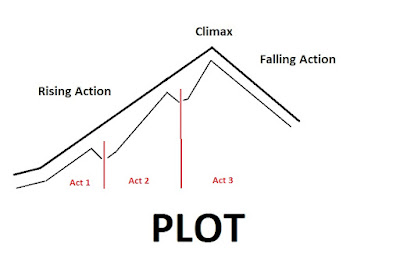
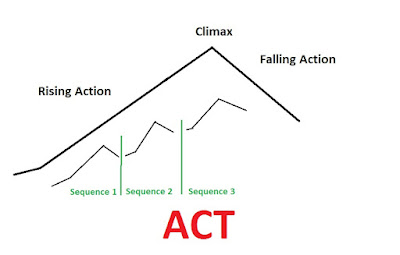
In the past, I've talked about how all structural segments really fit into this basic shape:


Whether it's a scene, sequence, act, or whole story. This shape is like a nesting doll or fractal--it fits smaller versions of itself inside:


This means that generally speaking, ideally, each of these structural units has its own climactic moment. This is also called a "turning point," because it turns the direction of the story.

The bigger the structural segment, the bigger the turning point--meaning an act's turning point is going to have more ramifications than a scene-level turning point.

This is a great way to start understanding structure. 

Essentially, each of these units has:

- Opening/Setup

- Rising Action

- Climax

- Falling Action/Resolution


Typically, the pacing is going to get faster, tighter, or more intense the closer it gets to the climactic peak.

Afterward, it will get looser and slower with the falling action.

In some situations, the writer may cut off most, if not all, of the falling action, but generally speaking, the pacing is going to slow down into a "valley." And if you are working with a smaller unit than the whole plot, this shape then repeats itself, so you then hit the opening or setup of the next segment.

Ideally, each segment will open with a hook to grab the audience, but after that, the pacing may be a little calmer as we get to the setup and before it really hits the rising action, where the main conflicts happen and develop.

Again, remember this is somewhat relative. You can give yourself a good headache if you overthink or misunderstand how this works, mainly because smaller shapes repeat inside bigger shapes. The smaller shapes have the same parts, but are small scale (read: less intense). 
Typically, the falling action of the segment is more reactionary. It's the character or characters reacting to the turning point. Because the turning point changed the direction of the story (and usually in an unexpected way), the character now needs to take that in, process it, and decide what to do next. 
Think of this on the large scale. At the climactic peak of the narrative arc, the conflict with the antagonist comes to an end. The character (and the audience) needs a moment to process emotionally and mentally what just happened. Then the protagonist must decide what to do next. The falling action usually hints at a "new normal," or at least the next path the protagonist takes, whether that's happy-ever-after or preparing for the next adventure or something else.

Many think that pacing mainly comes from the word count, and certainly word count plays into pacing. But when it comes to the narrative arc or even within scenes, structure often has to do more with pacing. For example, we wouldn't necessarily want to "speed up" the climax of the whole story by making it extremely short. Making it only a few pages doesn't necessarily make it extra intense. Just as you wouldn't want to make the falling action way longer than the climax, thinking that will make it better. In almost all stories, the falling action will have fewer words than the climax. Technically, someone could sustain a fast pace of a segment for more pages than the slow part of the segment. It's not strictly tied to word count. However, it's possible to make a segment too fast or too slow through word count.

Basically:

Word count --(influences)--> Pacing

But not:

Word count = Pacing

Along with structure, hooks, tension, stakes, suspense, and conflict play critical roles in pacing. More of them make the pacing feel tighter, and less of them make the pacing feel looser. We hook the audience at the beginning to get them to stick around through the setup and the start of the rising action. The conflicts and stakes should get bigger as they develop and become more complicated--they escalate. This makes the pacing feel more intense. After the turning point, those things hit an outcome (for better or for worse) and the conflict ends (if only temporarily). Because it ended, the pacing gets calmer and slower--how calm and how slow often depends on what structural unit you are working with. Obviously, in the plot as a whole, it will be calmer and slower in THEE falling action, than it would be in a scene. Nonetheless, it still gets calmer and slower compared to the climax, regardless of what unit you are working with.

When looking at the narrative arc as a whole, it's obvious how these things apply. We want the climax to be fast and intense, and if we handle plotting and structure right, this will happen naturally to some degree, because all the conflicts will be hitting their high points around that time. When they are resolved, it slows down and we tie up the story. 

And in the beginning of the story, we must work to hook the audience so they'll want to stick around long enough to get to the main conflict. 

But what about everything else in between?

This is when it's helpful to go down to the next structural unit: acts.

An act follows the same shape. This means that the beginning, middle, and end will each get a big climactic turning point. 


So what are these big moments?

In Act I, this will be what's called "Plot Point 1," "Crossing the Threshold," or "Break into Two," depending on what structure you use (7 Point Story Structure, The Hero's Journey, and Save the Cat! respectively. They all have different names for essentially the same moment.).

We open Act I with a hook, which will hopefully also be big enough to be THEE hook for the whole narrative arc. We spend time with setup: Who is this story about? Where does it take place? When does it take place? And we also establish a sense of normalcy.

Then the inciting incident hits (this is also called the "Call to Adventure" and the "Catalyst," depending upon your structural preference), which kicks off the story, both for the narrative arc as a whole and for Act I. This is something that disrupts the established normal, and it can either be a problem or an opportunity for the protagonist. 

This arguably starts the rising action, in the whole narrative arc, and especially in Act I.

(While it is possible for Act I to have its own separate "inciting incident" for an act-level problem or opportunity, let's keep this simple for now. I might do more posts specifically on acts in the future. But, if you feel you have multiple "inciting incidents," that might be part of what's happening.)

The protagonist is now having to deal with this problem or opportunity and what to do about it.

On the act level, this comes to a head at Plot Point 1(/Crossing the Threshold/Break into Two), where the protagonist chooses to accept the opportunity or chooses to try to address the problem, and engages with the main conflict. Often this is marked with a big moment--such as a parental figure dying (like in Star Wars) or discovering your birth dad is in New York City and on the naughty list (like in Elf). Whatever it is, it's essentially a moment that helps push the protagonist through a Door of No Return. 

What follows is usually a transitional segment where the protagonist "journeys" (literally or figuratively) to a new "world" (literally or figuratively). Both Luke and Buddy literally travel to a new place, but in many stories, this may be seen to be more of a new state of being (such as a character taking on an old lady persona as in Mrs. Doubtfire). The character gains a new goal as they accept the "adventure."

Know that I'm simplifying this a bit, as this is meant to be a post more about pacing than about structure. 

But that big moment and decision to engage with the main conflict is the climactic moment of Act I, and what follows is often the character reacting to that moment.

This means the pacing gets tighter at that moment, and a bit slower after that moment. 

The climactic moment of Act II, is Plot Point 2, which is also known as "The Ordeal" or "All is Lost." This is usually a part in the story where the protagonist engages with the main conflict, which leads to a loss or "death" (literally or figuratively). This is the biggest engagement with the main conflict so far. Meaning, it's bigger than the high point of Act I, and bigger than anything that came in the middle. So the pacing gets tighter and more intense here.

It's also followed by the biggest lull of the story--Plot Point 2's falling action. Usually, the protagonist fails or loses or "dies" from this engagement and falls into a "Dark Night of the Soul" moment. (Alternatively, the protagonist may succeed in the external conflict, but something isn't right, something is missing or wrong--it's a hollow victory, and this also leads to a lull.)

This is also followed by a transitional segment that takes us into Act III, when the protagonist gains something (whether plot-driven or theme-driven) that enables him to head toward THEE climax. This gives him a new act-level goal for the ending.

Finally, the climax of Act III is also simultaneously THEE climax, and same goes for the falling action.

When you have structure handled, pacing will often come with it--at least to an extent. But looking at the story this way, you can see where you want the pacing to be faster, more intense, and tighter, as well as when you probably want it slower, calmer, and looser.

There are just two variations I want to mention in regards to acts . . . 

Often in the writing community, we refer to stories as having three acts: beginning (Act I), middle (Act II), end (Act III), and I try to (more or less) talk about story in this way, just to keep confusion to a minimum. 

But personally, I feel acts have more to do with this structural shape than they have to do with beginnings, middles, and endings.

Another key moment in the narrative arc is the midpoint, which happens at the middle. This is often where the protagonist gains a bigger understanding of what's really going on with the antagonist and the main conflict, which then enables them to become more proactive in addressing the problem (they sort of go into "attack mode"). This is also often marked by a big event--either a victory or a failure (or at least a seeming victory or a seeming failure).

In stories that have big midpoints, I actually think it's helpful to think of them as having four acts:


This means the pacing will be tight and intense at the climactic moment that comes at the midpoint. 

After the high point, there is usually a bit of a lull as the protagonist processes and decides what to do with the new insight they've gained. This also may have a bit of a transitional segment that leads to a new goal about how to go on the attack for the second part of the middle.

Don't forget, though, that sometimes the falling action gets shortened or cut off or may simply not be on the page. And again, this is a post intended to be more about pacing than structure, so I'm trying not to get too detailed.

The other variation that sometimes happens is that the highest climactic peak of some stories actually hits at Plot Point 2 (The Ordeal or All is Lost moment), with the whole ending showing how the protagonist then applies what he learned from that experience to resolve the remaining conflict and wrap the story up (the film Old is an example of this).

For what it's worth, I actually picture these stories as having only two acts, since there are only two really high points:


In any case, understanding act structure will help you see where you will naturally want intensity and where you will naturally want lulls.

Long ago, I used to get confused when I felt like I needed to have a lully scene, worried that it was boring or would kill the pacing. I didn't understand that on the narrative level, the story should have lully scenes. I didn't understand that pacing happened on such a large level. 

Lully scenes are important in giving not only the protagonist a chance to process and react to what's going on, but also the audience. If there are no lulls, there is no time to digest what just happened. We don't get to react to what just happened. Or wonder about what to do next. We don't have a chance to catch our breath or let our worry fester or our hope build.

It can shortchange a lot of emotional breadth.

Then again, how much time and space you spend on the lulls may be determined by the kind of story you are telling. In a thriller, you will probably want to keep the lulls shorter than average. If you are writing literary fiction, you may want to draw out the lulls longer. 

It all gets down to your story and the effect you want on the audience.

If you are having problems with overall narrative pacing, check act structure.


Pacing and Proportions

Also long ago, I used to hate when instructors talked about percentages. Statements like "X needs to happen at 25% into the story" felt so stifling to creativity! 

. . . but after wandering around the pits of Writing H-e-double-hockey-sticks, I started to think that maybe . . . there was something to all that percentage junk . . . 😕

Well, present-me is here to tell you, there is!

However, that doesn't mean there isn't wiggle room or times to break the rules; it's just that, like with anything in writing, you need to know what you are doing first.

Like it or not, we humans are subconsciously conditioned to expect big moments (*cough cough* major turning points *cough cough*) to happen at certain places in a story.

I would even argue that it goes deeper than conditioning. For one, if there aren't big turning points at the right places, it's more likely that what is currently happening in the story is going to start feeling repetitious. Like, imagine if Harry Potter spent an even bigger part of the story trying to get his Hogwarts letter. How long can you really play around with that conflict before it gets boring? Before the audience is aching for some kind of change or progress? The big turning point ("Yer a wizard, Harry") is the change and progress. And if it takes until 40% into the story to get to that turning point, you can bet your bottom dollar that the audience has already bailed or is snoring. A conflict about trying to get a letter that doesn't really change, isn't sustainable.

I would also argue that turning points are archetypal and even a reflection of how our human minds work. We go along our lives until--bam--a problem or opportunity disrupts us. We wonder about what to do, debate about what to do, maybe resist what we should do, until we eventually come to a decision about it. Or, we take on goals, and as we try to pursue them, we face obstacles, and when it doesn't turn out in our favor, we react and try to decide what to do next, then we make a new plan and come up with a new goal. We don't sit there and react to it for the rest of our lives (or if we do, we need to get some therapy to move past it).

In any case, in the narrative arc, problems with pacing can arise if it takes too long to get to certain turning points (nothing kills pacing quite like repetition and stagnation). Or, if you get to them too quickly, which means there wasn't proper escalation or build-up (rising action).

Percentages are helpful as guidelines.

And here are a few to go with our acts.

- Plot Point 1 should happen around 25% into the story.

- The midpoint should happen around 50% into the story.

- Plot Point 2 should happen around 75% into the story.

As always, you can find examples of variations.

But having this as a baseline gives us the capacity to talk about timing as well as variations.

Generally speaking, if your story doesn't get close to this, it's disproportional. 

If the midpoint doesn't happen until 62% in, then it takes too long for the protagonist to become more proactive and go on the attack. This likely means the section before this is becoming repetitious and stagnant. Likewise, we now don't have as much time to properly build up to the climactic moment of Plot Point 2, for best impact. 

If Plot Point 1 is hitting at 31%, the setup is probably taking too long and getting boring.

Again, these are just general guidelines--I'm not saying no story can't ever play around with these any time or anywhere. 

For example, some stories start in narrative in medias res, which can change this approach. Some rare stories are structured so that the beginning, middle, and end are all the same length, which definitely changes the percentages. 

But if you are having pacing problems at the narrative level, consider looking at the percentages and checking the proportions.


Pacing in the Document

Outside of structure and percentages, there are a few other ways to affect pacing at the narrative level. And this has to do with how the story is actually presented to the audience. 

Chapter lengths can influence how fast or how slow the audience feels the story is going. Short chapters make the audience feel like they are tearing through the book faster. Long chapter makes it feel "meatier." 

This sort of thing can also happen with viewpoint characters. When working with multiple viewpoint characters, some writers will shift between them quicker near the climax of the story. This makes the moment feel tighter, more intense, and more dramatic--assuming, of course, all the viewpoint characters are active participants in the climax. (And it should be mentioned, you can also use this effect at other climactic moments, like within acts).

When it comes to printing, you can also use page and font size in similar ways you use chapter lengths. Reading a "chapter book" feels much faster, not only because the book itself is shorter, but because there are fewer words on a page and it has bigger font. My Lord of the Rings omnibus, on the other hand, has tiny font on big, thin, pages.

Depending on how you plan to publish your book, that may or may not be relevant to you, but I wanted to mention it nonetheless. 

Whew! That's about it for pacing on the narrative level. Next time, I'll talk about pacing on the scene level, then follow up with the line level (which is probably what most people think about when it comes to pacing).

Happy writing!


Read What Others have Written on Pacing

Pacing in Writing by Reedsy

What is Pacing in Writing? by Now Novel

How to Master Pacing by Master Class