Showing posts with label Twist. Show all posts

Monday, March 25, 2024

The Difference between a Plot Turn and a Plot Twist


Most writers are familiar with the terms "plot turn" and "plot twist," but a lot of writers have a vague understanding of which is which. Some may wonder if there even is a difference, and if there is, what is the difference?

Sometimes "twists and turns" is used to describe a plot, even if the plot doesn't actually have a twist. This only makes things foggier. (And by the way, every story has a turn, but not every story has a twist.)

On the other hand, some people can sense the difference when consuming a story in the "wild," but can't verbalize the difference. They know a good twist on sight, but explaining it? "Well . . . uh . . . it's something like . . . um . . ."

Yeah, I get it. I used to have all those same problems. 

And when I went looking online for help back then, I couldn't find any articles that simply explained the difference.

So today, I've written one.

Let's talk about the difference between plot turns and plot twists . . .


What is a Plot Turn?

A plot turn is also called a "plot point" or a "turning point," so we have three terms for the same element. It turns the direction of the story. The story was going one way, and then information is revealed or an action is taken and the story is now going a new way.

I like to use the metaphor of a railroad to explain it. Simplistically speaking, your protagonist is a train engine pursuing a goal, on a railroad. The tracks lay down a pathway, a trajectory, to get there. A plot turn (or plot point or turning point) is like that train track that switches the direction of the train. The character was on trajectory A, but is now on trajectory B. 


As Robert McKee points out wisely in his book, Story, a plot turn can only happen one of two ways (well, or both of them): 

- A revelation (information is dropped)

- An action (which may also show up as an event)

For example, in Star Wars IV, Luke learns (info) that the princess is on the Death Star. This changes the direction of the story, because now Luke's goal shifts to saving Leia. His trajectory changed.

Likewise, when Luke destroys the Death Star (action) at the end, it changes the direction of the story. He succeeded in his goal, and the story now drops into falling action (it's time to breathe a sigh of relief and celebrate). 

After a turning point, the goal and/or the plan to get the goal, should have shifted in some way. If it didn't, it wasn't a true plot turn, because it didn't carry meaningful consequences. And the revelation or action needs to carry consequences in order to turn the trajectory. (Yes, I know I'm talking in circles a little bit.)

The biggest, most recognizable plot turn of any story, is the climax.

Notice that in basic structure, it visually turns the direction of the plotline. It turns the story from conflict to falling action. 
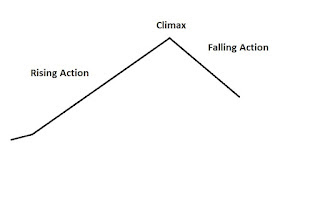

Luke destroying the Death Star is the biggest turn of Star Wars IV, because it definitively stops the antagonists and saves the "good guys" (at least until the next installment). Luke succeeds in getting the goal, and life as we know it changes for the characters.

But the climax shouldn't be the only turning point in a story. If it is, the story will feel monotonous and repetitious (and likely predictable), because we are on the same pathway from beginning to end.

In reality, each structural unit should almost always have a plot turn. Each act should have a plot turn. Each scene should have a plot turn. The difference is that the plot turn of an act will be smaller than that of the whole narrative arc, and the plot turn of a scene will be smaller than that of an act.

Commonly Act II is split in half.


Luke learning Leia is on the Death Star (after discovering Alderaan is gone and the Millenium Falcon gets pulled in by a tractor beam) is an act-level turning point, because it shifts his goal (in fact, all those things shift his goal and could frankly be dissected in more detail but let's keep it simple) to rescuing Leia, for the next quarter of the story.

And when the gang is in the trash compactor, Luke getting R2D2 to successfully shut down the compactor is the turning point of the scene.

Worth noting is that the term "plot point" commonly references act-level turning points. "Plot Point 1," "Midpoint," and "Plot Point 2" from 7 Point Story Structure are all act-level turning points. Technically though, you could call turns of smaller units a plot point, and the climax certainly is a plot point (the plot point of Act III, as well). It's just useful to know that when you hear the term "plot point" in the writing community, it's likely referring to act-level plot turns.

Every successful story needs regular plot turns. 

In contrast, not every successful story needs plot twists.


What is a Plot Twist?

A good twist will also contain a turn (though technically it can exist without one, it's just usually not very effective that way). A twist will turn on information being revealed, but it's more than that. The information being revealed has to change the audience's interpretation of what they knew or assumed to be true prior to that moment. It "recolors" their understanding of what came previously. It changes the context. The audience looks back at what happened earlier, and now they have a new interpretation of it, a new understanding of what was meant or what was really going on.

For example, in Star Wars V, Darth Vader reveals he is Luke's father. This is a twist, because until that moment, the audience thought Luke's father was dead. That was the context the audience was provided, the lens they had viewed the story through, what they had believed since the beginning. But it wasn't the whole truth. It was missing a piece. That piece is the fact that others were speaking of his death figuratively. Luke's dad didn't literally die, but he figuratively died, because he transformed into Darth Vader.

The twist is even more shocking because the audience had heard how Luke's father was a great Jedi--someone on the light side of the force. Darth Vader is on the dark side. He's the one who supposedly killed Luke's father.

Confused, the viewer's mind races back through earlier parts of the story, and realizes this new interpretation fits--it's been foreshadowed right under his nose. He just misinterpreted it.

He misinterpreted it because he didn't have the whole truth. He also made inaccurate assumptions about the information that was given.


Unlike turns, twists must work off ambiguity (which is not to be confused with vagueness)--there are at least two interpretations for the same moments (but the audience didn't realize there was a second interpretation). It's like this optical illusion. The viewer may only see a vase at first, and if we wanted, we could tweak this picture so it emphasizes the vase more. But in reality, it may truly be a picture of two faces staring at each other. When we point out the faces, it changes the viewer's interpretation of the picture.

That's what a plot twist is.

Which I realize, sounds rather different from a plot turn.

But as I mentioned, a good plot twist will also contain a plot turn. 

Because a good plot twist should carry meaningful consequences that shift the direction of the story. If it doesn't, it's probably just put in for shock value. If you can take out the plot twist, and the plot is the same, it's probably just gratuitous.

Consider Luke learning Darth Vader is his father. How does that alter the pathway of the story? Well, now Luke has to choose whether to join his father or continue fighting him, and each option carries more personal consequences than before. Can Luke kill his own father? Will he become like his father? This revelation has personal ramifications for Luke that will affect the whole trajectory of the next installment. It's what leads to Darth Vader's redemption at the end of the trilogy.

A plot turn should always affect the future of the story.

A plot twist should always affect the audience's understanding of the past.

And a good plot twist will also affect the future of the story, because it will also be a turn.

Of course, there are always variations and exceptions, but this is generally how it works.


Monday, August 15, 2022

The Quinary Principles of Plot: Reveals & Twists


Reveals and twists are a great way to take a plot to the next level. Already, some of us are likely recalling specific books or movies that had jaw-dropping reveals or twists--the kind that stick with us for years, if not decades, after.

Over the last two months, I have been breaking down what a plot actually is and what it actually contains. . . .

In the primary principles, we covered goals, antagonists, conflicts, and consequences.

In the secondary principles, we covered progress, setbacks, costs, and turning points.

In the tertiary principles, we covered plans, gaps, and crises.

In the quaternary principles, we covered setups, payoffs, and connections.

And today we will be finishing up the series with two of my favorite things: reveals and twists.

Just as a warning, there will be spoilers from . . . Harry Potter and the Deathly Hallows, Star Wars: The Empire Strikes Back, Squid Game, and The Sixth Sense

Tuesday, December 26, 2017

5 Types of Surprises


Last time I talked about the differences between surprise and suspense, saying that we should actually try to use both in our writing. I don't see enough articles that speak to how to write surprises and how to write them well. So I've broken down the element of surprise into five categories that may help.

Out of the Blue


The out-of-the-blue surprise is what it sounds like--it comes out of the blue. It isn't foreshadowed or expected in any way. In some ways, this can be the hardest surprise to pull off. Not because it's difficult to write, but because if you do it wrong the audience will feel cheated or disappointed.

One of the most important aspects of writing surprises is that the surprise isn't a disappointment. You want to make sure it doesn't undermine or cheat the reader. You don't want that being the surprise. If the out-of-the-blue surprise isn't a disappointment, it can be a fun one to throw into the story simply because the audience won't be expecting it.

For example, it could turn out in the story that the protagonist's cousin and close friend is actually working with the antagonist. If this was not foreshadowed and the audience was not prepared for this revelation in any way, it's an out-of-the-blue surprise. However, if your audience knows the cousin character well and this revelation seems to go against all that she is and what they believe of her, you run the risk of unbelievability. It may not sit well with them. In some cases, the audience may feel that the writer threw it in there for shock or in an effort to try to make the story more interesting.

But, if the revelation comes and it fits the character in some way (though not foreshadowed), it will be a big surprise, and while shocking, will still be believable.

The out-of-the-blue surprise is probably the easiest to write but the most difficult for the audience to accept.


Foreshadowed Surprise


A foreshadowed surprise is--yup, you guessed it--a surprise that has been foreshadowed. Now in order for it to actually be a surprise, you can't be heavy-handed with the foreshadowing. When you are heavy-handed with the foreshadowing, the audience guesses the outcome before it happens, so it's not actually a surprise.

To be successful at this, the foreshadowing is there, but it's subtle. If we use the example from the last section, we might give hints earlier in the story that the cousin character is working with the antagonist character, without actually revealing that fact outright, until the proper moment.

When you subtly foreshadow, and then the surprise happens, the audience thinks back and says, "Oh yeah, that makes sense. I see that now."

A foreshadowed surprise takes a bit more skill to write, but it's easier for the audience to accept, because it makes sense with what came prior.

A good example of a foreshadowed surprise in Harry Potter is **spoiler** that Harry is a Horcrux. There is enough foreshadowing in the seven books, but it's very subtle. So when we find out, it's a big surprise, but it all fits. 


The Twist


People love a good twist. It's almost its own thing. But in order to pull off a good twist, it needs an element of surprise. It belongs in the surprise, not suspense, category.

I've talked about this in other posts, but a twist works off a shift in context. Sure, of course there is foreshadowing, but we actually move beyond subtle foreshadowing. We give the audience much more context for how to interpret the information they are receiving.

Last time I mentioned the movie the Sixth Sense, which is famous because of its twist. In the Sixth Sense, the audience is given context for everything that is happening with and to Bruce Willis's character. For example, the reason his wife won't talk to him is because they're having marriage problems.

A twist shifts the context. The content is the same it's been (i.e. Bruce Willis's wife won't talk to him), but our interpretation and understanding of it changes with new information or a new revelation about the information we already have (we find out Bruce Willis is dead).

This is what makes a twist so powerful. The content was there in front of us the whole time. We had even interpreted it. But the reality was actually different than we'd assumed.

A twist is probably the most difficult surprise to pull off, but it's the easiest for the audience to believe--they've been staring at the evidence the whole time. They just didn't see it that way. They may say things like, "I can't believe Bruce Willis was dead!" But this comes from surprise and shock, rather than them disbelieving the story to be authentic. They have a hard time taking in the new information--it's not that it ruins their suspension of disbelief, it's that they are so surprised.


Exceeding Expectations


You can surprise your audience by exceeding expectations. You may have heard the concept that if you show a gun hanging on the wall in a story that that gun needs to go off by the end of the story (Chekhov's gun). The audience expects the gun to go off. So you surprise them by not having it go off once, but three, four, five times at the end.

That's the simple way to explain it. Of course, there are other facets in play and things you can do wrong--I mean, if you are writing a cozy story, then having the gun go off and kill five people probably wouldn't fit the tone. However, having it go off five times and hit other things, maybe even humorously, might work.

But it's the idea that you surprise the audience by moving beyond what they expect. You not only give them what they expect, but you take it much further to something they didn't even imagine.

That's surprising.


The Trope Twist


If you aren't familiar with the term "trope," then I highly suggest checking out tvtropes.org, where you can learn more than you ever wanted to about them. A trope is a storytelling technique that has been used enough for the audience to recognize (consciously, or more often, subconsciously). It's a pattern in storytelling. It can be about plot, character, story structure, and just about any number of things. For more about what at trope is, read this page.

Here are some quick examples:

Wake Up, Go to School, Save the World (Story type)

Tsundere (Character type)

Taking the Bullet (Micro-plot element)

It Sucks to be the Chosen One (Story/character element)

Be Yourself (Theme)

The Call Knows Where You Live (Plot element)


Basically, a trope is any thing that is done regularly in storytelling. Some people get a little disheartened learning and exploring tropes for the first time, because tropes may seem to oversimplify their amazing story (not to mention that tvtropes.org uses a witty tone in most all their entries (that is admittedly very entertaining)). But tropes aren't bad, and every story has them. They're only bad when they are handled poorly. And they get annoying if the same tropes seem to keep cropping up in the same ways. For example, after Harry Potter got big, I swear, almost every book had the prophecy trope in it. It was annoying.

That's where surprises come in.

I bring up this example a lot, but one of the reasons I love Brandon Sanderson's Mistborn trilogy is because he took familiar tropes and twisted them in unexpected ways, so that even though we as the audience are familiar with the concept of "the chosen one," we couldn't guess the ways Brandon Sanderson ended up twisted them. So we were surprised.

When you twist a trope, you take something familiar to storytelling, and you do something atypical with it.

These work doubly well for writing twists in general. Because the audience knows the trope, they have an expectation (interpretation, context) already for the outcome in a story. But if you do something different, they'll be surprised. They'll say things like, "I didn't see that coming." Well, that's because that trope usually doesn't end that way. You, the writer, did something uncommon with it.

You can twist tropes in a number of ways. You can deviate from expectation. You can also move the expectation up, so that it happens and is dealt with much sooner than is typical. For example, "the chosen one" dies before Mistborn even starts. What a clever way to start a story. What happens when the supposed chosen one dies trying to defeat the ultimate villain? What's next? When you read the back cover of Mistborn, it's surprising. You can twist typical character roles. You can twist typical character tropes. You can twist typical plot outcomes.

When you mess around with tropes, you can come up with something surprising.

However, you can also, like the other surprises, end up with a worse story, if you don't do it right. Which leads me to the next important point.


Where Surprises Go Wrong


Surprises work off doing something the audience doesn't expect. But as I mentioned earlier, they can go wrong when that something is a disappointment or "lesser" than what is expected. The audience will feel cheated or shortchanged. You need to keep your promises to the audience. Whatever the surprise is, it should either be just as good as what the audience expected from the story, or better.

Surprises can alter the overall outcome of the story.

Or they add to the overall story.

But they should not takeaway from the overall story.

You don't want to "cheat" the audience by promising them vanilla ice cream and then giving them broccoli by the end. You can surprise them by promising vanilla ice cream and then giving them chocolate ice cream instead (assuming they like chocolate as much as vanilla, so the exchange is equal). And you can surprise them by promising broccoli and then giving them ice cream instead (something they like even better). And you can surprise them by promising them broccoli, delivering that dish, and also vanilla and chocolate ice cream (exceeding expectations).

But you should definitely not promise food and serve them nothing.

(I understand that people will grumble different dissents to my metaphor because they don't like ice cream or whatever the case, but it's to illustrate my point, all right?)

So, go forth and surprise me.

Related Posts

Crafting a Killer Undercurrent for Your Story 
The Mechanics of Rendering Mysteries and Undercurrents
How to Write What's Not Written (Subtext)
Vague vs. Ambiguous: Which are You Writing
Context vs. Subtext (Context Should Not Become Subtext)
Surprise vs. Suspense--Which is Better?
Validating the Reader's Concerns
Hiding What the Main Character Knows from the Reader