Showing posts with label plot. Show all posts

Monday, June 22, 2026

Writing Stronger Plots for Character-driven Stories


In a character-driven story, the emphasis is placed on the protagonist and her internal journey. The stakes are personal and often tied to the character's identity--her character arc. How she responds to external events matters more than the external events themselves. These stories tend to offer more "substance" and "meaning" (generally speaking). But critics of character-driven fiction sometimes feel that "nothing happens," and may even ask, "Where's the plot?" They may understand on some level that the story is supposedly "good," but if they are too bored to make it through the first act, they may wonder, Who cares?

Just because a story is "character-driven" doesn't mean it can be completely plotless (something that new writers may trick themselves into thinking).

Previously, we covered the differences (and similarities) between character-driven and plot-driven stories, and I gave some tips for writing plot-driven characters.

Today I'm back with the opposite of that: tips for writing character-driven plots.

Monday, May 25, 2026

Character-driven vs. Plot-driven Stories (Examples, Definitions, and Writing Tips)


Stories are often broken down into two major categories: character-driven and plot-driven. 

In a character-driven story, the focus is on the character's internal journey. The stakes are personal, often tied to the character's identity—who he will or won't become. In a plot-driven story, the focus is on the external journey. The stakes are broad, tied to society or the world. Most stories have both, but emphasize one over the other.

Character-driven

Plot-driven

Internal Journey Emphasized

External Journey Emphasized

Personal Stakes

Broad Stakes

Character Arc is Central

Plot Goal Completion is Central

Substance & Meaning

Action & Intensity

Slower Paced

Faster Paced

Examples: Legally Blonde, Hamilton, a Man Called Otto, Finding Neverland, Michael

Examples: Indiana Jones, Interstellar, 007, The X-Files, Pirates of the Caribbean


Character-driven & Plot-driven: A Spectrum

While you can find stories that are strictly character-driven or strictly plot-driven, the truth is, most stories are, to a large extent, both. 

Usually the main difference is which plotline gets the most emphasis: the internal or the external.


Plotlines: Internal and External

Most successful stories will feature both internal and external plotlines that interweave. The character impacts the world. And the world impacts the character.

And pretty much any powerful plotline will have these four things: an objective, antagonist, conflict, and consequences.

These tend to be most obvious when looking at the external plotline.

In Moana, the protagonist aims to restore the heart of Te Fiti (objective), but Te Ka (and other antagonists) attack her (conflict). If she doesn't restore the heart, blight will overtake her home (consequences).

In the external plotline, the objective is a concrete, measurable goal. Moana aims to return the heart. We know that success is doing that.

The antagonists exist outside the character. Te Ka, Tamatoa, and the coconut people are forces that get in the way of her goal.

The conflicts are also external. Moana (and Maui) have to fight off and/or escape these entities.

The consequences are external as well. They are broad and far-reaching, meaning they affect a good-sized group of people and their "world"--in this case, everyone on the island and even beyond.

Plot driven story Moana External Plotline


But there is also an internal plotline with these four things.

In her heart, Moana wants to be true to herself (objective), but she is battling her own psyche (antagonist); she is facing doubt that she is the right person for this quest (conflict). If she doesn't overcome that doubt, she'll never become who she yearns to be (specifically a voyager) (consequences).

In the internal plotline, the objective is more abstract--such as "freedom," "love," or, like Moana, being "true to yourself." It's often the main motivator behind what the character does.

The antagonist exists inside the character. The antagonist is the character's self. It's Moana's own doubt that is getting in her way.

This means the conflicts are also internal. She must find it within herself to overcome this doubt.

The consequences are likewise internal. What Moana chooses to do in the face of that crippling doubt, will determine who she becomes--it will determine her character arc, her identity. Will she give up and never become who she wants to be? Or will she press on and realize her dreams?

Character Driven Story Moana Internal Plotline

The internal plotline can often be trickier to discern, because it is internal, and therefore more abstract. It usually exists within the psyche.

And while it's technically possible to write a successful story that has an external plotline but no internal plotline, it's extremely difficult to write one that has an internal plotline and no external plotline.

This is because what's happening internally will often be expressed externally.

It's Moana's desire to be true to herself--and help her people be true to themselves--that motivates her to return the heart. Sure, it's not the only motivator (the consequences of the blight are another big one), but it's a key motivator.

If the character truly wants something, she'll pursue a concrete goal to make it a reality. If she doesn't, she really didn't want it that badly.

Likewise, what happens externally will often affect the character internally--this creates the weave of the plotlines.

While technically that doubt exists in Moana's self, it's being brought on and exacerbated by other forces. Maui voices doubt that she was the right person for this journey, and the formidable (external) antagonists are testing Moana, bringing that doubt to the forefront, so she has to eventually confront it.

What she chooses to do in one plotline also affects the other. If she gives in to the doubt, then the heart won't be restored, and her island will be doomed. And if she successfully restores the heart, then she and her people can become who they truly are: voyagers.

Most stories have both an external and internal plotline--the difference is the emphasis. Are we largely focused on the external plot? Or the internal character?

Or does it fit somewhere in between, like Moana?


Plot-driven Stories (External Plotline Emphasized)

So, in a plot-driven story, the main difference is that the focus is on the external plotline, not the internal. 

In Indiana Jones, there is no internal plotline. It's almost all about the external--getting the Ark (objective), the Nazis (antagonist), the physical confrontations and chases (conflict), saving society from supernatural forces falling into the wrong hands (consequence). . . . Indy doesn't struggle much psychologically. This isn't to say he never does--he might have moments of internal conflict about what to do in a given (plot) situation (how will he overcome his fear of snakes?), but a moment of internal conflict here and there, isn't the same as having an internal plotline. 

A plotline is longer than a moment, longer than a scene or two. An internal plotline is a struggle with the self that has the potential to change who the character is (identity). It's the internal journey.

Indy has little to no internal journey.


That doesn't make Indiana Jones inferior. It just makes it different.

And if Indy did have an internal plotline, that means less time and attention spent on those epic fights and chases.

It's likewise possible to write a plot-driven story that still has an internal plotline--it's just de-emphasized, less important, and maybe even less developed.

Christopher Nolan's film Interstellar is plot-driven, but this doesn't mean it has no internal journey.

In the external plotline, Cooper aims to find a habitable planet (objective), but in outer space, Mother Nature is a beast (antagonist); this creates life-threatening encounters (conflict), that can potentially kill his team, and by extension, the whole human race (consequences).

These are very broad, external stakes, and they get most of our attention. But this doesn't mean there's no internal journey.

Cooper's abstract want is for him and his family to live--literally and figuratively (objective). This comes from his core and motivates essentially everything he does. He wants his family to live, so he goes on this space journey. But he also experiences doubt (like Moana) and regret on the journey. He also debates what's worth the costs (antagonist and conflicts). But in his efforts to complete the external goal, he changes internally. He learns that ultimately love is the most powerful force in the universe--more powerful than space, time, and gravity. It's so powerful, it helps him "defeat" Mother Nature, so he "wins" the main conflict, and gets his goal.

Earlier in the story, it's shown that Cooper is dismissive of love when in the clutches of nature. But by the end, he knows it is a force greater. His worldview of love has been altered.

This internal journey gets less attention, but that doesn't mean it's not there.

It may be less obvious, but it's still present.

And still impactful.


Character-driven Stories (Internal Plotline Emphasized)

In a character-driven story, the internal plotline gets the focus.

It's rare you'll find character-driven stories that have no clear external plotlines--it's extremely difficult to the point of being nigh impossible to pull off. This is because the abstract pieces almost always need to show up in concrete ways to be effective.

If we only dwell on what the character wants and thinks of doing, but she takes no action to do it, then the story isn't very interesting because it's not evolving or progressing.

It's not enough for the character just to want something--she needs to try to make it real, which usually means taking concrete action. 

So, if Moana only ever yearned to be true to herself, but took no concrete action to get that, it's not much of a story. The internal "world" must show up in the external "world."

Yet in a character-driven story, the focus will still be largely on the character's internal desires, experiences, and consequences ("consequences" meaning character growth/the character arc).

The film, A Man Called Otto is a character-driven story. In it, Otto wants to stop living (objective), so he takes concrete action by making suicide attempts . . . which keep getting disrupted by other people. The disruptions and people eventually lead him to confront his loneliness and unwillingness to accept help (antagonist and conflict). The stakes are not broad and far-reaching, but are deep and personal. Frankly, if he successfully takes his own life, not much of the "world" will be impacted. It's really mainly Otto's life and well-being that are at risk. If he doesn't learn to see beyond his own loneliness and learn to receive help, then he'll never move forward from his wife's death.


The plot isn't "thrilling" or action-packed. Yet it's deep and meaningful. It's not a story about the external; it's about the internal. It's about who Otto is and who he grows into.

Character-driven stories also tend to put more focus on (character) relationships and relationship plotlines, especially if the external plotline is modest. Because Otto doesn't have a major external plotline, the "relationship journeys" are highlighted instead. They are used to make the internal more "external"--more concrete. Otto feeling like he doesn't want help is one thing. Otto shutting the door on Marisol, who offers help, is much more effective. It's the internal world showing up in the external one.

With that all said, it's of course possible to write a character-driven story that has a solid external plotline. In fact, this is most common.

Hamilton is also a character-driven story, and it has plenty happening externally--like the whole founding of the United States of America. But the story is about Hamilton--who he was and who he became--and all the historical events are linked back to him.

It's about Hamilton's quest to build his legacy (objective), how he gets in his own way (antagonist) and causes problems (conflict), which eventually lead him to learn that, despite his best efforts, no one has full control over their legacies (consequences). This all changes who he is, by changing his beliefs.

The historical events are there, but they are framed around Hamilton's personal journey.


The Character-driven vs. Plot-driven Spectrum: A Matter of Emphasis

Interestingly, because most stories are somewhere between the two extremes, it's entirely possible to take a story idea and push it one way or another.

For example, if Lin-Manuel Miranda wanted to write a "plot-driven" play about the U.S., he could have totally done that. The Revolution and founding of America are ripe with thrilling turns, twists, and action. He could have written it with a broader scope and covered more of the founding fathers, and he could have leaned harder on the societal (external) conflicts.

But he didn't. 

He chose to write a character-driven story because, to him, Alexander Hamilton was the most interesting part. (Not to mention that an "external" view of America's beginnings has been done countless times before already.)

Likewise, Disney could technically take Moana and push it more one way or another. They could have cut down the internal journey and built up the external one. Or, they could have cut down the external journey and built up the internal one.

Recently I watched an adaptation of Trigun. It's the second adaptation of the source material. What's interesting is that in the first adaptation of it (from the 90s), the writers made the story character-driven. They focused more on the characters, relationships, and their internal journeys. But in the latest adaptation, the writers made the story plot-driven. They focused on the overarching external goals, the big action scenes, and the world-leveling stakes.

What was surprising to me is that even though they were so different from each other, they both still felt like the source material--which falls more in the middle. One production team tilted the story one way, and the other tilted it the opposite way.


However, this is easier done with some stories than others. If you made a character-driven Indiana Jones, it frankly wouldn't feel like Indiana Jones anymore. The epic chase scenes would be cut back, and we'd be focusing more on Indy's internal struggles. That's not what fans came for.

Likewise, turning A Man Called Otto into a plot-driven story would be a nightmare. It's so character-driven, that in order to place it at the other end, you'd have to essentially write a completely different story. It wouldn't be recognizable anymore.

So while most stories can be pushed one way or another, some can't, and to try would be a disservice.

Furthermore, some genres lean heavily toward one over the other. Women's fiction is going to be character-driven. Thrillers are going to be plot-driven. Literary fiction is going to be character-driven. Investigative mysteries are going to be plot-driven.

While we may have our personal preferences, neither is technically "better." They're just different.

Critics of plot-driven fiction feel that the stories lack substance and meaning, that they lack takeaway value. To them, it's like eating candy--dumb fun without nutrients.

Critics of character-driven fiction feel that the story lacks plot, that "nothing happens." To them, it's like eating liver--maybe it's "good," but who cares if you can't get beyond the first bite?

Personal preference isn't a sin. However, if you desire, you can minimize these criticisms by strengthening what each is apparently "lacking" . . . 

. . . and I'll have some upcoming posts on how to do that. (I was originally putting the info in here, but it got too long.)


Character-driven and Plot-driven: Misconceptions & Myths

A Misconception: Which "Drives" the Story and Makes it "Happen"?

So far in this article, I've been using "character-driven" and "plot-driven" to mean "character-focused" and "plot-focused," but there is another, less common way these terms get used that I want to address.

See, one of the problems with the writing community . . . is no one polices our writing terms. And so sometimes one term gets used to mean two or more different things. Or, we end up with multiple terms for the same concept.

While most people use the terms in the way I have, some use them to reference what makes the plot "happen."


They argue that in a "character-driven" story, the character "makes the plot happen." For example, at first glance, in Legally Blonde, the protagonist, Elle, is the full "driver" of the plot. She's the one who goes to Harvard, applies for the internship, and wins the case. She is "driving" the plot forward.

They likewise argue that in a "plot-driven" story, the external world "makes the plot happen." Meaning, the events are happening to the character. In Interstellar, the Earth is dying, forcing humanity (and by extension Cooper) to do something. Limited resources, time, and Mother Nature are pushing the characters forward through the story.

While I think there is something to this, this line of thinking is really misleading.

In a well-written story, both the character and the "world" are making the plot "happen." It's a weave. If only the character is making it happen, then the external world is too weak. If only the external world is making it happen, then the character is too weak.

This is true regardless of whether the story is character-focused or plot-focused.

In A Man Called Otto, the external world makes the plot "happen," just as Otto does. At the midpoint, when Otto goes to the train station to end his life, another man falls onto the train tracks instead (external event--"plot"). Otto responds by saving him (internal choice--"character"). Similarly, when Marisol finds a cat nearly frozen to death ("plot"), Otto reluctantly takes him in ("character").

In Indiana Jones, the protagonist makes the plot "happen" just as the external world does. Indy uses the medallion to successfully locate where the Ark is ("character"), but the Nazis discover him, seize it, and seal Indy in the Well ("plot"), yet Indy finds a way to escape and capture the truck hauling the Ark ("character"). He finds a way to transport the Ark to London, but the Nazis intercept them ("plot").

We see the same weave in Legally Blonde and Interstellar.


It doesn't matter if the character is proactively chasing the "carrot" (reward/positive consequences) more than avoiding the "stick" (punishment/negative consequences), like Elle, or avoiding the "stick" more than chasing the "carrot," like Cooper. It's still a weave.

It also doesn't matter if the character is a go-getter or reluctant. Indy is a go-getter in a plot-focused story. But Otto is reluctant in a character-focused story.

It also doesn't matter which force initiates the journey. Elle is in a character-focused story, but external forces initiate her journey: Warner breaks up with her. While The X-Files is a plot-focused story, Mulder initiates his own journey by jumping headlong into cases.

So suffice it to say, this outlook likely does more harm than good.


Myth: In a Plot-driven Story, You can Swap out the Characters

I've seen the argument that in a plot-driven story, you can swap out the characters without it changing the story.

Regardless of what type of story you are writing, if you can do this, it's a bad sign.

Most commonly, this is a sign that your characters don't exercise enough meaningful agency. Meaning, as I just mentioned in the previous section, they aren't impacting the plot and are therefore too weak.

And even if your characters are (unfortunately) bland at the surface level, different characters should be making different choices. Our choices show who we are. 

There is a big difference between someone who chooses to help someone only when he gets something out of it, someone choosing to help someone only when he has the time, and someone choosing to bend over backward to help someone at the drop of a hat. These are three very different people (even if they look "identical" on the surface).

If the first character is in a situation where there is nothing to be gained, his choice not to help should send the story in a different direction than if the third character were in that situation.

And if the third character harms himself bending over backward to help someone (he's probably a people-pleaser), then that should change the story's direction as well.

If you can just swap out a character for any other character, you have a problem.

There are maybe some rare exceptions to this, like when working with "everyman" characters, or, possibly, when working with stories that are offering more of a bird's-eye view of a societal conflict. But even then, probably not. Doing this sort of thing would be more of a rule break . . . which proves my point.


Myth: In a Character-driven Story, the Character Transforms

Quite a few people say that in a character-driven story, the character must transform or change, but this isn't true either. Not all protagonists have to go through a big change arc. Some stories are about the character remaining steadfast in who he was in the beginning, growing in resolve, and becoming an even better version of who he already is.

In the beginning of Legally Blonde, Elle already believes she can be herself and do serious things--that she can be taken seriously. But when Warner dumps her, doubt creeps in. The rest of the story tests Elle's resolve. In the end, she succeeds by holding fast to her initial beliefs and proving them true to others. You can be true to yourself (ultra-feminine) and still accomplish serious things. This doesn't mean she doesn't grow at all--she becomes a better version of who she was initially. But it's not a big transformation or change.

Likewise, in Finding Neverland, Barrie doesn't go through a big transformation either. Yet this is a very character-driven story. Instead of changing himself, Barrie helps those around him, specifically Peter, to change.

Technically, your protagonist does not need to undergo a big change arc to create a great character-driven story.


Ready for what's next? Here are some writing tips on creating stronger characters in plot-driven fiction. 

Coming Soon: Creating stronger plots in character-driven fiction.

If you don't want to miss my tips and would like them delivered straight to your email, you may want to join my mailing list (if you haven't already). When you do, you can get a free copy of my booklet Core Principles of Crafting Protagonists.

***

Character-driven vs. Plot-driven FAQs

Here are some quick FAQ responses on this topic.

Can a Story be Both Character-driven and Plot-driven?

Yes. In fact, most successful stories are both character-driven and plot-driven. The difference is which plotline (internal or external) gets the most emphasis. Stories exist on more of a spectrum, and while some will lean heavily one way or another, most will meet in the middle.

Which is Better: Character-driven or Plot-driven?

Neither is better. They are just different. Character-driven stories will highlight personal stakes and character arcs. They will focus on the character changing or remaining steadfast in who she is. These stories often feel more thematic and meaningful. Plot-driven stories will highlight external stakes and completing the plot goal. They focus more on how society or the world is impacted. These stories tend to be more action-oriented and intense.

Some audiences prefer character-driven stories and others prefer plot-driven.

Which Genres are Usually Character-driven?

Literary fiction, women's fiction, romance, coming-of-age, drama, comedy, and slice of life are usually character-driven.

But genre does not always dictate whether a story is character-driven or plot-driven.

Which Genres are Usually Plot-driven?

Thrillers, action, adventure, mystery, suspense, military fiction, and heist stories are usually plot-driven.

But genre does not always dictate whether a story is character-driven or plot-driven.

Is Fantasy Character-driven or Plot-driven?

Fantasy can be either character-driven, plot-driven, or both. The Lord of the Rings by J. R. R. Tolkien is more plot-driven, while Harry Potter by J.K. Rowling is more character-driven.

Is Science Fiction Character-driven or Plot-driven?

Science fiction can be either character-driven or plot-driven, or both. Ender's Game by Orson Scott Card is more character-driven, while Jurassic Park by Michael Crichton is more plot-driven.

What is a Character-driven Story?

Character-driven stories focus more on the character(s). They focus more on the character's internal journey, how he is impacted by the events of the plot, and how he arcs through the narrative (because of his choices). The stakes are deep and personal, and are often related to the character's identity--who he will or won't become.

Character-driven Story Examples

Legally Blonde, A Man Called Otto, Hamilton, Jane Eyre, The Secret Life of Walter Mitty, Michael, Twilight, Finding Neverland, Pride and Prejudice, Rocky

What is a Plot-driven Story?

Plot-driven stories focus more on the plot. They focus more on the external journey. Rather than emphasizing personal stakes, they emphasize broad, far-reaching stakes. They are less about how the protagonist is impacted by the events, and more about how other people or the world are impacted by them.

Plot-driven Story Examples

007, Indiana Jones, Stranger Things, Star Wars, The X-Files, Pirates of the Caribbean, Jurassic Park, The Hunger Games, Knives Out, Squid Game

How do I Know if a Story is Character-driven or Plot-driven?

A character-driven story puts more emphasis on the character's personal journey--the internal plotline. The stakes are deep and often relate to the character's identity, the character arc. What greatly matters is how the protagonist is impacted.

A plot-driven story puts more emphasis on the external journey or plotline--how the world or groups in it are impacted. The stakes are broad, affecting many people or a large place. What greatly matters is the state of the external world.

Most successful stories are both character-driven and plot-driven. But many stories lean one direction or another.

How Do I Write Strong Characters in Plot-driven Stories?

Just because a story is plot-driven doesn't mean the characters can be weak. Check out "Writing Stronger Characters for Plot-driven Stories" for 6 tips.


Monday, April 13, 2026

Turning Point vs. Plot Point vs. Plot Turn

Plot turns, turning points, and plot points work to turn the direction of the story, but few writers fully understand what they actually are.

And when I was learning the writing craft, I sometimes wondered what the difference was between turning points and plot points. And plot turns for that matter.

At the time, I couldn't find any clarity online. So . . . here is the post that past me needed. 😉

Monday, March 9, 2026

Kishotenketsu Story Structure Explained (with Examples, Visuals, Variations)


Kishōtenketsu is a 4-part narrative structure from East Asia, and over the years, it has slowly been making its way into Western writing communities. From Studio Ghibli's Spirited Away, to the award-winning horror film Parasite, to anime and manga like Demon Slayer topping the charts, and the climbing craze for k-dramas, many Westerners have fallen head over heels for the kishotenketsu (pronounced "kee-show-ten-ketsu") storytelling approach (whether they know it or not). Unfortunately, though, there have also been quite a few misunderstandings about what kishotenketsu actually is, and how it works, on its way to the West.

Last year, a student in my writing course asked me to comment on kishotenketsu. And while I will openly admit I'm not an expert on it, or East Asian culture, I'm not completely clueless either. Japan has long held a special place in my heart because my dad, brother, aunt, uncle, and cousins lived there. My best friend's dad did work there. And my other brother's close friend was half-Japanese--he'd sometimes share cool shows with us (fun fact: my first Studio Ghibli film was all in Japanese, no subtitles, thanks to this friend).

I wish I could say these people helped me write this article, but the truth is, they didn't; they haven't studied kishotenketsu or writing in depth . . . and with the research I've done, I know more than them on this topic now. (It probably also helps that I inhaled a lot of anime during my formative years 😉) With that said, I am open to hearing corrections from those who know more than me--I just ask they be given with kindness.

I am not East Asian, but what I am is a professional editor and writing instructor who has studied a lot about stories and their structures. I believe my thoughts on this topic are worth sharing. Also, I did look at sources that were actually East Asian, because I do prefer to learn straight from the originators. My references are listed below.

Let's get into it.

(*Notes: I sometimes use West and East in this article as generic terms; I'm aware they are imprecise, but this allows for simplicity. Based on the content of this article, I'm sure you'll get what I mean. Also, plurals are handled differently in English versus Japanese, so I've coined the word "tens" to reference multiple "ten" for clarity, for my audience--I'm aware this isn't how it's handled in Japanese.

Finally, because this ended up being a longer-than-normal post, I've included a table of contents 😊)

Monday, January 12, 2026

What is a Deus ex Machina? Why is it "Bad" Writing?

What is a Deus ex Machina? 

In writing, a deus ex machina happens when something (character, object, ability, event) suddenly resolves a seemingly unsolvable situation, usually at or near the climax. The "something" is unexpected or unlikely, coming out of nowhere.

The term deus ex machina is Latin and translates into "god from the machine." It references ancient Greek theater, where a god character would be lowered on a crane (machine), or raised through a trapdoor on a riser (machine), to resolve the story's problem. This pulls the story toward its conclusion.


Deus ex Machina Examples

Some examples of a deus ex machina include:

- A powerful, skilled minor character who abruptly shows up to save the protagonist by defeating the antagonist at the end.

- A protagonist suddenly finding a magical object that defeats the antagonist.

- An unexpected rainstorm that puts out a fire surrounding the heroes' homes.

- A character who abruptly reveals she's the sharpest shooter in the region, and she can make the unlikely, extremely difficult shot that will definitively thwart the antagonist.

- A pack of wolves charging into the clearing to take out the bad guy at just the right moment.

Monday, December 22, 2025

Writing Try/Fail Cycles: Strengths vs. Weaknesses


What is the Try/Fail Cycle? 

The try/fail cycle is a writing approach where a character attempts to achieve a goal multiple times and fails at least twice before succeeding.

For example, our child protagonist may have the goal to own a bike. She goes to a neighbor who has outgrown hers, and asks if she can have it (try), and the neighbor says no (fail). So, then she decides to do a bake sale on her sidewalk to earn money to buy a new one (try), but it rains, so no one shows up (fail). She learns about a contest that has a new bike as a prize, so she competes (try), and wins (success). She now has her own bike.

This is a very simple example, but the try/fail cycle is simple in and of itself (which is simultaneously a strength and a weakness).

The try/fail cycle approach was common in the 1950s, and taught by author, editor, and critic Algis Budrys. Unfortunately, though, no one seems to know who originated it, since it wasn't Budrys himself. I first learned about it from David Farland, who was mentored by Budrys, but I've never been able to track down the original source (though David talks about it in his book, Million Dollar Outlines). David himself mentored many writers who went on to become best-selling authors (like Brandon Sanderson and Dan Wells, to name two). And in more recent times, some of those writers (and others) have evolved the concept. For example, Mary Robinette Kowel pairs it with the "No, and" vs. "Yes, but" rule. And I've seen others relate it to Orson Scott Card's M.I.C.E. quotient. 

In its initial form, though, the try/fail cycle is that simple. The character tries and fails at least twice, before succeeding.

Monday, December 8, 2025

Using Character & Theme to Fix a Scene


Recently I rewatched the original Pirates of the Caribbean trilogy (if you haven't noticed from my latest posts), and it really holds up: complex and sophisticated plotting, iconic characters with sturdy arcs, and nuanced themes about honor and freedom.

This trilogy did so many things right. It's no surprise it was a huge hit. (Do they even make movies like this anymore?)

While I could go on long about everything that it does right, today I actually want to zoom in on what I consider its weakest element: Davy Jones's Locker.

This is one (1) scene in the whole trilogy, but it's always felt off and just . . . weird to me. To the extent that it sort of taints my memory of the last film (which, revisiting it again, is actually quite well written).

Monday, November 24, 2025

Is Your Character Truly the Antagonist?


Previously, I went over what a protagonist actually is (and what it isn't), and I gave some defining attributes to help you determine if your character is truly the protagonist. So it only seems natural that I do a follow-up on something similar: what an antagonist truly is.

Of course, though, not all antagonists are characters. Some stories may not even have an antagonistic person. The antagonist could be nature, like a hurricane or a disease. It could be technology, like a computer virus. It could be a religion. With that said, though, many stories do have an antagonistic character.


Villain vs. Antagonist

We often think of the antagonist as the "bad guy," the villain. And frequently she is. But just as I pointed out that not all protagonists are heroes, not all antagonists are villains. The antagonist does not need to be "bad." A loving family member, friend, ally, significant other, or pet could actually be an antagonist. Technically, a hero could be the antagonist. This is exactly how Death Note is set up. The bad guy/villain is the protagonist. And the good guy/hero is the antagonist. The role has nothing to do with morals.

Monday, September 22, 2025

Why You Should be Cautious with Beat Sheets


Beat sheets are amazing tools that can guide you to write a great story, but unfortunately, they also have their pitfalls. For those unfamiliar with the term, a beat sheet is like a story template, and it can help you brainstorm and/or map out a sturdy structure for your story--generally speaking, anyway. Some of the most famous beat sheets are Save the Cat!, The Hero's Journey, and 7 Point Story Structure (depending on the version you are using). There are also beat sheets for writing romance (Romancing the Beat by Gwen Hayes has a great one).

These guides walk you through the beats--the moments that move the story forward--so that you can use them to shape your own more-likely-to-be-successful story.

Though, I must admit, the term "beat" is a bit of an ambiguous one in the writing community, as it gets used both for parts of the whole narrative arc, and for tiny parts that exist in scenes, and people define the term in different ways (which isn't very helpful when you are learning). Some people argue beats are plot points, others say they are shifts in emotions or tone. And sometimes in a screenplay, the word is used to denote a pause. So yes, another ambiguous writing term to add to the list. But anyway . . . 

Beat sheets can also be useful when learning about story structure, what happens when and how (and sometimes, why).

And some people are rather religious about beat sheets in the writing community. There are many people who will speak as if every story needs to follow this specific beat sheet, and they will try to fit every story that's been successful into that beat sheet.

While many successful stories will--actually--fit multiple beat sheets, not all of them will fit a popular beat sheet.

Beat sheets are super helpful, but I also feel like they have damned a lot of stories, writers, and to some degree, even the writing community itself.

Monday, August 11, 2025

Goals: the REAL Framework of Plot


Often in the writing community, people define plot by conflict. "Story = conflict"--or so they say. In reality, goals, not conflict, are the true foundation and framework of plot. It's by changing and evolving the protagonist's goal that you truly progress the plot, not by how much or how little conflict you have.

This isn't to say conflict isn't important; it most certainly is. I still consider it a critical element (most of the time). But more important than that, is actually the goal, which is where true plot starts, anyway.

You can't have conflict, until you have an antagonistic force. The antagonistic force is a form of opposition--it's something in the way of the protagonist's pathway. In other words, it's something in the way of the goal. So, you can't have a real antagonist, until the protagonist has a goal.

Okay, already some of you who are new around here, are chomping at the bit to tell me I'm wrong. You want to tell me you can think of great stories where the protagonist wasn't pursuing a goal. She was just enjoying her life, until something interesting happened.

And that's one of the problems with talking about goals in the writing community: most of us have a narrow idea of what a goal is. Too many of us envision big or aspirational goals, but that's actually only one type of goal.

At the most basic level, there are, in fact, three types of goals: to obtain something, to avoid (or stop) something, or to maintain something.

Monday, June 23, 2025

The Importance of Conveying Character Plans


Character plans may sound like kind of a boring topic to cover; they aren't as exciting as character goals, antagonists, conflicts, or stakes, but they are often still critical to communicate to your audience. In fact, conveying a character's plans will reinforce many of those exciting plot elements and help them show up in more impactful ways.

I consider the primary plot elements to be goals, antagonists, conflicts, and consequences.

And I consider the secondary plot elements to be progress, setbacks, costs, and turning points.

And the tertiary plot elements are plans, gaps, and crises.

Plans reinforce goals and help create a sense of progress.

If a character wants to achieve a goal, but has no plan, then the goal feels more like a wish. It's what the character wishes would happen, but the character isn't trying to make it happen herself. She isn't making plans for how to make it happen.

Monday, May 26, 2025

Misaligned Character Wants & Plot Goals


Over the last several months, I've been writing on and off again about the internal plotline, and I've mentioned how one of its major components is the character's abstract want, which many in the writing world don't really talk about. Many of us were discouraged from focusing on the abstract, and for good reason, but the truth is, some of the most important components of your character are abstract--they exist within the character's mind and soul. 

In order to be effective though, these things have to show up concretely. A character who wants to be free, but then never takes any action toward that, doesn't do much for a story. It also calls into question whether that character actually wants freedom that bad.

If someone wants something bad enough, he will take action to get it. If he doesn't, it's just wishful thinking.

Sometimes, this abstract want is referred to as the motive, but to me, a character can have a lot of motives from one scene to the next. This abstract want I speak of, is something the character wants deeply and desperately, something the character will go to great lengths to get or, in some cases, keep. It's the driving force for almost all of the character's major decisions (and even many minor decisions.)

For example, in The Office, Michael Scott wants to be liked. This is what drives him to hold his bizarre conferences, to do a fun run to try to win Meredith's (and everyone's) respect back, to put "golden tickets" in their paper supply, and to even attempt jumping off a roof. When Michael thinks he's liked and admired, he feels his best, and when he thinks he's hated or rejected, he feels his worst.

A character can have more than one abstract want, but they're usually limited to one or two, sometimes three.

In The Hunger Games, Katniss has two driving wants, which are frequently in conflict with each other--to survive and to save others (particularly the innocent). This is why she volunteers to take Prim's place, why she wants to win the Games, why she teams up with Rue, why she destroys the Careers' supply, why she looks for and saves Peeta . . . and the list goes on, through the series.

Monday, January 13, 2025

What Happens When There are No Plot Points in a Story?


Plot points are a vital part of storytelling, but many writers aren't taught about them until they are elbow-deep into writing. Some are lucky enough that they naturally put proper plot points into their stories without consciously understanding what they are. But others . . . aren't so lucky.

Today I want to go over what actually happens when you don't put enough plot points in. But first, let's review what a plot point is.

Monday, October 7, 2024

Promise, Progress, Payoff--in Stories, Acts & Scenes


When lecturing on plot, New York Times best-selling author Brandon Sanderson often breaks structure down into three parts: promise, progress, and payoff. These fit beginning, middle, and end, respectively. 

While I find this approach too simplistic for what I need to write a great story (hey, I'm not Brandon Sanderson!), it is an excellent foundation to build on. Without these things in place, your story will always be lacking. Without these things in place, you'll run into problems that will lead to bored (or even annoyed) readers.

Lately, I've been thinking about how these principles not only apply to the story as a whole, but how they are useful for smaller structural units as well--acts and scenes.

As always, I'm not going to say using them is vital to every scene or every act of every story.

But I will say, they can be super helpful if this approach resonates with you, your story, your act, or your scene.

Before I explain all that, though, let me give a brief overview of Sanderson's perspective . . . (though I admit to sprinkling in some of my own thoughts along the way). 

Promise, Progress, Payoff

Essentially all stories are made up of beginnings, middles, and ends. And as mentioned, Brandon Sanderson assigns these three different purposes (broadly speaking of course). The beginning makes promises to the audience. The middle shows progress toward those promises. And the end illustrates the payoff of the promises and progress. 


Beginning--Promise

When the reader opens up the book, they want to know what sort of story this is going to be (and if they want to stick around for it). As a writer, it's your job to make promises that convey that. 

Sanderson talks about several promises you need to make:

- Genre (The opening of the book should make it clear the story is science fiction, historical, romance, crime, or whatever it is. However, Sanderson does acknowledge the cover, title, and back cover will likely illustrate this as well.)

- Tone (the feel--will this be comedic? Dark? Whimsical? Cheerful? etc.)

- Plot (Will this be a mystery? Travelogue? A heist? A rivalry? etc.)

- Character (Who is the protagonist and what is he like?)

- There should also be a promise of change or conflict--it's a promise that something will be in motion.


I admit that Sanderson uses the term "promises" a little differently than I have on here in the past, but I think it's fair to call these promises (and Sanderson also admits to wanting the alliteration of three P's: promise, progress, payoff).

I want to mention, too, that you are essentially setting up the story here. You are conveying to the audience where and when the story takes place, who it's about, what's going to happen, and why it matters (the "why" would be the stakes). When you look at Sanderson's list of promises, you see they basically cover all that as well. (But I'm pointing it out for something I will bring up later.)


Middle--Progress

When the reader gets into the middle of the story, you need to keep them reading by showing progress on what you promised. If this story is a mystery, you need to show the characters finding clues. If the story is about traveling to a destination, you need to show the characters traveling. If this story is about a competitive rivalry, you need to show each character striving to outdo the other.

After introducing the protagonist in the beginning, you need to show how she is progressing toward her wants, as well as how that character is progressing through her character arc.

You may also want to show "progression" related to genre. If you introduced a magic system in the beginning, you may want to dig deeper into it in the middle. (And you don't want to introduce magic in the beginning, and then have no magic in the middle (usually).)


End--Payoff

This one is pretty straightforward. As the reader gets to the end, you are going to pay off everything you promised and progressed. The mystery gets solved. The destination gets reached. The rivalry ends with one or the other as the victor.

The character achieves her objective and/or completes her arc.

And you'll probably have the biggest, best illustrations of your genre at the end.

This is all simplistically speaking though. Of course not every story ends with the character reaching her destination or achieving her objective. There are absolutely ways to turn the ending with a surprise, or twist or subvert an expectation, but that's beyond the scope of today's article. 

Basically, the ending is about doing a good, satisfying job of completing what you started. 

As Brandon Sanderson says, ideally you want to give the audience the expected thing (what you first promised), but in a way that is better (read: bigger, more surprising, more powerful) than expected.


Application to Acts

Recently I've been thinking about how these same basic principles can be used to create satisfying acts.

If you've been following me for a long time, you may know that I see basic story structure as fractal. 

This basic shape has smaller versions of it that live inside it, like a Russian nesting doll.

Not only does the story as a whole take this shape.

But so does each act.

And most scenes.

It's just that, the smaller the structural unit, the less impactful and important the pieces are.


I think I also feel that way with the concepts of promise, progress, and payoff. Yes, they're very important to the story as a whole, but to a smaller degree, for many stories, they are also important to acts. 

If it suits your story, you can likewise view acts as following these principles of promise, progress, and payoff--they just show up a little watered down.

I'm not necessarily saying you have to promise genre, tone, and everything else, all over again. 

But what I mean is, it's this idea that there is a sense of setup and promise for the act. 

Then a sense of progress.

Then a sense of payoff.

If we look at the first act of Harry Potter and the Sorcerer's Stone (which I've been using as an act example lately), you'll see how this works.

The story opens with the Dursleys and then Harry being left on the doorstep before we move forward in time to when he is ten--this has both promises for the story as a whole, and also for the act.

In the middle of Act I, strange things start happening. Harry can make odd things happen, and odd things seem to be happening around him, while the Dursleys continue to hate anything out of the ordinary (including Harry). 

We hit Act I's peak turn, which is when Hagrid reveals Harry is a wizard, and he's been accepted into Hogwarts.

Promise. Progress. Payoff.

Start Act II (Part I).

As Hagrid takes Harry to Diagon Alley, we get promises of what Harry's new life will be like as he gets a wand, and we also see Hagrid take a mysterious package from Gringotts.

Harry starts his new life and begins learning magic. On the train ride to Hogwarts, Ron mentions someone tried to rob Gringotts, and later Harry learns from the paper, that that was the same day he went there with Hagrid.

Harry goes to meet Malfoy for a midnight duel, and then finds the trapdoor with Fluffy. Harry realizes that whatever Hagrid took from Gringotts is now below the trapdoor, being protected. Soon after, someone tries to steal the item (which results in a troll getting loose). The thief is at Hogwarts.

Promise. Progress. Payoff.

No, it's not as big or as obvious as the story as a whole, but I certainly think it can be useful at times to look at acts in this way. 


Application to Scenes

Likewise, it may also be helpful to consider these principles in relation to scenes.

When you open the scene, and set it up, you make promises about what's going to happen in the scene.

Then you show the character taking action toward an objective (progress).

Then you hit the scene's peak, where it often becomes clear if the character did or didn't get their scene-level objective (simplistically speaking). Promise, progress, payoff.

So as a quick example, Harry plays his first quidditch match. . . . 

The start of the scene sets up the time and place and characters involved, and makes the promise that yes, this scene is going to be about a quidditch match. We know Harry's objective is to catch the snitch. We know the stakes.

As the game starts, we get a sense of progress as the characters play, and Harry searches for the snitch. (And there are some other surprises along the way, too.)

The game ends with Harry successfully catching (in his mouth) the snitch.

Promise. Progress. Payoff.

--They can be useful for any structural unit. 😊

***

Recently I attended FanX as a panelist, and it turned out great! Later this month I will be teaching a class on balancing dialogue, description, action, and interiority in scenes, at LDSPMA in Orem, Utah. I'll also have a vendor table while there. (So if it seems like I've been slightly MIA lately, just know I've been busy with these things ☺️)


Monday, March 25, 2024

The Difference between a Plot Turn and a Plot Twist


Most writers are familiar with the terms "plot turn" and "plot twist," but a lot of writers have a vague understanding of which is which. Some may wonder if there even is a difference, and if there is, what is the difference?

Sometimes "twists and turns" is used to describe a plot, even if the plot doesn't actually have a twist. This only makes things foggier. (And by the way, every story has a turn, but not every story has a twist.)

On the other hand, some people can sense the difference when consuming a story in the "wild," but can't verbalize the difference. They know a good twist on sight, but explaining it? "Well . . . uh . . . it's something like . . . um . . ."

Yeah, I get it. I used to have all those same problems. 

And when I went looking online for help back then, I couldn't find any articles that simply explained the difference.

So today, I've written one.

Let's talk about the difference between plot turns and plot twists . . .


What is a Plot Turn?

A plot turn is also called a "plot point" or a "turning point," so we have three terms for the same element. It turns the direction of the story. The story was going one way, and then information is revealed or an action is taken and the story is now going a new way.

I like to use the metaphor of a railroad to explain it. Simplistically speaking, your protagonist is a train engine pursuing a goal, on a railroad. The tracks lay down a pathway, a trajectory, to get there. A plot turn (or plot point or turning point) is like that train track that switches the direction of the train. The character was on trajectory A, but is now on trajectory B. 


As Robert McKee points out wisely in his book, Story, a plot turn can only happen one of two ways (well, or both of them): 

- A revelation (information is dropped)

- An action (which may also show up as an event)

For example, in Star Wars IV, Luke learns (info) that the princess is on the Death Star. This changes the direction of the story, because now Luke's goal shifts to saving Leia. His trajectory changed.

Likewise, when Luke destroys the Death Star (action) at the end, it changes the direction of the story. He succeeded in his goal, and the story now drops into falling action (it's time to breathe a sigh of relief and celebrate). 

After a turning point, the goal and/or the plan to get the goal, should have shifted in some way. If it didn't, it wasn't a true plot turn, because it didn't carry meaningful consequences. And the revelation or action needs to carry consequences in order to turn the trajectory. (Yes, I know I'm talking in circles a little bit.)

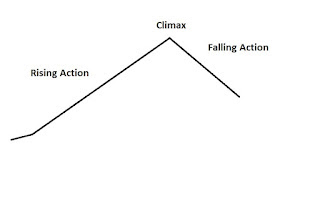
The biggest, most recognizable plot turn of any story, is the climax.

Notice that in basic structure, it visually turns the direction of the plotline. It turns the story from conflict to falling action. 


Luke destroying the Death Star is the biggest turn of Star Wars IV, because it definitively stops the antagonists and saves the "good guys" (at least until the next installment). Luke succeeds in getting the goal, and life as we know it changes for the characters.

But the climax shouldn't be the only turning point in a story. If it is, the story will feel monotonous and repetitious (and likely predictable), because we are on the same pathway from beginning to end.

In reality, each structural unit should almost always have a plot turn. Each act should have a plot turn. Each scene should have a plot turn. The difference is that the plot turn of an act will be smaller than that of the whole narrative arc, and the plot turn of a scene will be smaller than that of an act.

Commonly Act II is split in half.


Luke learning Leia is on the Death Star (after discovering Alderaan is gone and the Millenium Falcon gets pulled in by a tractor beam) is an act-level turning point, because it shifts his goal (in fact, all those things shift his goal and could frankly be dissected in more detail but let's keep it simple) to rescuing Leia, for the next quarter of the story.

And when the gang is in the trash compactor, Luke getting R2D2 to successfully shut down the compactor is the turning point of the scene.

Worth noting is that the term "plot point" commonly references act-level turning points. "Plot Point 1," "Midpoint," and "Plot Point 2" from 7 Point Story Structure are all act-level turning points. Technically though, you could call turns of smaller units a plot point, and the climax certainly is a plot point (the plot point of Act III, as well). It's just useful to know that when you hear the term "plot point" in the writing community, it's likely referring to act-level plot turns.

Every successful story needs regular plot turns. 

In contrast, not every successful story needs plot twists.


What is a Plot Twist?

A good twist will also contain a turn (though technically it can exist without one, it's just usually not very effective that way). A twist will turn on information being revealed, but it's more than that. The information being revealed has to change the audience's interpretation of what they knew or assumed to be true prior to that moment. It "recolors" their understanding of what came previously. It changes the context. The audience looks back at what happened earlier, and now they have a new interpretation of it, a new understanding of what was meant or what was really going on.

For example, in Star Wars V, Darth Vader reveals he is Luke's father. This is a twist, because until that moment, the audience thought Luke's father was dead. That was the context the audience was provided, the lens they had viewed the story through, what they had believed since the beginning. But it wasn't the whole truth. It was missing a piece. That piece is the fact that others were speaking of his death figuratively. Luke's dad didn't literally die, but he figuratively died, because he transformed into Darth Vader.

The twist is even more shocking because the audience had heard how Luke's father was a great Jedi--someone on the light side of the force. Darth Vader is on the dark side. He's the one who supposedly killed Luke's father.

Confused, the viewer's mind races back through earlier parts of the story, and realizes this new interpretation fits--it's been foreshadowed right under his nose. He just misinterpreted it.

He misinterpreted it because he didn't have the whole truth. He also made inaccurate assumptions about the information that was given.


Unlike turns, twists must work off ambiguity (which is not to be confused with vagueness)--there are at least two interpretations for the same moments (but the audience didn't realize there was a second interpretation). It's like this optical illusion. The viewer may only see a vase at first, and if we wanted, we could tweak this picture so it emphasizes the vase more. But in reality, it may truly be a picture of two faces staring at each other. When we point out the faces, it changes the viewer's interpretation of the picture.

That's what a plot twist is.

Which I realize, sounds rather different from a plot turn.

But as I mentioned, a good plot twist will also contain a plot turn. 

Because a good plot twist should carry meaningful consequences that shift the direction of the story. If it doesn't, it's probably just put in for shock value. If you can take out the plot twist, and the plot is the same, it's probably just gratuitous.

Consider Luke learning Darth Vader is his father. How does that alter the pathway of the story? Well, now Luke has to choose whether to join his father or continue fighting him, and each option carries more personal consequences than before. Can Luke kill his own father? Will he become like his father? This revelation has personal ramifications for Luke that will affect the whole trajectory of the next installment. It's what leads to Darth Vader's redemption at the end of the trilogy.

A plot turn should always affect the future of the story.

A plot twist should always affect the audience's understanding of the past.

And a good plot twist will also affect the future of the story, because it will also be a turn.

Of course, there are always variations and exceptions, but this is generally how it works.