Showing posts with label protagonist. Show all posts

Monday, January 26, 2026

What Your Character Likely Fears Most


While I don't consider the protagonist's greatest fear to be positively vital to a good story, knowing it and working with it can certainly improve the story and give it more impact. Perhaps the reason I don't focus too much on fears, is because if you have the proper story pieces in place, your protagonist's greatest fear is likely already in place as well--you just may not realize it. But once you do, you can utilize it to better effect.

So let's dig into how to find your protagonist's (or any character's) greatest fear, according to story theory.

Monday, November 10, 2025

Check: Is Your Character TRULY the Protagonist?


Many writers have a vague understanding of what a protagonist actually is, and the misconceptions in the writing community haven't helped. Learn what truly makes a character a protagonist (and what doesn't).

Recently, I was brave enough to share my dissection and analysis of Twilight 😉🙃, and in it, I pointed out that--regardless of what the internet, readers, fans, or even the author says--Edward, not Bella, is the true protagonist (at least in the first installment). It is Edward who embodies what a protagonist actually is. Bella is the viewpoint character, and an important one, but she is not the protagonist. 

Do I think this was a conscious decision? 

No.

Yet it obviously still worked for a lot of people, regardless.

Most writers, though, are not so lucky.

As an editor, I've worked with a lot of new writers who tell me the protagonist is one character, but it actually isn't.

Because, in the context of the story, that character does not fit the role and definition of a true protagonist. This often makes the plot, and character, weaker.

The problem typically comes from a misunderstanding: The writer thinks that making someone the POV character makes him a "protagonist." But these are not technically the same.


Point of View Character vs. Protagonist

Just because someone is the viewpoint character, the one relaying or narrating the story, the one the audience is following around, does not mean he is automatically the protagonist.

Sherlock Holmes, Jay Gatsby, and Edward Cullen are all protagonists who are not the POV characters. John Watson, Nick Carraway, and Bella Swan are the POV characters; we read the protagonists' stories from their perspectives. It's entirely possible to write a story where these roles are not one and the same.

Almost always, though, we want these roles to be one and the same. This is what is usually most effective. When the protagonist is the viewpoint character, the audience is closest to the most important person--the person who has the most to win or lose, and the person who is the main driver of the plot. This theoretically creates the most impactful story. Everything hits stronger when the audience is in the mind and body of the protagonist.

But of course, there are exceptions. And they are just that, exceptions. 

If the viewpoint character is going to be different than the protagonist, then it needs to be done for a good reason--like the fact that the protagonist is a genius who is difficult to relate to (like Sherlock Holmes), or a vampire who can read minds and, by extension, foresee the future (like Edward). Both of these protagonists' perspectives would be overwhelming to access, and difficult to read, right out of the gate. So instead, the authors gave us people more ordinary, John Watson and Bella Swan.

Or perhaps your POV character offers a special perspective on the protagonist or situation, like Nick Caraway. Or maybe you want or need to create distance from the protagonist because he is an unsavory person. Or because his impact on others is more important than being in his mind.

There are several reasons that may justify making these roles different characters.

But ignorance or laziness usually aren't part of them.


Hero vs. Protagonist

I also want to mention that a hero isn't necessarily a protagonist either. Being heroic doesn't make the character any more of a protagonist than being the viewpoint character does.

Once again, most often, the protagonist will be a hero, a "good guy."

But these are not one and the same.

The word "hero" is Greek, and comes from a root word that means "to protect" or "to serve." A hero is ultimately willing to sacrifice her wants on behalf of what is needed or necessary, on behalf of others. A hero has a positive character arc.

But there are many protagonists who have a negative character arc, who prioritize their own wants over what is needed or necessary, who prioritize themselves over others, when it comes down to it.

Often the word "hero" is used interchangeably with "protagonist" (and I myself am known to do that on occasion, because often they are one and the same).

But technically, the protagonist may be an anti-hero, or even a downright villain.

In Death Note, the protagonist is the villain. And the antagonist is the hero.

So being a protagonist has little to do with morals, ethics, or character arcs either (which is a common misconception).


What is a Protagonist?

The word "protagonist" comes from the Greek word "prōtagōnistḗs," which literally means "first combatant." This is essentially the character who combats the antagonistic forces the most. So he is usually the one who struggles in the story the most, while still exercising meaningful agency (he can't just be a victim).

A true protagonist will be one of the most active characters in the plot, and likely, the most active. He is the one taking action toward the goal.

His agency ultimately matters more than the other characters'--what he chooses to say and do turns the direction of the plot. He makes the story happen. It does not matter if he is a peasant or a king, a professional or a rookie, experienced or naive, within the context of the plot, his decisions are influencing what happens next.

It's Sherlock who is solving the case. It's Edward who is overcoming his vampiric tendencies to be in a relationship.

Similarly, it does not matter that Frodo is a humble Hobbit from a shire--one of the objectively most "powerless" people--and not a king like Aragorn; in the story, it's Frodo's decisions that ultimately affect the plot the most (though Aragorn is probably the second most important).

The protagonist must be assertive enough to make the story happen--whether that motive is innate or brought on by threats (read: the stakes become so significant, the protagonist feels he must do something). 

The protagonist is almost (always) the biggest player in resolving the main conflict. It's Sherlock getting to the bottom of the mystery. It's Edward overcoming his vampiric nature to save Bella from James. It's Luke shooting the Death Star. It's Katniss pulling out the berries. It's Rumi defeating Gwi-Ma with her blade.

And if I were asked to sum up what a protagonist is in one word, it would be "problem-solver."

It does not matter if she is objectively "weak" within her "world," or even if she wants to be the laziest, most passive person on the planet, within the context of the plot, she must be a problem-solver (even if a reluctant one).

Of course, this does not mean she needs to be a genius like Sherlock Holmes.

At the most basic level, what this means is that when she encounters the antagonistic force (a problem), she's coming up with--or perhaps shifting--goals and plans (however big or small, or grand or modest), and taking action to try to make those a reality.

If she's not doing that, she's probably too passive in the plot and not exercising enough agency. The story is happening to her, but she's not doing anything to make the story happen. She's not influencing the direction of the story.

In other words, she's probably not the protagonist.

And she's likely just a viewpoint character.

Yes, there are always exceptions (for example, you may be writing an ensemble story, where there is no real protagonist), but if your "main character" is not fitting these qualifications, then the truth is, she's probably not the protagonist.

And the truth is, that's probably going to be a big problem.

So make sure your character meets these qualifications.


Tuesday, May 14, 2024

12-Step Checklist for Writing Beginnings (Act I)


Beginnings tend to be the most difficult part of a story to get right, at least for many writers. There is so much Act I needs to accomplish--the hook, the introductions, the turns. 

And if your opening doesn't interest readers, they won't stick around for the "good stuff."

Well, recently I was looking for an Act I checklist . . . and I didn't really find what I wanted, so . . . I decided to make my own (and share it with you, of course). 

For most stories, the beginning--or rather, specifically, Act I--makes up the first quarter of the narrative arc. Let's go through what it should contain.

Monday, November 20, 2023

Why the Protagonist Must Be a Problem-solver


In some ways, this post's topic sounds obvious, in others . . . not so much. On the surface, the tip seems simple, and yet, it is easily and often overlooked.

Your protagonist must be a problem-solver.

Yup. 

A problem-solver.

I don't care if she's the laziest, most passive, most dimwitted person on the planet, within the context of the plot, she must be a problem-solver (even if a reluctant one).

Otherwise, she'll feel like a weak character.

Otherwise, the plot will feel weak.

Of course, I'm sure you can find rare exceptions to this.

But 99% of the time, your protagonist needs to be a problem-solver.

So let's talk about why.

Monday, October 23, 2023

The True Purpose of Antagonists


Hear the word "antagonist," and it will likely conjure up images of "bad guys," like Darth Vader, the Joker, or Mother Gothel; and even a simple search online will reveal that "antagonist" is often defined as a person, group, or even specifically, a character.

None of these things are completely accurate, though. An antagonist is not always a "bad guy." In Death Note, the antagonist is actually the true hero. The antagonist also doesn't have to be a person or a group. In The Martian, the antagonist is the Martian landscape.

Truthfully, any well-written story will be loaded with antagonists. Sure, there may be what we think of as the "main" antagonist. But in order to be a good story, there will be lots and lots and lots of antagonists.

The problem is, so many of us have a narrow view of what an antagonist is.

Yeah, it can be a "bad guy," or another character, or a group.

But it can also be a storm, a computer, a rock, a substance, or even one's own sleepiness.

When we broaden our understanding of the antagonist and comprehend its true purpose, we can write better stories.

Because we can write better plots.

And if you've been with me for a while, you may know I consider "antagonist" to be the second element of plot, with "goal" being the first.

At the most basic level, there are just three types of goals (this will be a review for some of you, but it's better to have a review than leave newcomers in the dark).

Monday, May 23, 2022

The 4 Basic Types of Character Arcs (with Examples & Variations)


A character arc is how a character grows or changes through a story. At the most basic level, there are four types of character arcs: change positively, change negatively, remain steadfast positively, or remain steadfast negatively. Any other character arc should be able to--theoretically--fit into one of these four types. This article will go through each, while also giving examples and variations, and talking about common misconceptions.

While I've discussed character arcs on my blog before, including breaking down these four types, I've been missing an article that focuses solely on them to refer readers and clients to, so . . . I figured it was time. 😊  

When you understand the different character arcs, you'll be able to understand your protagonist better and write a stronger story for him or her. You'll also be able to write stronger antagonists and Influence Characters, as well as better side characters. Because character, plot, and theme all interconnect, you'll also be able to write better plots and themes, too.

Monday, December 20, 2021

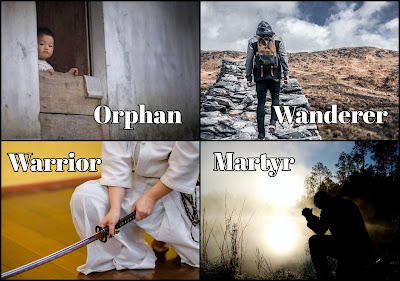
Character States: Orphan, Wanderer, Warrior, Martyr


As the protagonist goes through the journey of the story, she goes through four states of being. I've heard these called "orphan," "wanderer," "warrior," and "martyr." While I've talked about them elsewhere, I've never done a post specifically on them, so thought it was about time I do that. 

Unfortunately, I'm not sure where this concept originates. Someone once told me it's from The Hero's Journey, but I've read Campbell's Hero with a Thousand Faces and Vogler's The Writer's Journey books, and while you can argue The Hero's Journey embodies these, they didn't explain the protagonist's role in this exact way. Someone else told me it may have come from the book, The Hero Within by Carol S. Pearson, but that book was first published in 2013, and I've definitely heard this concept before that. Larry Brooks includes these exact states of being in his book Story Engineering, but I know they predate that volume, at least in some form.

In any case, this approach is another tool to look at the protagonist's role in the journey, and early on in my own writing journey, I found them very helpful. They might be helpful to you too.

Each state of being can be literal, but more often they are figurative. Let's dig in.

Sunday, December 5, 2021

Writing Protagonists Without Strong Wants or Goals


Often in the writing world, we are told to make sure our protagonists have strong wants. After all, the protagonist's want usually leads to a goal, and goals allow audiences to measure progress or setbacks in a story (which also helps with pacing). The protagonist's pursuit of the goal often makes up most of the plot. 

For change-arc protagonists, often what they want will be at odds with what they need. For most flat-arc protagonists, they often want the need, though sometimes they have to deal with a competing want or even lose sight of the need. (For more information on wants and needs, check out "Character's Want vs. Need") But if you aren't familiar with the want vs. need approach, no worries. Suffice it to say that the protagonist's want is almost always a key component of character arc, plot, and even theme.

So, must every protagonist absolutely have a powerful want driving them through the plot? Of course not. All "rules" are really more like guidelines. It's just that if you break that rule, it will likely come at a steep cost, since it influences so many parts.

Because of the nature of story itself, it's nearly impossible to have a protagonist who doesn't want something significant by the end. Pretty much always the protagonist will have a want by the end of Act I. If not then, she will at least have a want or goal by the midpoint, at the latest--but that's often pushing it. Rarely do protagonists make it through a whole story without having a clear significant want, though I won't go so far as to say it's impossible. And in some types of stories, you may be dealing with one significant want per section of the story.

Let's talk about some situations where the protagonist doesn't start with a driving want, goal, or hobby. 

Monday, September 6, 2021

Pinch Point 1: Key Features


I've been thinking more in depth about Pinch Point 1 lately, and have been wanting to expand the basic concept on my blog. The term "pinch point" originates from 7 Point Story Structure. A pinch point relates to the antagonistic force, and it's what you might imagine: It's the equivalent of the protagonist getting pinched by the antagonist. It might be a small pinch or it might be one that leaves a nasty bruise. Whatever the case, it reveals to the audience that the antagonist is a legit force and foe.

Most stories will actually have multiple pinch points, but in 7 Point Story Structure (and its variations), there are two pinch points that are critical: Pinch Point 1 and Pinch Point 2. These are simply beats that show the audience the power of the antagonist. Pinch Point 1 comes about halfway through the first half of the middle--or perhaps better said, about 37% into the story. Pinch Point 2 comes about halfway through the second half of the middle--or perhaps better said, about 63% into the story. But of course, the percentages are just guidelines.

I like and appreciate the concept of pinch points because it puts emphasis on the antagonist. In contrast, some story structures don't acknowledge the existence of pinch points, making it easier for the writer to overlook necessary antagonistic beats. But regardless of what story structure you prefer, every story should have the critical two pinch points--Pinch Point 1 and Pinch Point 2--even if you are "blind" to them.

Let's talk about Pinch Point 1 in more depth. 

Monday, August 2, 2021

The Steadfast, Flat-arc Protagonist in Story: The End


Hello everyone! Today we are finishing our breakdown of story structure, according to the positive steadfast, flat-arc protagonist--protagonists who don't change drastically in their worldviews (and instead usually inspire change in others). 

Here are the previous posts in the series:

Debunking 6 Myths about Steadfast, Flat-arc Characters

Principles of the Steadfast, Flat-arc Protagonist

3 Categories of Steadfast, Flat-arc Characters

The Steadfast, Flat-arc Protagonist in Story: The Beginning

The Steadfast, Flat-arc Protagonist in Story: The Middle 


Just as a recap, there are three categories of positive steadfast protagonists.

1. One that experiences little to no doubt, such as James Barrie in Finding Neverland. (Because they experience no doubt, there isn't much of an internal journey plotline, so another type of plotline will be emphasized in its place--likely the world/society or the Influence Character plotline.)

2. One that doubts applying the truth (his or her accurate worldview) in one of these ways:

- Doesn't know how to actually do what he needs to do (i.e. We all believe no one should go hungry, but how do we actually solve world hunger?), such as Ashitaka in Princess Mononoke.

- Doubts his capabilities. Does he have what it takes to claim victory? Can he survive the costs? This is where Peter Parker is at in the beginning of Spider-man 2.

- Doubts her role or worthiness. Should she be the person taking this journey? This is what happens in Moana

3. One that entertains doubt concerning the truth, the accurate worldview. Could the opposing worldview (the lie, the misbelief, the anti-theme) be the right one? Diana does this in Wonder Woman.


And just to have everything together on the same page for reference, here are the stories we have been dissecting as examples:

Monday, July 26, 2021

The Steadfast, Flat-Arc Protagonist in Story: The Middle


Last week I began breaking down story structure according to positive steadfast, flat-arc protagonists--protagonists who don't much change their primary worldview (this is sometimes referred to as the "truth," which is essentially the story's theme). Here we continue that journey into the middle. 

I hope this is helpful to anyone who has struggled with the flat-arc characters. 

Just as a recap, there are three categories of positive steadfast protagonists.

1. One that experiences little to no doubt, such as James Barrie in Finding Neverland. (Because they experience no doubt, there isn't much of an internal journey plotline, so another type of plotline will be emphasized in its place--likely the world/society or the Influence Character plotline.)

2. One that doubts applying the truth (his or her accurate worldview) in one of these ways:

- Doesn't know how to actually do what he needs to do (i.e. We all believe no one should go hungry, but how do we actually solve world hunger?), such as Ashitaka in Princess Mononoke.

- Doubts his capabilities. Does he have what it takes to claim victory? Can he survive the costs? This is where Peter Parker is at in the beginning of Spider-man 2.

- Doubts her role or worthiness. Should she be the person taking this journey? This is what happens in Moana

3. One that entertains doubt concerning the truth, the accurate worldview. Could the opposing worldview (the lie, the misbelief, the anti-theme) be the right one? Diana does this in Wonder Woman.

These are not all exclusive. For example, a protagonist may doubt her worthiness and begin doubting her accurate worldview (the truth). A protagonist may also be one way for the primary theme, but a different way for a secondary theme. For example, in Finding Neverland, James Barrie never doubts the primary theme (that playfulness empowers us by getting us to believe in something more), but he does express doubt in the secondary theme (that sincere friendship is more important than reputation). 

Again, here are our breakdowns of the stories we're dissecting as examples.

Monday, July 19, 2021

The Steadfast, Flat-Arc Protagonist in Story: The Beginning


A couple of times, I've been asked to explain how positive steadfast, flat-arc protagonists actually work in story structure (or "beat sheets," if you prefer that term). Luckily, as I mentioned in a previous post, the flat-arc protagonist story has pretty much all the same pieces as the change-arc protagonist story--many of them are just reversed. 

This means, that frankly, a lot of the same moments happen, if a little differently.

Writing a steadfast protagonist is like being left-handed in a right-handed world. Same world. Different experience.

Since this can (like a lot of writing concepts) be a little difficult to "see," I'm gonna go ahead and guide you through a positive steadfast protagonist story. 

Well, three in fact.

And even if you never intend to write a flat-arc story, this may still be helpful to some degree, as most stories will feature a flat-arc character, even if they are not the protagonist. (However, I wouldn't recommend getting hung up on trying to make a side flat-arc character hit all the same points as a protagonist one would.)

One of the most obvious differences in structure is that the positive, steadfast, flat-arc protagonist starts on an accurate worldview--sometimes referred to as the "truth." This is almost always, more or less, the primary theme of the story. By the end of the story, this worldview will be proven true, so the protagonist ultimately doesn't flip in his or her beliefs, making him or her "steadfast." (In contrast, a positive change character will start with an inaccurate worldview--the "lie" or "misbelief" or "flaw"--this is basically the "anti-theme"--the opposing argument to the "truth." The positive change character will change to the "truth," the accurate worldview, the true thematic statement at the end.)

However, many stories have more than one theme. Many stories have secondary themes.

Because of this, it's possible for the positive steadfast character to be steadfast in the primary theme, but be a change character in the secondary theme. A steadfast protagonist may or may not be steadfast for every theme. But by definition, they must be steadfast for the primary theme (obviously).

This is why you may see writers argue over whether a particular character has a change or flat arc, and why the same character may get categorized differently--it depends entirely on what thematic thread the person is pulling.

For example, in The Lion King, Simba is ultimately a steadfast protagonist in the primary theme--he believes in the Circle of Life at the beginning, and even though he temporarily loses sight of that, he ultimately holds true to it at the end. However, he's a change character in the secondary theme of responsibility--he starts out believing in irresponsibility but flips into embracing responsibility at the end. Because of this, different people may get in arguments about how he arcs.

Someday I will write a post specifically on secondary themes and secondary arcs. For now, I do want to illustrate how secondary themes and arcs play out for steadfast protagonists, as I feel they can be particularly important in understanding them (Simba's structure being just one example). 

Monday, June 21, 2021

How Character Creates Context


I've been reading Dwight V. Swain's famous book, Techniques of the Selling Writer; published in 1965, it's kind of considered a classic in the writing world, and so far, I've been impressed with how his advice has held up. This book is most famous for Swain's approach to scene structure ("scene" and "sequel"--if you've heard of that) as well as what he calls motivation reaction units (or MRUs). But it covers plenty of other topics as well, one of which is context. 

Now, when I talk about context, I'm not talking about the year a story is written, who it is written by, or the climate of that time. Context in a story is all the information the audience needs to accurately interpret, understand, and assign value to, what is happening. It includes all the grounding and guiding information the audience may need, such as who the characters are or where it takes place, as well as any pertinent worldbuilding information, such as taboos of the time period or the rules of a magic system. This enables the audience to derive meaning from what is happening

When the audience lacks context, the story becomes very vague, which is a problem for several reasons. (See my post on vague vs. ambiguous for further reading.) If there is no context, there is almost no investment in the story, because the audience doesn't have access to the meaning of any of it. If they don't have access to any clear meaning, they are unable to care about what happens. Perhaps the only time where a lack of context works well is when writing teasers (which must always be short strictly because they lack context). An audience will not sit through a lack of context for very long.

Context will usually be supplied through the viewpoint character or narrator (and in most stories, these will be essentially the same, and usually be the protagonist). Whoever is telling the story, will convey the setup of a scene and slide in any important information--such as the laws of a dystopian society or why the Smith family who lives down the street matters. One thing newer writers need to be careful of, is to not make the context into subtext. Context = what the audience needs, to understand what is happening in the text itself. Subtext = additional information that is implied from the text. Context allows us to understand the text, which then allows us access to subtext.

In his book, Swain talks specifically about how character creates context, which is what I'd like to share with everyone today. 

As events unfold in a story, the reader needs to be able to assign value to whether what happened was good or bad. Say that a big rainstorm comes in the story, is that good or bad (or irrelevant)? What about a bombing raid? Good or bad?

As readers, we might bring some of our own experiences and opinions to the text, but in order to properly experience a story, we need to be able to assign value to events in the story. Some of that value will come from the potential consequences (stakes) of the event. But a lot of that value will come from the characters. 

If the character is suffering a drought, then a big rainstorm will be a blessing. If a character has her clothes hanging out to dry, then a big rainstorm will be a curse. 

"A thing matters only insofar as it relates to and affects and is judged by people. . . . We decide how significant a thing is by the way a particular somebody behaves when faced with a specific instance." - Dwight V. Swain. 

Without someone to orient us as to whether something is good or bad, we are just reading about events

Meaning and significance only take real effect when we know about the characters. As an audience, what we have to gain or lose from an event in a story, will be based on what the characters have to gain or lose and who we are rooting for. What the character wants (goal), what the character has to lose (stakes), and how the character feels about events (reaction) help readers assign meaning and interpretation to what happens (plot). Otherwise, it's just stuff happening. (And trust me, I've read passages of "just stuff happening" and it's not very interesting.)

Let's look at an example. Last week I saw the musical Annie. Early in the play, Annie tries and manages to escape from the orphanage . . .

Event: Sneaking out of the orphanage.

Protagonist: Annie

Goal: Escape the orphanage, so she can find her parents

Stakes: If she finds her parents, she can be part of a loving family. If she doesn't find her parents, she'll live the next several years as an orphan under the mean Miss Hannigan (and probably never have a loving family). 

Reaction: Glad (and optimistic) to have escaped and to be looking for her parents

The event itself, "sneaking out of the orphanage," could be interpreted as a good thing or a bad thing. But it's Annie who equips us to properly identify it as a good thing. 

Because Annie is who we care about, and (furthermore) because we know her goal and the stakes tied to it, we view the fact she sneaks out of the orphanage as something successful, as something good. Her reaction strengthens that. Running away from the orphanage is progress

However, in contrast, if Miss Hannigan was the focal character, then the same event would be interpreted as something bad. Miss Hannigan's goal is to keep Annie from leaving. If Annie leaves, Miss Hannigan could get in trouble with the law. Annie sneaking out is a setback.


This is all in general, of course, because like all writing things, there are exceptions. It is possible to deviate the audience's experience from the protagonist's experience. After all, in A Christmas Carol, the audience isn't meant to share Scrooge's views on Christmas in the beginning. The narrator, tone, promises made, and simply our own cultural understandings may provide a context that is the exact opposite of the protagonist's experience. However, one may argue, that in some sense, we are being provided more than one "context" or interpretation of events. Scrooge's and our own. 

Also, if you have multiple viewpoint characters throughout your story, it may be that the protagonist of the story, may not be the "protagonist" of a particular scene. You may have a viewpoint character who acts as the focal character for the scene. 

So this can all get pretty messy, pretty fast. 

But notice in these examples, the audience is essentially being given multiple interpretations of the story's events. This creates ambiguity. Ambiguity happens when something has multiple interpretations. Vagueness happens when something has no clear interpretation. Ambiguity is fine and is often a great tool to use. Vagueness is often problematic, as it makes the text inaccessible to the audience. 

So having multiple entities create context for the audience is okay.  Having no entity create clear context is problematic--because the audience can't care about what happens, if they can't interpret it.

As you work on your writing this week, maybe make sure your scene has these things: 

A clear focal character

with a goal

that has stakes.

An event related to that goal

and the focal character's reaction to that event.

This will help draw your audience in, because they'll have context, which allows them to make meaningful interpretations. 


Monday, June 14, 2021

3 Categories of Steadfast, Flat-arc Characters


Recently, I wrote a couple of articles on the positive steadfast (also known as flat-arc) character. First I did one debunking six myths about them, then I did one on the basic principles of a steadfast, flat-arc protagonist. Today I'm going to talk about the three different categories they fit into, which, as I'll show later, will influence how you write their stories, particularly if they are the protagonists. 

Steadfast/flat-arc characters are characters who don't drastically change their worldviews over the course of the narrative. In contrast, a change character will do largely a 180 flip in worldview from the beginning of the story to the end of the story. For example, in Charlie and the Chocolate Factory (2005), Charlie maintains the same worldview at the beginning and at the end. In contrast, in The Emperor's New Groove, Kuzco does a 180 flip in worldview from the beginning to the end, because of the story. 

Both types of characters will be tested through the obstacles and conflicts of the middle. The difference is that the steadfast character will (ultimately) remain steadfast to their beliefs in spite of the tests, and the change character will transform because of the tests. 

There are positive and negative versions of each type of character. Characters who hold strong or change for the good (or rather, for the accurate worldview--sometimes referred to as the "truth") have positive arcs. While characters who hold strong or change for the worse (or an inaccurate worldview--sometimes called the "lie") have negative arcs. 

I've been asked a couple of times to break down how a steadfast protagonist story is structured differently from (or similarly to) a change protagonist story. This is forthcoming, but in the process, I realized I needed to talk about three categories of flat-arc protagonists, because to some extent, that influences how the story is structured. 

Now, as with most writing things, this is really more of a spectrum than exact categories, but being able to categorize helps us make informed writing decisions. 

In my post, "Principles of the Steadfast, Flat-arc Protagonist," I echoed K. M. Weiland's assertion that doubt is key to creating a meaningful internal journey for the flat-arc character. I pointed out that some steadfast characters doubt very little, while others may be brought to their knees by doubt. But not all doubt is the same, and not all doubts hit with the same force. 

This is why it's helpful to break down the steadfast character further. Below we move from little to no doubt, to the most crippling forms of doubt.

Please note that for my examples, I'm specifically using positive steadfast characters. For negative steadfast characters, you'd simply flip the worldview so that they start and end on the inaccurate one.

I've also chosen to focus on protagonists in particular, but most stories will feature a steadfast character, even if the protagonist has a change arc. Considering the following can still help with writing steadfast side characters. (And if you are writing with a change protagonist, it's likely the Influence Character will be a steadfast one).

Monday, May 3, 2021

Principles of the Steadfast, Flat-arc Protagonist


Last week I debunked six myths about the steadfast (also known as the flat-arc) character. Now, I would like to share some of the basic principles of writing a positive steadfast protagonist. 

Steadfast/flat-arc characters are characters who don't drastically change their worldviews over the course of the story. In contrast, a change character will do largely a 180 flip in worldview from the beginning of the story to the end of the story. 

For example, in Wonder Woman, Diana begins the story with the perspective that we should fight for the world we believe in. At the end of the story, she proves that true by using it to defeat the antagonist (this helps make up the story's theme). But in Frozen, Elsa begins the story with the worldview that one must be closed off to be safe and authentic. Because of the story, she learns that, actually, we must be open to be loved authentically (that might mean we get hurt, but some love is worth the hurt). This enables her to set things right, which proves that perspective true (and helps make up the story's theme).

Both flat-arc characters and change characters have negative versions: a character who remains steadfast to an inaccurate worldview and suffers punishment for it, and a character who changes from a true worldview to an inaccurate one and suffers punishment for it. Negative versions of each type are harder to find, but not nonexistent. 

Almost all protagonists are positive change-arc protagonists. This means that almost all writing resources help writers write positive change-arc protagonists. This also means there are very few resources to help writers write steadfast protagonists.

You often can't apply change-arc advice to steadfast characters. It doesn't work.

Luckily, whichever protagonist type you're writing, each story actually has pretty much the same structural pieces--they're just arranged differently. Some are reversed while others receive more emphasis.

Today I'm going to explain how these pieces are different for a positive steadfast protagonist story, in comparison to the common positive change protagonist story. 

This is a little like being left-handed in a right-handed world. That's it--the steadfast protagonists are the lefties of the storytelling world. 

First, I would like to acknowledge those in the industry who have helped me understand the flat-arc protagonist and therefore influenced this post. If you want to learn more about this protagonist, check out these resources:

K. M. Weiland's Character Arc Series (Katie is amazing and this is honestly the best resource I've found so far on flat-arc characters.)

Character Arcs by Jordan McCollum (This book has a brief section on the flat arc.)

"Character Arcs 102: Flat Arcs" at The Novel Smithy (Lewis succinctly breaks down the flat-arc protagonist's three-act structure.)

Dramatica Theory (I already mentioned last week how Dramatica uses the term "steadfast" instead of "flat arc")

Writing Characters Without Character Arcs by Just Write (Youtube video)

I'll also be doing more posts on this protagonist type in the future.

Monday, April 26, 2021

Debunking 6 Myths about Steadfast, Flat-arc Characters

Steadfast/flat-arc characters are characters who don't drastically change their worldviews over the course of the story. In contrast, a change character will do largely a 180 flip in worldview from the beginning of the story to the end of the story. 

For example, in the fable of the Little Red Hen, the Little Red Hen never changes her worldview about hard work. But in A Christmas Carol, Scrooge completely changes his worldview from the beginning of the story to the end of the story. 

In the writing community, there are a lot of misconceptions of the steadfast/flat-arc character (at least from my experience), which I'm going to talk about, debunk, and clarify today in this article. This information will still be useful to writers who have no interest in writing a steadfast protagonist--because nearly every successful story features a key character who is steadfast.


First, though, we need to visit our familiar pit stop on writing terminology. The most common term for this character is the "flat-arc" character. But it is not the only term. This character has also been called the "steadfast" character, which is what Dramatica Theory calls it. While "flat-arc" is more common, I prefer "steadfast" for a few reasons:

- It conveys that the character must struggle to hold onto something (after all, one is only "steadfast" when there is opposition)

- "Flat-arc" sorta sounds like there isn't really any growth or movement, which isn't exactly accurate.

- For much of my experience in the writing world, protagonists who don't have much of an arc have been frowned upon or treated as "lesser." The term "flat-arc" reminds me of that.

This is completely preference. You may use whichever term you want. Today, I'll be switching between the two.

Now, you can have positive and negative steadfast characters. A positive one will hold onto a true worldview throughout the story, while a negative one will hold onto an inaccurate worldview. For the sake of this article, I will be focusing on the positive one, which is more common, and may do a future article that focuses more on the negative version. 

Now, let's talk about some of the misunderstandings and myths about the positive steadfast character.

Monday, April 5, 2021

Sanderson's Character Scales


Hey everyone, today I'm here to share a perspective on characters that comes from #1 New York Times best-selling author Brandon Sanderson. I love learning from Sanderson because he's prolific, experienced, and successful (Wheel of Time, Mistborn, The Way of Kings . . .). I also love learning from him because he shares concepts and techniques that I have found nowhere else. Lately, one of his concepts has been revisiting my mind--his character scales. 

So in this post, I'm going to explain what they are and how they work, while sharing my own ideas and interpretations along the way. Let's dig in!

Monday, March 15, 2021

Core Principles of Crafting Protagonists (Free Download)


**You can get a free download of Core Principles of Crafting Protagonists when you sign up for my blog via email. **


One of the common problems I see related to character creation is that many writers focus too much on figuring out surface details about their protagonists and don’t know how to add dimension and depth to them. They may fill out lengthy questionnaires with inquiries on everything from “What’s your character’s favorite day of the week?” to “What is your character’s computer password?”

It’s not that these questions can never be helpful. It’s just that, more often than not, they aren’t particularly useful. They lead writers to go overboard brainstorming superficial characteristics rather than taking a deep dive into character

At best, they are fun fluff that make you feel good. At worst, they are clutter that tempt you to take your story the wrong direction, as you struggle to incorporate what is actually irrelevant information.

Perhaps no character is more important than the protagonist. This is the lead of the story. This is the person the audience will most closely identify with, follow, and root for. 

Months ago I put together a ~12k booklet on protagonists, called Core Principles of Crafting ProtagonistsPart of it was a response to this problem, and part of it was because I've always been a character-focused writer at heart. (And I'll be honest--I filled out plenty of those questionnaires as a young writer, and they pretty much never helped me write a great story.)

In this booklet, you will learn about the most important protagonist component for storytelling, how to make your protagonist round and complex, and how to convey his or her personality immediately on the page.

Here are some of the concepts it includes:

- Character Arcs (The 4 Types of Protagonists)

- How Plot and Theme are Directly Influenced by the Protagonist

- Your Protagonist's Ghost

- Understanding Want vs. Need

- Making a Character Complex through (1) Contradictions, (2) Stakes and Boundaries, and (3) Identity

- How to Convey Your Character Quickly on the Page Through Voice

- Dos and Don'ts for Writing Your Character's Voice

- Effective Components to Include When Introducing Your Protagonist

- And more.

I have talked about many of these topics on my blog over the years (and several even recently), but this booklet serves as an introduction to them as well as covers a few concepts I haven't posted about on here. It also might be helpful to have all these topics in one place. 

**You can get a free download of Core Principles of Crafting Protagonists when you sign up for my blog via email. **


Happy writing! 


Monday, January 18, 2021

Giving Your Character a Ghost (or Wound)


Many main characters will have what some in the industry call, a “ghost.” 

The ghost is a past significant (often traumatic) event that shaped the protagonist’s worldview or lifestyle in a thematic way. 

For example, in Disney's Frozen, Elsa accidentally freezing Anna when they are children, is Elsa's ghost--it's what leads her to become closed off and isolated. In the movie, I, Robot, protagonist Del Spooner witnesses a robot save him over a 12-year-old girl. This is Del's ghost--it's what leads him to distrust and hate robots.

The term “ghost,” comes from the idea that the protagonist is being haunted by the event. Others in the industry may refer to this concept as being a wound. In her book Story Genius, literary agent and story consultant Lisa Cron refers to the ghost as “The Origin Scene.” These are all different words for the same concept. 

I prefer the term "ghost" because that's how I was first introduced to it. Despite the fact we often think of a ghost being a person, remember that this ghost is usually an event

The ghost is important because it relates to the protagonist's character arc, and therefore, the theme.

Most protagonists start with a flaw, weakness, or misbelief that they must overcome by the end of the story. 

The ghost is the event (or events) where that flaw, weakness, or misbelief took hold in the first place. 

Monday, January 4, 2021

Getting Passive Protagonists to Act


Many beginning writers struggle with protagonists who are too passive. The plot seems to constantly be happening to him or her, but the protagonist doesn’t take an action to make the plot happen. 

Ideally, when an event happens to a protagonist, the protagonist responds by taking an action that influences the next event, which then influences the protagonist, which then influences an event—and on and on. But that can be easier said than done. Especially if you have a protagonist who prefers to live life passively.

This could all get confusing, though, because in story structure, almost all protagonists will more or less become more proactive. But for the sake of this post, I'm talking about protagonists who are characteristically passive. A protagonist who may want to kick up his feet in a hammock with a glass of lemonade and watch the world deal with its own problems. How do we write a story about that guy?

Many people will tell you that you can't--you must change the character. 

But that is not wholly true. 

It's true in a good story, we need the protagonist to act--especially at key moments--but that doesn't mean he innately yearns to act. 

Often the best solution in dealing with a passive character is to strengthen the stakes. Let me explain.