Showing posts with label The Hobbit. Show all posts

Monday, February 3, 2020

The Hero's Journey Explained: The End


For the last couple of weeks, I've been talking about the Hero's Journey (the beginning and the middle), and today I'm back to talk about the ending of the story structure.


Reward: Seizing the Sword


During The Ordeal, the protagonist faced a trial that pushed them to the brink; they died, perhaps literally or, more often, figuratively (the old them died). Almost always this comes from having to confront some inner demon, a weak characteristic and/or a greatest fear (which plays into the theme). Now that they have faced such a crisis, they will be rewarded for it as they are reborn into something greater.

If they did die, literally, they will somehow come back to life--maybe through CPR, a prayer, or a magical item. If it was figurative, they'll be revived through a sudden realization, new information, a heightened level of determination, or perhaps something else.

The Reward may be something concrete--maybe the protagonist literally seizes a magical sword that will make her a more powerful fighter. But it can also be more abstract, like the personal revelation that brought him "back to life." Typically the Reward is what the protagonist truly came to the Special World for (whether or not she was fully aware of it at the time). In Star Wars, Luke rescues Princess Leia and gets the plans of the Death Star. In The Hobbit, the heroes regain the mountain and get treasure. In The Lion King, Simba finally realizes on a personal level who he is--the son of a king and true heir to the throne--as he gets to speak with his father one last time.

In a lot of stories, the Reward may be multiple things, something concrete and something abstract.

Monday, January 27, 2020

The Hero's Journey Explained: The Middle


In my last post, I started talking about the Hero's Journey, its strengths and weaknesses, and how it differs from other popular story structures. I also broke down the elements of the beginning (Ordinary World, Call to Adventure, Refusal of the Call, and Meeting the Mentor) and decided to again use Spider-verse as one example, to help illustrate how it actually fits multiple story structures. You can see that post here. Today I would like to pick right back up, covering the middle.


Crossing the First Threshold


Armed with whatever magical thing she got from the mentor, the protagonist is now ready for adventure. This is another moment that I think can be a little confusing, so I want to pause and talk about a few things. Like I said last time, the magical thing may be real or figurative. It can be a magical pendant or it can be something like sage advice. The character may be armed with a magical thing without realizing it yet. Or the character might be armed with a magical thing he doesn't like or is reluctant to have.

In Crossing the First Threshold, the time arrives for the hero to officially depart from the Ordinary World and enter the Special World. Remember, the Ordinary World and the Special World are relative. This is the moment Buddy the Elf goes to New York. Or Elle Woods goes to Harvard in Legally Blonde. Or Bilbo leaves Hobbiton behind. Or Harry goes to Diagon Alley. Or Katniss leaves District 12. Or Lucy goes through the Wardrobe in The Lion, the Witch, and the Wardrobe.

But in some stories, the Special World is more a state of the character than an actual place. It might be when a dad dresses up as a nanny to see his kids, like in Mrs. Doubtfire. Or a Chinese girl dressing up to take her father's place in the war, like Mulan--it's a "special world," for the character. And of course, it might have nothing to do with the external. The character might need more personal growth, and the Special World can be him now striving to grow in that direction.

The main idea is that the character is leaving normalcy behind and is now truly entering a new, unfamiliar, or different situation. Some characters may be eager to go, while others may be forced. But the Special World has come, whether they want to embrace it or not.

Monday, January 20, 2020

The Hero's Journey Explained: The Beginning


The Hero's Journey is one of the most popular story structures. Last year, I shared my personal hybrid story structure that I like to use when evaluating narratives (which is pretty comprehensive, I think), and in it, I argued that despite there being various "story structures" to choose from, they are pretty much saying the same thing, in different ways with different approaches--they simply slice and dice story differently.

With that said, it can still be very beneficial to familiarize yourself with all of the major structures, so you can find which one connects best with you, and also, so you can refine and troubleshoot your own manuscript when writing. Have you ever just needed to hear a different perspective to solve a problem? Or needed another perspective to grasp a concept? Learning all the major story structures can help with just that and give you new insights.

So what is the Hero's Journey structure, and how is it different? The Hero's Journey came into the writing world from a famous book titled The Hero with a Thousand Faces by Joseph Campbell, but in reality, the structure is much, much older. Campbell was a mythologist who looked at and studied stories across all cultures and noted what patterns they had in common. This became the Hero's Journey. In the 90s another book titled The Writer's Journey: Mythic Structure for Writers by Christopher Vogler took Campbell's work (which was rather labyrinthine and scholarly I'm told) and made it more accessible and practical for writers today, in part by applying it to contemporary works.

Vogler's updated approach is slightly different than Campbell's, but the patterns are the same.

For this series, I will be using Vogler's version.

Personally, I feel the Hero's Journey approach has both strengths and weaknesses. This structure puts more focus on the protagonist's experiences and growth than perhaps any of the other popular guides, which also means that it's probably better at addressing theme than many others as well. But as a result, I feel it downplays antagonistic forces, which could be problematic to some writers. While the terminology is vivid, bringing to mind mythic moments, I also think it can be misleading, which can lead to confusion. The main thing with the terminology, is that the actual terms are often more specific than what they are defining, which can feel a little backwards to me. The best way to probably deal with that though, is to take them all more metaphorically and less literally.

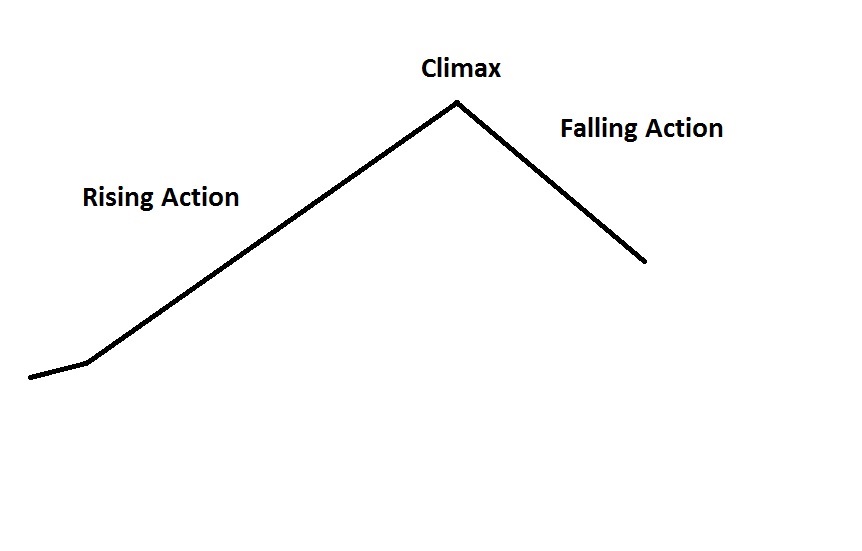
Another difference worth noting is that traditionally the Hero's Journey is in the shape of a circle, not a triangle. The circle emphasizes a typical journey, where you leave home, go somewhere new, and come back having gained more experience. But you could just as easily diagram this as a triangle, really. It's just emphasis and preference.


In reality, you can just as easily translate this structure into a triangle.


Like the other structures, there can of course be variations and some parts may bleed into other parts. That's okay as long as it serves the story.

And one more thing, I'm going to be referencing Into the Spider-verse again (in short (and along with others)). You might be thinking, woah, you must really like that movie! But in reality, I'm using it again to show you how the same story actually fits multiple plot structures, a sign that really, it is all about how you like to slice and dice it. (And I wish I understood that long ago.)

Thursday, March 12, 2015

Birthday Giveaway!!! Harry Potter, Sherlock, The Hobbit, Trigun, FMA

(This giveaway is now closed)

Fun fact: the more birthdays you have, the longer you live.

Today is my birthday! Yay!! I'm older than I've ever been!

To celebrate, I'm doing a pick-your-prize giveaway, where the winner gets to pick an item from one of my favorite stories. These are a few of my favorite things: Harry Potter, Sherlock, The Hobbit (but more than that, Lord of the Rings), Trigun, Fullmetal Alchemist: Brotherhood. I tried to find a cool Hunger Games thing to giveaway, but had no luck.

Here's what the winner gets to pick from:


  • Harry Potter Time Turner Necklace (Need a few extra minutes? No problem!)
  • Trigun Decal (Meyaaaw)
  • A key to 221b Baker Street--who wouldn't want that ;) --key chain, so you can entertain Sherlock when he's bored.
  • (followers' favorite) Fullmetal Alchemist Pocket Watch (become a dog of the military)
  • The Ring from The Hobbit/Lord of the Rings (Renders you invisible. Side effects include fleeing for you life from Ring-wraiths)
  • A Dark Mark temporary tattoo (Become a Death Eater . . . temporarily)
  • One of my favorite writing resources The Emotion Thesaurus. Learn how every mood is expressed physically, internally, mentally, and how it is suppressed, then learn how to write it! (This is an ebook copy, no a physical copy.) (I use this book almost every week.)

Monday, October 21, 2013

Saturday, September 28, 2013

What Else You Need to Know Most About Character Voice


Here's part 2 of my article on character voice. In part 1(you can read it here) I came up with this formula:

What the Character Thinks or Talks about + How She Says it = Voice

And I discussed the first portion of it, using Hobbits from The Lord of the Rings as examples. They often choose to talk about food and rarely talk about battle tactics. Also note, that what your character chooses to say in a given situation often reveals what he's thinking about in that moment. Today I'll explore the next part.

How Your Character Talks


Education, culture, experience, interests, and social circles factor in to how your character delivers his lines. Consider speech patterns and word choice as well. 


Back to my examples of the nutritionist, the fashionista, and the dentist from last time. Their interests influence how they speak. They will have a wider range of vocabulary for dieting, clothes, and teeth. The fashionista, for example, probably wouldn't say, "she's wearing a blue shirt." She'd say, "she's wearing a teal tunic with lace along the hem, Swarovski drop earrings, and she's carrying a patent leather Coach purse in coral."


Listen to how the Hobbits talk:

"It's like the great stories, Mr. Frodo. . .Those were the stories that stayed with you. That meant something, even if you were too small to understand why. But I think I do, Mr. Frodo, I do understand. . . . .Folk in those stories had lots of chances of turning back, only they didn't. They kept going. Because they were holding on to something." --Samwise Gamgee

Notice words like "Mr. Frodo," and "Folk," help establish Sam's voice. Pretend, instead, Gandalf said this. The words and speech patterns would be different. Instead of "lots of chances" he might say "many opportunities." He might pause in different places and use different sentence structures. He's far more educated and experienced than Sam, so he'd say those same thoughts in a different way.


Then think how Gollum would say those thoughts. . . oh, wait, he wouldn't say those thoughts. Gollum doesn't think like that. That's voice too.

Saturday, September 21, 2013

What You Need to Know Most About Character Voice


I'm kind of embarrassed to admit I didn't have much of an understanding of character voice at the beginning of this year. None of my professors in college really talked about it. I think I remember learning the definition in high school and reading it briefly in a few writing tips.

In truth, I've probably heard the fact that "Voice is one of the biggest draws for getting an agent or editor" more than I've actually heard tips on writing voice. Since then, I've gotten to the heart of what voice is. Or so I think. You'll have to judge for yourself. Here's what I found for anyone who might be struggling like I once was, or anyone who wants to learn more.

Sometimes when people think of character voice, they think of first person narration, but really, all characters have a voice of their own, even if they aren't telling the story.

To illustrate, here are three lines from Harry, Ron, and Hermione:

  • "Don't go picking a row with Malfoy, don't forget, he's a prefect now, he could make life difficult for you..."
  • "Can I have a look at Uranus too, Lavender?"
  • "I don't go looking for trouble. Trouble usually finds me."

If you've read the books, I bet you can tell who said what.


Voice is made up of two things: What the character talks (or sometimes thinks) about, and how she says it. In other words:

What the Character Thinks or Talks about + How She Says it = Voice

Wednesday, April 24, 2013

A Trip to Hobbiton, New Zealand

One does not simply post about Hobbiton, which is why I invited someone who has actually been there to share her travel adventures with us. I hope you like pictures. Lots of pictures. And hobbit holes.

Heather Ostler and I have a lot in common: Harry Potter, Lord of the Rings, pugs, ballet, writing, and a love for traveling. She is the author of The Shapeshifter's Secret, which you can find online, in stores, and even at the Barnes and Noble in Hawaii. The cover for the second installment in the series, The Siren's Secret was recently revealed on her blog.

A few months ago she visited Australia and New Zealand. So, of course, she toured Hobbiton:

The Hobbit Movie Set in New Zealand


In the heart of New Zealand's north island you will find rolling, grassy hills, bleating sheep, and small, round, colorful doors. This is Hobbiton.


When Peter Jackson and his crew began looking for a location to film the shire, they flew in a helicopter to get a bird's eye view of the perfect spot. When they found the Alexander family sheep farm, they asked the family to sign a contract without releasing what movie they were filming. The Alexander family said yes, and the nine month construction began for The Lord of The Rings' set.