Showing posts with label writing. Show all posts

Friday, February 6, 2026

Registration Now Open for the Triarchy Method


Hi friends! 

Registration for my live online writing course is now open. 

- Sign-ups are first come, first serve 

- I'm only taking 9 students for the course this year. 

- Classes start June 9th at 7 pm EDT (5 pm MDT) and end on August 27th (all classes are recorded, so if you miss it live, you can watch it later. You can also rewatch the course however many times you want to in coming years)


The Triarchy Method is a developmental writing course that is all about strengthening the "bones" of your story (character, plot, and theme)--and you may have heard me reference it in my posts . . . or seen me share some slides and diagrams from it. Like these . . . 

Monday, April 6, 2020

How a Book is Like a Baby


Story time: When I had been out of high school for less than a year, one of my friends had her first baby. I still remember some of the advice her mom gave her. Something along the lines of, "Everyone wants to put their baby on a schedule, but you know, the baby will let you know when it needs something. The baby will cry when it's hungry, when it is wet, or when it is tired. It will let you know."

Now, I'm still not a parent, and I'm sure life can be more complicated than that (and that people wished their baby's needs were a little clearer), but something about that statement stayed in my nineteen-year-old brain. Maybe part of it was the relief it brought in knowing that any frustration that might come from trying to enforce a set schedule, would be avoided.

For the last couple of months, I've been thinking about how a book is like a baby.

You study and plan and prepare and pick names. You might even envision a whole path your "baby" will take. You might prewrite and outline and organize.

If you are like me, you've done a lot of prepping.

But when it's time to sit down and write a scene, you have to listen to the baby.

Lately one of my mantras has been, "The story will reveal its needs to me."

Just as when preparing to have a real baby, the prior work isn't a waste. You'll likely use nearly all your preliminary material (generally speaking). But when it's time to actually put the thoughts to page, you have to listen for its crying.

It might cry that there isn't enough surface tension.

It might cry that the pacing is too slow.

It might cry for a little extra TLC.

Or maybe that there is a better direction to take.

Even if you've done a lot of prep, to some extent, you need to answer the cries of the baby. If you have enough experience, the manuscript will let you know its needs.

Now, that's not to say there won't be times where the story is crying and you're clueless as to why. Like with babies, you might have to try a few different things to get that to stop.

And if you get it just right, you'll even be able to hear it coo.

So on the one hand, it would be ridiculous to have a baby with no preparation--think about how dangerous that could be!

On the other, when you actually have it in your arms, it won't fit what you envisioned perfectly--you have to listen for its crying.

You have to meet its needs.

And when you do, everyone will be happy.

So, I think a book is like a baby.

And maybe in more ways than one.

***

Turns out that there is a huge sale on TeachersPayTeachers today (April 6th) and tomorrow (April 7th) to help with Covid--all of my resources will be 20% off as well. If you are a teacher, homeschooling, or just like learning stuff, you might want to check it out. My stuff is here, but you can browse the whole site for deals. This last week I added a resource about Imagery and another on basic story structure. Right now I'm working on one about the Hero's Journey. 


Friday, December 4, 2015

How to Write a Good Novel

Just a friendly reminder: Don't forget about my Comic Con giveaway, where you can enter to win one of eight prizes from franchises like The Hunger Games, Harry Potter, Sherlock, Dr. Who and more.

Rebecca asked: I'm writing a fantasy thriller but feel it won't be successful. How do I write a good novel?


First off, at some point or another, pretty much all writers feel like they will be unsuccessful. It's normal. Keep in mind that writers define "success" as different things. One might define success as making as much money as J.K. Rowling. Another writer might consider the fact they had a writing session, period, a success.

The truth is, there are so many parts to writing a novel that I really can't speak to them all (plot, style, character, setting, theme, emotion, brainstorming . . . ). I don't have a magic bullet. But the good news is I can give you some places to start:

Monday, July 13, 2015

Tips for Finding Writing Motivation


walking-with-turtles asked: Do you have any tips or advice for motivating oneself to get back into writing after having fallen out of practice? :3 


Hmmm, one quote I know comes to mind: “People often say that motivation doesn’t last. Well, neither does bathing - that’s why we recommend it daily.” - Zig Ziglar

Thursday, March 12, 2015

Birthday Giveaway!!! Harry Potter, Sherlock, The Hobbit, Trigun, FMA

(This giveaway is now closed)

Fun fact: the more birthdays you have, the longer you live.

Today is my birthday! Yay!! I'm older than I've ever been!

To celebrate, I'm doing a pick-your-prize giveaway, where the winner gets to pick an item from one of my favorite stories. These are a few of my favorite things: Harry Potter, Sherlock, The Hobbit (but more than that, Lord of the Rings), Trigun, Fullmetal Alchemist: Brotherhood. I tried to find a cool Hunger Games thing to giveaway, but had no luck.

Here's what the winner gets to pick from:


  • Harry Potter Time Turner Necklace (Need a few extra minutes? No problem!)
  • Trigun Decal (Meyaaaw)
  • A key to 221b Baker Street--who wouldn't want that ;) --key chain, so you can entertain Sherlock when he's bored.
  • (followers' favorite) Fullmetal Alchemist Pocket Watch (become a dog of the military)
  • The Ring from The Hobbit/Lord of the Rings (Renders you invisible. Side effects include fleeing for you life from Ring-wraiths)
  • A Dark Mark temporary tattoo (Become a Death Eater . . . temporarily)
  • One of my favorite writing resources The Emotion Thesaurus. Learn how every mood is expressed physically, internally, mentally, and how it is suppressed, then learn how to write it! (This is an ebook copy, no a physical copy.) (I use this book almost every week.)

Monday, February 9, 2015

15+ Tactics for Writing Humor

A monster-length master list of over 15 tactics for writing humor, with examples from The Office, Trigun, Diary of a Wimpy Kid, Emperor's New Groove, The Fault in Our Stars, Harry Potter, Pink Panther, The Series of Unfortunate Events, Elf, Enchanted, The Amazing Spider-man, and more. Be prepared to laugh.


Introduction


I've been to a few workshops on writing humor, and I've read about writing humor, but the funny thing is, none of them really taught me how to actually write humor. But yet they all said the same thing: Writing humor is hard, harder than writing seriously, because if you fail at humor, you fail horribly.

I heard it so much, it made me fear failure rather than strive to develop that writing talent. For years I avoided writing humor, period. But the catch to that is that I also often hear how humor is a huge draw for an audience.

I read recently in Showing & Telling by Laurie Alberts that humor is hard to teach and that some writers believe it can't be taught at all. If you know these writers, send them to this post, send them to this post.

People think writing humor can't be taught because they don't know how to teach it. Some people can write humor, but can't teach it. They don't know how they are funny because it's just intuitive and natural to them. I was at one workshop on humor, and the only "how-to" tip they gave was that humor had to just come up naturally in the story. But professional comedians slave away and work their butts off writing their jokes, and then practicing them. That's not natural. Sure, some comedians do improv (Whose Line is it Anyway? was one of my favorite shows), so they're more natural, but I believe most comedians have to work to be funny.


Friday, October 17, 2014

NaNoWriMo Giveaway, Win 12 Writing Books

This giveaway is now closed.

image

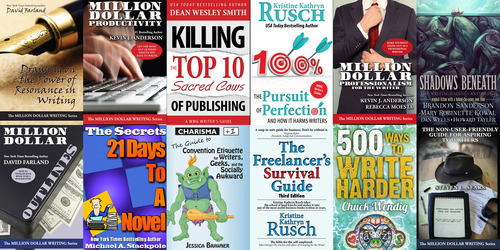
Hey guys, StoryBundle has a great bundle out for NaNoWriMo next month. If you aren't familiar with StoryBundle, they let you get six books from professionals and established writers for a minimum of $5 or 12 books for a minimum of $15 (you get to pick how much you want to pay). Some of the money is donated to charity.

The 12 books pictured above are all books about writing, from authors like the Writing Excuses Crew, Kevin J. Anderson, David Farland, Kristine Kathryn Rusch, and others.

I happen to have some of these bundles to giveaway. To enter for a chance to win, like or share this Facebook post, like or reblog this Tumblr post, and watch my Twitter for a giveaway tweet. I have 5+ bundles to giveaway, so you have a good chance to win. In fact, the first person to comment on this blog post will win one too.

Alternatively, you can just purchase your own bundle over at StoryBundle.com/nano. They are awesome! Go support them. Thanks to them for the giveaways.

Monday, October 13, 2014

Showing & Telling by Laurie Alberts (AKA I'm Gonna Tell You When, How, and Why to do Each)

Recently I finished a how-to writing book titled Showing and Telling by Laurie Alberts. Personally, I needed this book. I heard the adage "Show, don't Tell" so much in college that I felt guilty and crummy every time I Told something in my fiction. Yes, in college I was taught it was okay to Show eighty percent of the time and to Tell twenty percent of the time, but I still developed some sort of Telling complex.


So I read Showing and Telling to help me get over that. I'm still not cured, but I'm making headway. In this book, Laurie Alberts not only explains the basics of Showing and Telling, but goes through all the different types and when and how to use them effectively. The book is divided into three sections: scene, summary, combining scene and summary. 

In the first section, which is all about Showing, Laurie Alberts talks about the different types of scenes that exist, their structures, and Showing pitfalls, and tools you can use for an effective scene. 

In the second section, which is all about Telling, she goes over all the different purposes and types of summaries in creative writing, such as to provide background information (and she talks about how one background summary is more effective than another), to compress time, to explain actions that happen in general time, to alert the reader to repeated actions, to offer insight and reflection, to provide characterization, and the list goes on. How is one summary better than another? Laurie Alberts will tell you. She explains how to make your summaries so vivid that they feel like scenes.

Monday, September 15, 2014

Are You a Passive or Active Audience Member?

You'll have to thank my brother for my blog post today, because he pointed out to me that there are two different ways to watch a movie or t.v. show (or, I'll add, read a book)--actively or passively. And honestly, I think a lot of people are passive.

Since movies, t.v. shows, books, and games tend to be something people wind down to or a means to cope with stress, we sit back and relax and simply let those mediums entertain us. We're being spoon-fed a story. We're letting the story take us on it's little ride. We might miss some minor details of the plot, setting, or characterization, but we get most of the story. Being a passive audience takes no effort.


A passive audience member isn't necessarily bad, but an active one is better, particularly for writers. Active audience members are constantly consciously putting themselves in the story. They are participating in it, actively looking for the fine details, that little snippet of dialogue that implies why a character is a certain way, exactly why that fighting maneuver worked or didn't. They will come up with questions and actively listen or watch or read for the answers. They will make fine-tuned predictions and have little questions about the characters' world. They will find the minuscule plot holes, not just the blaring ones. They will pick up on the gestures a character makes and what they mean.

Monday, August 18, 2014

Empty Threats

Sometimes when I'm reading a novel or watching a show, the writer throws an empty threat into it. In a novel I was recently reading, a love triangle develops, but I knew from day one that the protagonist was going to stay with her first love. Yet, the author dragged me about this awkward love triangle for the majority of the book. It was still interesting, but it lacked stakes, it lacked intensity because I knew nothing big would come out of it.

The story might have been better if the author actually threatened with something I believed could happen. Often empty threats in a story mean missed opportunities to write something that really digs into the reader's emotions.

It's like parenting kids. If you don't follow through with your threats, then the kid stops believing in them. The threats have no effect. But if you follow through with those threats, they work.

In writing, it's not required to follow through with all of your threats. But don't be afraid to follow through with a lot of them. Then readers know you're not afraid to do so, and they really don't know how the story is going to play out. The stakes are real. Will Joseph die? Will Kristin choose Jack over Stephen? Even if Joseph doesn't die, the threat doesn't feel empty, because the readers know you're not afraid to kill him.

But if you keep threatening to kill people, and you never do, then it can lose its effect.

Friday, August 15, 2014

Level-up Your Writing with Epic (Literally) Music


I did not know that "Epic" was, in actuality, a real genre of music, until I ran into a playlist of it on youtube. And oh-my-gosh it makes everything epic! Listen to it and your motivation to write will increase 50%. Your concentration when you write will increase 50%. (Do I even need to add it's super effective?)

I haven't been interested in doing a post on writing to music, because it's been done so many times. And frankly, unless it's J.K. Rowling, I don't really care what people are listening to when they write. I care about what I listen to, and I'm assuming most people are the same way. But this stuff--I had to share it, because it really made that big of an impact on me. And I've made a playlist of my favorites for other writers to listen to.

First off, some of you might be wondering what epic music is. You know all those awesome movie trailers where there is crazy cool music playing? And it gets you all pumped or all sentimental for the movie? That is epic music. The music used on trailers is not even from the movies' soundtracks. It's made by companies who specialize in making trailer scores. That's what they do.

Go here and start this playlist to hear some while you read the rest of this post.

Monday, August 11, 2014

How to Get a Job in the Writing World


How do you get a job in the writing world? Either working for best-selling authors like yourself, or having your book published or anything relative to the writing career path? (Name withheld)


The writing world can be so versatile that it really depends on your goals. I hate to say this, but networking can be a big help. I got my job, in part, because I knew my boss’s wife and kids. Today, you don’t even have to network in person. You can meet people in the writing field online. Look for internship opportunities. I did three internships in college and not only did they look good on a resume, they gave me skills I would later use in my job today. If you can afford it, don’t be afraid of doing cheap labor—it can lead to better jobs later.


While you don't need an English degree for most writing jobs, pursuing one will not only make you a better writer and a more respected professional, but can open doors to career-related opportunities and experiences. If you do pursue a degree, it's helpful that you have a career plan in mind. Because an English degree can be so versatile, a lot of people graduate and then don't know what to do with it.

Monday, July 28, 2014

Editing with the Elrics: Sacrificing What You Want Most


So I've been discussing some lessons I learned from Fullmetal Alchemist Brotherhood. Here is another plotting tool/technique/method that hit me right in the gut--if done right, it can be really powerful emotionally for your audience. But this post does contain a spoiler, so if you plan on actually watching or reading Fullmetal Alchemist Brotherhood, you'll want to finish it before you read this.

Alright, so I mentioned last Monday that one of the main characters, Alphonse, doesn't have a body. The laws of alchemy require equivalent exchange--you give something to gain something. One of the things Al gave up accidentally during an alchemical transaction was his own body. Ed is missing an arm and a leg. The protagonists' goals for the whole story is to get their bodies back to normal. It's a quest they've been on for years. It's a quest we go on with them for over 60 episodes. They scour the field of alchemy to find a way to do it.

Monday, April 28, 2014

Freehanding the Perfect Circle


In one of my art classes, I was told that Michelangelo was such a good artist, he could freehand a perfect circle. I haven't checked sources on this, but I told this to my nine-year-old nephew one day. His response? "I can do that. That's easy."

"Remember," I said, "just because something is simple and you understand how to do it, doesn't make it easy."

My nephew pulled out some paper and a pencil and got to work. One thing I want to say. . .generally speaking, he's not a very patient person. He likes to get stuff done as fast as possible. So I knew this would be interesting.

He drew circle after circle after circle (rather quickly considering it needed to be perfect.) After about 15 minutes, he said, "I can't do it."

Just because something is simple and you understand how to do it, doesn't make it easy.

Earlier I talked about your writing eye, and how it should, hopefully, be ahead of your abilities. Understanding and knowing how to do something is the first step, but it can take lots of practice to do it right. I think sometimes we forget about this with writing. I know several people who have an amazing eye for writing, but then I read their work and was surprised to see that they couldn't yet follow their own advice. They're still learning. And we should all still be learning.

Their insights reveal their potential for where they can be.

Monday, April 14, 2014

Your Writing Eye


If you want to be great at writing, you have to do more than just write. You have to develop an "eye" for it. If you aren't developing an eye for it, you're not progressing very far. You can't become a better storyteller if you can't see how to. Right?

Your writing eye should always be ahead of your writing abilities. Read that sentence again: Your writing eye should always be ahead of your writing abilities. Why? Because that's how you learn and grow as a writer! If your eye is always ahead of your abilities, you always have something to strive for. If it's not, you can't improve your storytelling abilities.

Whether you're a beginning writer or a seasoned one, there is always more to learn.

Here are three ways to strengthen your eye for writing.

Friday, March 28, 2014

Tips on Starting a Story

Anonymous asked: Do you have any tips on starting a story? Haha, sorry, I'm new at this thing .-.


Don’t be sorry. Many writers feel the starting of the story is the hardest part to get right—and with good reason!

Luckily, you’ve come to the right place. I’ve read literally thousands of story beginnings, reading through slush piles.

First off, there are basically two methods of writing: “Pantsing” and “Plotting.” Some writers like to just start writing a story without an outline or anything, and they just discover their plot and characters as they go. People who do this are called “discovery writers,” or informally, “pantsers.” Other writers like to have a solid outline before they start a novel. They may even plan out the dialogue and action for a scene before they write it. These are “plotters,” or “planners.” A lot of writers use a hybrid method of both.

Monday, December 23, 2013

2013 Resources for Writers

Last week I posted about the best books I found this year. Today, I'm listing all of the valuable resources I've found for writers, including a site where you can create your own audiobooks, references for writing tips, and a word processing plugin that will actually teach you to write better.

(Sidenote: Thanks for participating in our giveaway! You can see the winners here!)

References for Writers

ACX.com

If you hold the rights, you can go to ACX.com and turn your book into an audiobook. You can either read the book yourself, or hire an actor. Here's how it works for the latter:
1. You upload an excerpt of your book
2. Actors audition for it.
3. Judging from the auditions, you pick who you want to read it.
4. Once it's all recorded, you're set to sell it. ACX can get it up on major retail sites.

Watch this (fun) video about the process.


Check it out for yourself at ACX.com

The Emotion Thesaurus


One of the biggest problem areas for writers is conveying a character's emotions to the reader in a unique, compelling way. This book comes to the rescue by exploring seventy-five emotions and listing the possible body language cues, thoughts, and visceral responses for each.

Using its easy-to-navigate list format, readers can draw inspiration from character cues that range in intensity to match any emotional moment, including situations where a character is trying to hide their feelings from others. The Emotion Thesaurus also tackles common emotion-related writing problems and provides methods to overcome them.

This writing tool encourages writers to show, not tell emotion and is a creative brainstorming resource for any fiction project.


Monday, November 11, 2013

Writing as a Lifestyle


When you decide to take writing seriously, you're making a lifestyle choice as much as you are making a career choice. As a writer, you may have to change up your living conditions. If you haven't made any sells yet, that might mean stretching your $20 or leaving your work only to come home and work some more. It might mean staying up late to get a chapter in or waking up early to fit in an hour of editing before your day job. Frankly, you'll probably have to cut back on time with friends and family and hobbies, because to be a great writer, you have to not only write, but read, and study, and it helps to network and have an online presence as well.

I've been living a writing lifestyle for over a year and a half now. This post will cober some things I've learned that have helped me be most productive. It seemed fitting for National Novel Writing Month.

Embracing the Writing Life

Finding (Making) Time


The most important thing about being a writer is to write! This is your priority. This means you need to put in the time and effort. Talking or daydreaming about it, or staring at the keyboard isn't enough. If you're a parent or work at another job, like I mentioned above, this might mean fitting time in at night or in the early morning, or during nap time. 

If you have a more flexible schedule, try finding out what time of the day you write best, and schedule your life around it. I've heard that most writers work best right before or after sleeping, because that's usually when the creative side of the brain is active. It's true for me. So I wake up extra early and get in some writing before I go to work. If I have trouble getting back into my story in the afternoon, I take a power nap, and magically, writing becomes easier.  I was a little skeptical of this idea before, but now I know how it really can play a role in my productivity.

Getting the Most out of Your Writing Session


You've made the time, now, make the most out of your time.

Monday, October 14, 2013

Calculating How Long Your Novel will take to Write


* You can listen to this post on Youtube


First, I would like to say, no, this post does not give you a mathematical equation to literally figure out how many hours, days, months, years, whatever, that it will take you write your novel. Obviously there are a lot of factors that depend on you personally as a writer.

But what this post does give you is a questionnaire that helps you determine how complex your novel is, which will then, hopefully, help you gauge what kind of effort and energy you will need to complete your story.

While some authors write faster than others, some stories, frankly, take longer to write than others.

And it doesn’t just depend on the length of your manuscript. Some stories have simpler structures, others more complex.  Here are some questions you can ask yourself when plotting your novel to help you gauge how long it will take to write it.

Keep track of your answers. They run from simple to complex, with the letter “A” being simple and onward, more complex. Remember, the more complex doesn’t mean the better your story is. Simple stories can be powerful too.

(Note that I created this myself, so if you have any ideas for improvement, please let me know. This was the best I could get it at this moment.)


How large is your cast of characters?

A. Small cast of characters
B. Medium cast of characters
C. Large cast of characters


How many different settings are in your story?

A. Story takes place in mostly one area. (For example, the character never leaves the farm.)
B. Story takes place over a lot of different areas I’m familiar with
C. Story takes place in another time or place that I will need to research extensively
D. Story takes place in another time and place I will need to research extensively
or
Story takes place on a completely different world I need to create from scratch


Monday, October 7, 2013

Actions Vs. Words: the Loud and the Quiet


You might have an idea of what this post will be about based on the title. "Actions speak louder than words," right? Some people are "all talk and no action," blah blah blah--most of us have heard all those sayings before. True, all of those cliches are techniques you can incorporate in your writing, specifically in your characters. But this post is taking the whole actions vs. words in a different direction, one you probably haven't heard or thought about before. I hadn't until recently.

Last week I was watching a t.v. show where the lead female character spends most of her time yelling, complaining, and bossing others around. She's basically the only female character in the whole show. And she's loud, self-centered, and annoying. She talks a lot.

What is with this girl? I wondered. Is this how the writers view women? 

Then, I think, on a subconscious level, I remembered that saying, "actions speak louder than words." So I started watching what she did. I soon realized I had misjudged her. She's the most intelligent character on the show. She talks a lot about herself, but she's actually not self-centered; she often volunteers to help others out. She lets strangers stay at her home when they have nowhere else to go. She's decisive and independent. Without her talents and abilities, the show wouldn't even exist.

She doesn't boast about her good qualities. They're subtle. They're quiet. You'll miss them if you aren't looking for them. She's a better person than she appears to be.

Because her shortcomings are so loud, I couldn't see passed them to her strengths.