Like many writing terms, "voice" can be a little ambiguous, mainly because it happens at three levels: the writer's voice, the narrator's voice, and the character's voice. And like many writing subjects, voice can seem elusive when you are learning. Often we know it when we see it, but what is it?
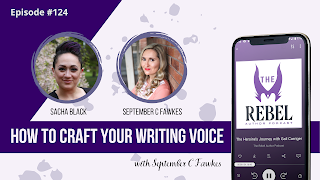
I've written posts on character voice before: "What You Need to Know Most About Character Voice," "Dos and Don'ts for Writing Your Viewpoint Character's Voice." But I've never really talked about the author's voice. Probably because it's not so much something you learn as something you already have and develop. And for the narrator's voice, well, in most stories, it's often very similar to the writer's or the character's voice. It can all get pretty tricky pretty fast. Recently, I was on The Rebel Author Podcast as a guest to talk about character voice, and when preparing, I spent some time thinking about the other two types. So in this post, I'd like to define and talk about each.
While voice may feel elusive and ambiguous, it's one of the most effective ways to give audiences a powerful impression of who you, your narrator, and/or your character are. Multiple times I have heard agents and editors talk about how voice is one of the first things to grab them. It's also one of the first things that can grab a reader.
So what is it exactly? And how do we put it to work?
What is Voice?
In the recent podcast, the host, Sacha Black mentioned a few times how voice is simply that person's personality, and that's a great way to say it. And for years when talking about character voice, I have used this equation:
What the Character Thinks or Talks about + How He Says It = Voice
But in prepping for the podcast, I realized . . .
. . . this works at the other levels as well.
What the Writer Thinks or Talks about + How She Says It = Author Voice
&
What the Narrator Thinks or Talks about + How He Says It = Narrator Voice
So really, one might simply sum it up like this:
What a Person Thinks or Talks about + How She Says It = Voice
Look at the two ingredients of voice. One is about content and the other is about how it's communicated. Voice is made up of both, not just the content and not just the way it's communicated.
Together, this is how the writer's, narrator's, and/or character's personality gets on the page.*
*Okay, it also sometimes includes what's not said, and the way it's not. Sometimes avoiding talking about a topic, or perhaps tactfully steering away from a topic can show as much personality as what is in the text. It just shows up as subtext, which also makes a story powerful.
How the Writer's Voice, Narrator's Voice, and Character's Voice Work Together
Every book has characters, a narrator, and a writer. So how the heck do these work together, and how do we utilize and get them on the page all simultaneously?
Glad you asked.
See, it's sort of like a Russian nesting doll. (I know I've used that as a comparison for story structure, but it works well with voice too.)
The biggest doll is the author's voice--because every story the writer writes helps make up that voice.
Inside of that is the narrator's voice--this is the voice of the narrator of a particular story. Now, you may have multiple books that have the same narrator, but the narrator's voice is not the exact same as the author's voice.
Inside of that is the character's voice--and you may even break this down further, into the viewpoint character's voice and then into any nonviewpoint characters' voices (which is often coming through the viewpoint character's perspective, obviously). . . . Or not, it just depends how you want to slice and dice it.
So, when you look at this, you realize, to some degree, they all overlap, though to some extent, they are individual pieces.
Now, in some stories, each piece may be more distinct than in other stories. Let's look at some examples.
A Series of Unfortunate Events is narrated by Lemony Snicket, but he has also narrated other books such as Poison for Breakfast and All the Wrong Questions, and while "he" is listed as the "author," he's not. Daniel Handler is the real author and has written several other books. Lemony Snicket is just a narrative personality he puts on--it's part of Daniel Handler, but it's just a narrator. Inside of Lemony Snicket's stories, the characters have their own voices, and we may even follow specific viewpoints, but it comes through Lemony Snicket's narration, which comes through Daniel Handler. Author, narrator, and characters all have distinct voices.
Sometimes the narrator and the viewpoint character are more one in the same. In the Percy Jackson series, Percy Jackson is the viewpoint character and the narrator, but he's not the author--Rick Riordan is.
In The Adventures of Tom Sawyer, the narrator isn't Tom. In The Adventures of Huckleberry Finn, Huckleberry Finn is the narrator. But both are told through Mark Twain, and make up his author voice.
In a memoir, one may argue they are all more aligned. The viewpoint character is the narrator who is also the author. However, it is possible the story is narrated by an older version of the viewpoint character, and that will affect the way the story is told. Furthermore, the author's voice may be made up of more than only the memoir.
And if we get deeper into viewpoint and POV penetration, well, it's enough to make anyone's head spin. No need to do that today for this post.
Suffice it to say that the characters, viewpoint character, narrator, and author all have their own voices--it's possible for them to be obviously distinct or more closely aligned. There are, in some sense, three voices, but they all come from the author.
Let's talk a little about each.
The Writer's Voice
You are a unique person. You have unique experiences, a unique personality, a unique worldview, a unique belief system. There are particular types of stories (or genres) you like to write--whether that's wide-ranging or narrow. There are particular tropes you are drawn to and perhaps types of people or places you like to write about. There are types of themes you like to visit. Maybe you enjoy writing protagonists that have positive change arcs.
There are also particular types of stories (or genres) you don't want to write--whether that's wide-ranging or narrow. There are particular tropes you turn away from. There are certain types of people you'd rather not write about or types of places you have no interest in. There are themes you don't wish to touch and arguments you don't believe in. Maybe you dislike writing negative steadfast arcs for protagonists.
All of these things help make up your voice as a writer.
But it's more than that.
There is a breadth and limit to your lexicon. There are sentence structures you like using more than others. Maybe you like using lengthier, more poetic and meaningful descriptions. Or maybe you prefer simple and straight-to-the-point descriptions. Maybe you are prone to choosing metaphors that come from nature. Or maybe you only ever tell stories in first person. Or maybe you prefer having protagonists who are female. Maybe you like to always add at least a little romance to it. Maybe you use dashes more than most writers.
There are also things you may never write. Perhaps because you dislike profanity, you'll avoid using the f-word. Instead of having sex scenes, you always "fade to black." You almost never write long descriptions. You'll probably never tell a story in omniscient viewpoint. You'll never use a semicolon--you hate them.
How you tend to tell stories also makes up your author voice.
If we pick up a book by Mark Twain, we know what kind of places and people and themes and plots and language to generally expect. Same goes for Jane Austen. Same goes for Rick Riordan. William Faulkner. Dan Brown. C.S. Lewis.
Sure, some may have a wider range than others, but they still have their limits. Jane Austen wouldn't write a Dan Brown book.
In the near future, I'll do a post specifically on the author's voice, with techniques to help you understand yours. For now, let's continue.
The Narrator's Voice
The narrator's voice exists within the author's voice, but it's not exactly the same thing. I may choose to use an essentially invisible omniscient narrator for an adult general fiction book, and then I may choose to use a narrator that breaks the fourth wall in limited third person for a YA romance book. The narrators may sound very different, but they both come from my author voice.
Why?
Because even with different narrators, I'm still the same person. I may still write about similar characters and places with similar themes, and I will still favor certain tropes. I will still add a dash of mystery, even if it's just for a minor subplot. I will still choose not to use the f-word, and I will still choose not to write graphic, violent scenes.
However, the narrators are different in the simple example that one will break the fourth wall and the other won't. And one can know the thoughts of all the characters simultaneously, and the other can't.
Whether it's The Adventures of Tom Sawyer or The Adventures of Huckleberry Finn, the writing still rings of Mark Twain. But they have completely different narrators.
Often these days, the viewpoint character is the narrator, just as Huck Finn is the narrator of his own story. (But he's not Mark Twain.)
Just as any author's voice may take on and move into their narrator's voice, the narrator may actually take on and move into the character's voice. So Daniel Handler(author) takes on the voice of Lemony Snicket(narrator). Markus Zusak(author) takes on the voice of Death(narrator) in The Book Thief. But also, the narrator of Harry Potter will take on Harry's voice--but the story isn't exclusively narrated by Harry. There are scenes where Harry isn't present. An omniscient narrator may possibly dip in and out of a character's voice as he dips in and out of their minds.
Each level can take on the levels below it, but not necessarily the other way around. Tom Sawyer can't put on the voice of the narrator nor the voice of Mark Twain. The only way you can get away with something like this, is if you are doing something unusual, like say having a viewpoint character who breaks the fourth wall and mimics the narrator or author, but that's a highly specific situation.
The Character's Voice
Just as with the other levels, the character also has his or her own perspectives and personality. They have their own culture, identity, dominating emotions, things they like and dislike talking about. They may use slang or get easily distracted or try to sound smarter than they are. The list goes on. Again, they may also be the narrator of the story.
But they still exist within the author's voice.
Why?
Because they themselves and how they show up on the page comes out of the author.
For example, maybe I don't like using profanity. But I have a character who uses coarse language. Since the rest of my story doesn't use profanity, it doesn't take much to get the character's language across. I may only need to throw in one or two swears or naughty phrases, and the point is made. Or alternatively, instead of writing exactly what the character says, I may summarize with something like: "Alfred shared a joke about Jacob's mom." Or, "Alfred swore at the top of his lungs."
But . . . this could also just be the narrator.
For example, maybe I don't have any problems with profanity, but I'm writing a chapter book for kids. While I might write cusses like sailors in a book for adults, I may choose to narrate the chapter book differently, and I may choose that no character has coarse language.
Harry's voice isn't the exact same as the narrator's voice and neither are the exact same as the author's voice. But the first two are components of the author's voice.
Sometimes the differences aren't obvious at first glance. Both The Hunger Games and The Ballad of Songbirds and Snakes have similar narrative voices, which speak to Suzanne Collins's author voice. Even though they both have more straightforward prose and tell their stories in similar ways, each viewpoint character has a different voice simply because the content of what they think is different. Katniss's thoughts aren't Coriolanus's thoughts. Neither work is particularly "voicey" on the page, but each character still has a unique voice because their experiences and worldviews are unique, because they are unique. Because they are unique, they don't speak in the exact same way.
Character voice also exists beyond the viewpoint character. Pretty much every character should have his or her own unique voice, because every character has a unique personality. What they choose to talk about and how they communicate that makes up their unique voice.
Again, for more on character voice (and I guess, to some extent, voice in general) check out: "What You Need to Know Most About Character Voice," "Dos and Don'ts for Writing Your Viewpoint Character's Voice." You can also check out the podcast episode at these links:
Blog Link: https://sachablack.co.uk/2022/02/09/124-how-to-craft-your-writing-voice-with-september-c-fawkes/
YouTube Link: https://youtu.be/WgivPeRR6nQ
Podcast General Link: pod.link/rebelauthor
See you in a future post as we talk more about author voice.