Showing posts with label NaNoWriMo. Show all posts

Friday, October 17, 2014

NaNoWriMo Giveaway, Win 12 Writing Books

This giveaway is now closed.
image

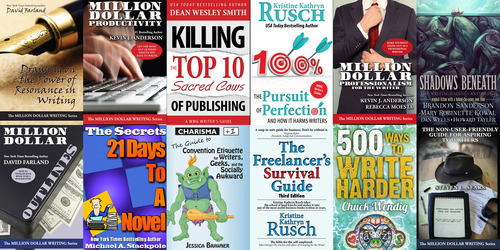
Hey guys, StoryBundle has a great bundle out for NaNoWriMo next month. If you aren't familiar with StoryBundle, they let you get six books from professionals and established writers for a minimum of $5 or 12 books for a minimum of $15 (you get to pick how much you want to pay). Some of the money is donated to charity.

The 12 books pictured above are all books about writing, from authors like the Writing Excuses Crew, Kevin J. Anderson, David Farland, Kristine Kathryn Rusch, and others.

I happen to have some of these bundles to giveaway. To enter for a chance to win, like or share this Facebook post, like or reblog this Tumblr post, and watch my Twitter for a giveaway tweet. I have 5+ bundles to giveaway, so you have a good chance to win. In fact, the first person to comment on this blog post will win one too.

Alternatively, you can just purchase your own bundle over at StoryBundle.com/nano. They are awesome! Go support them. Thanks to them for the giveaways.

Monday, November 11, 2013

Writing as a Lifestyle


When you decide to take writing seriously, you're making a lifestyle choice as much as you are making a career choice. As a writer, you may have to change up your living conditions. If you haven't made any sells yet, that might mean stretching your $20 or leaving your work only to come home and work some more. It might mean staying up late to get a chapter in or waking up early to fit in an hour of editing before your day job. Frankly, you'll probably have to cut back on time with friends and family and hobbies, because to be a great writer, you have to not only write, but read, and study, and it helps to network and have an online presence as well.

I've been living a writing lifestyle for over a year and a half now. This post will cober some things I've learned that have helped me be most productive. It seemed fitting for National Novel Writing Month.

Embracing the Writing Life

Finding (Making) Time


The most important thing about being a writer is to write! This is your priority. This means you need to put in the time and effort. Talking or daydreaming about it, or staring at the keyboard isn't enough. If you're a parent or work at another job, like I mentioned above, this might mean fitting time in at night or in the early morning, or during nap time. 

If you have a more flexible schedule, try finding out what time of the day you write best, and schedule your life around it. I've heard that most writers work best right before or after sleeping, because that's usually when the creative side of the brain is active. It's true for me. So I wake up extra early and get in some writing before I go to work. If I have trouble getting back into my story in the afternoon, I take a power nap, and magically, writing becomes easier.  I was a little skeptical of this idea before, but now I know how it really can play a role in my productivity.

Getting the Most out of Your Writing Session


You've made the time, now, make the most out of your time.

Monday, October 14, 2013

Calculating How Long Your Novel will take to Write


* You can listen to this post on Youtube


First, I would like to say, no, this post does not give you a mathematical equation to literally figure out how many hours, days, months, years, whatever, that it will take you write your novel. Obviously there are a lot of factors that depend on you personally as a writer.

But what this post does give you is a questionnaire that helps you determine how complex your novel is, which will then, hopefully, help you gauge what kind of effort and energy you will need to complete your story.

While some authors write faster than others, some stories, frankly, take longer to write than others.

And it doesn’t just depend on the length of your manuscript. Some stories have simpler structures, others more complex.  Here are some questions you can ask yourself when plotting your novel to help you gauge how long it will take to write it.

Keep track of your answers. They run from simple to complex, with the letter “A” being simple and onward, more complex. Remember, the more complex doesn’t mean the better your story is. Simple stories can be powerful too.

(Note that I created this myself, so if you have any ideas for improvement, please let me know. This was the best I could get it at this moment.)


How large is your cast of characters?

A. Small cast of characters
B. Medium cast of characters
C. Large cast of characters


How many different settings are in your story?

A. Story takes place in mostly one area. (For example, the character never leaves the farm.)
B. Story takes place over a lot of different areas I’m familiar with
C. Story takes place in another time or place that I will need to research extensively
D. Story takes place in another time and place I will need to research extensively
or
Story takes place on a completely different world I need to create from scratch