Get regular writing tips from a professional in the industry—everything from basic writing rules, like "Show, don't Tell" to advanced lessons, like subtext and point of view penetration. Let me guide your writing to the next level.
My Philosophy
I aim to teach others how to write with intention and control. To me, this often means bringing things we notice from the subconscious experience of reading and writing into the conscious part of the mind, learning how they work, and mastering them, so that we can write our best stories.
There are so many wrong ways to start a story, or even just a scene, and one of the common "wrong" ways is to open with a character waking up. It's even more "wrong" if the character then goes about his or her ordinary routine--shower, clothes, breakfast, commute. And yet, we've all seen and read stories, or scenes, that start, more or less, this way. So what gives? Why is it a "don't"? And when and how can we make it a "do"? In today's post, I want to go through just that.
What's the Rule?
Don't open a story or scene with a character waking up. Furthermore, don't then have the character go about her ordinary day.
Save the Cat! is one of the most popular modern story structures, used by filmmakers and novelists alike. I admit, out of the most popular story structures, this approach has not been my favorite, even though it's very effective and very famous. But the more time goes on, the more I've come to appreciate it.
Like all the other story structures, I feel like Save the Cat! has both strengths and weaknesses. As I explain the structure, I'll also be sharing my opinions on any concepts I feel could be refined and improved upon. Who am I to think I can do this? Well, I certainly don't have the same credentials of the creator of it, Blake Snyder! But I can back up everything I say, and you'll have to decide for yourself what you think.
But this structure is a great one to learn, in part because it works for so many writers and in part because it includes elements that other structures do not. Also, I know I have friends and followers who have probably had years more experience with it than I have, so I'd like to invite anyone who can refine our understanding of this structure to leave comments, should they so desire.
Again, I'll be referring to Spider-verse--not because I'm obsessed
with it, but because I want to again show
how the same story actually fits multiple structures--not one, as
so many tend to believe. (If I had known I was going to do all this
story structure stuff, I probably would have picked a different story,
but hey, it won an Academy Award, so yeah!) There is also a bigger point all these structure posts are building up to, which will eventually be on my blog, once I get all the groundwork done. If you are sick of this example, feel free to skip the Spider-verse sections, as you can still get the definitions of the structure.
This structure was developed by a screenwriter, and the title comes from a screenwriting method, where you show the hero saving a cat to make them more likeable, although the method is never in the structure itself (I think it stuck, because that's the title of the book it comes from). The numbers next to the terms represent what scene that term takes place in. If you
are writing a novel, you often have more wiggle room. But I've left them
as a guideline.
Is Save the Cat! really the last story structure you'll ever need (as the book claims)? I question that sometimes. But I'll let you decide for yourself. For now, let's appreciate and dig into this wonderful thing Blake Snyder created and decided to share to help all of us writers.
The idea for this post has been floating around in the back of my mind for a while now, and this last week when I eagerly cracked open the newest Hunger Games book, Ballad of Songbirds and Snakes, and read the first eight pages, I knew it was time to write it. (Plus, let's be honest, I just wanted an excuse to write about a new Hunger Games book) (And don't worry, no spoilers here.)
Almost the entire first eight pages are introspection. And they work so, so well.
. . . like lots of other published books that open with introspection.
And yet time and time again, writers are told to not do this. So what gives? Is Suzanne Collins just such a money-maker now that she can do whatever she wants? (Maybe.) Is she just so famous she doesn't need to care about writing rules? (I hope not!)
So why does it work?
I shall count the ways. (Many of which you can use in any story opening or passage of introspection to make them stronger.)
But first, let's discuss the rule.
What's the Rule?
The Rule:
Never open a story with a long chunk of introspection.
Why it's a Rule
Many beginning writers love (and I mean, love) starting a book with big chunks of introspection. Sometimes it feels so natural, they don't even realize they are doing it.
And what can be even worse, is that often the viewpoint character isn't doing anything--literally. He or she may be sitting on a rock, thinking. Or taking a shower, thinking. Or lying in bed, thinking.
There are quite a few reasons why this is a problem.
First, the story lacks a sense of immediacy. Because nothing is actually happening. There is literally nothing important happening in the present.
Second, when most learning writers write introspection, it has the viewpoint character focusing on the past.
Oh sure, the past may sound interesting (*cough cough* to the writer *cough cough*), because it often relays what led to the present and who the character is today (even if there doesn't seem to be anything important going on . . . "today").
For the writer, it usually feels awesome writing the character thinking about his or her past--he or she is so interesting! (To the writer.) And surely his or her past is so riveting! (To the writer.)
And the writer needs to know his or her past usually to start the story, to boot.
I'm pretty sure all of us have done this at some point. 🙋♀️
But the reality is, for the reader, opening with a big chunk of writing about a character sitting and doing nothing and thinking about the past isn't interesting.
Like I talked about in my flashbacks article, the past is only usually interesting when it clearly links to something in the present, or better yet, future, that needs addressing--when the past provides meaningful context to the present or helps solve a current problem. But in the opening, the reader doesn't know the character nor his or her current, significant problems, so going immediately to the past is not very effective.
This is doubled by the fact that the past has already happened--it's done, it's over. Therefore, it holds little to no tension or stakes, because nothing can be changed. Not only does it not draw the reader in innately, but it can become boring because the past has nothing at risk.
The reader doesn't care about the past until he or she cares about the present. And they won't care about the character's past, until he or she cares about the character.
(Generally speaking, of course.)
But wait--there's more!
When writing a character's thoughts--they are often told in "telling" ways. After all, that's how we think. (Well, at least when we put our thoughts into language--in real life some thoughts don't actually make it to language.) And in the hands of a beginning writer, telling can be even more boring--because often beginning writers haven't learned how and when to tell well, yet. (Which is fine, we all start in the beginning). So not only is it boring, but it's vague and non-immersive for the reader.
All of these things combined, lead to slow pacing. Nothing is happening in the present. There is no real tension or risk. The past has already happened. All the writing is told. The audience struggles to care about the character . . .
And all of these things together and--look! Let's watch that new show on Netflix instead of reading. (*closes book*)
And because so many unpublished authors want to start a story this way, it's often preached to never open with long chunks of introspection.
Don't forget, most of what people read are published stories--which means they haven't seen the hundreds or thousands of stories that people who read unpublished stories have. Most of the "writing rules" come from navigating the realm of unpublished stories--because that's where you see most of the problems manifested. By the time something is published, most of the major problems are all sorted (hopefully).
Okay, now it's time for Songbirds and Snakes--err . . . I mean, how to break the rule. 😅 (And don't worry, I'm only referring to the very opening pages.)
How to Break the Rule
As I've said before, I love an excellent chunk of introspection. (The keyword there being "excellent.")
So after everything we've talked about that can go wrong when opening with introspection, how on earth can anyone do it right?
Here are some features you'll need to use to your advantage.
Think Forward, not Backward
One of the worst things about opening with introspection, is that the writer turns the character's thoughts to the past. In reality, almost every story should have some character thoughts sprinkled in, in the opening--that focus on the uncertainty that is called the future. Unlike the past, the future hasn't happened yet. And few things hook an audience better than uncertain possibilities.
This means (and you've heard me say it before!) putting in the text what the viewpoint character fears or dreads may happen in the near future or, what the viewpoint character hopes may happen in the near future. Ideally, you do both.
This is the first great rule of opening with lots of introspection. Have the viewpoint character think forward to what could happen.
Sometimes you can also get away with the character worrying or hoping about what could be presently happening--to someone else.
Songbirds and Snakes does this all over in the first eight pages.
It begins with Coriolanus worrying that if his stomach growls at the reaping, everyone will realize his biggest fear--that he's poor, which in the society of the Capitol, can have major consequences for him and his loved ones.
He also fears that his appearance will give it away (particularly his shirt), which means he simultaneously hopes that he can find a better shirt before it's too late.
Which also leads to him worrying about his cousin, who he knows is willing to even sell her body to find him appropriate apparel--something he doesn't want her to have to succumb to, but something she may be doing at this very moment.
Through the layers of his thoughts, these build and build, so that both his hopes and fears reach a climactic moment--if he doesn't take care of his stomach and his shirt, he may lose his opportunity to be a mentor, which means he won't be awarded at graduation, which means he won't be able to afford to go to university after he graduates, which means no career, no future--not only for him, but his family.
By having the introspection focus on the positive and negative near-future outcomes, we're drawn in. Which leads me to my next point . . .
Think, Significant Stakes
It's not enough to just have the character think about what could happen in the future. He or she needs to think about what significant things could happen in the future.
This means that whatever he or she thinks about, needs to have either deep, personal ramifications, or far-reaching, broad ramifications.
For Songbirds and Snakes--who really cares that Coriolanus (who will eventually become one of the worst villains in modern fiction) doesn't have a dress shirt and his stomach might growl? No one! It's a shirt. It's a stomach growl. But Collins lures the reader into caring, because each of those things have, juicy ramifications, a.k.a. significant stakes, attached to them.
These things together innately bring in tension and hooks.
Complexity happens when you smash together contrasting ideas and explore the space between them (sorry, some of you are probably sick of hearing me say this by now 😅 but it's still true!).
When you smash together things that seem to be opposites, or at least contradictory, the audience can't help but want to understand how such a thing can exist. Therefore, it draws them in.
As Coriolanus is praying cabbage soup can save him, he's also recollecting the long passed power of the Snow family. Imagine, living in a penthouse in the Capitol and having to worry about what you can stuff your starving stomach with to keep up an appearance. And isn't the Capitol supposed to be terrible? And Snow himself--starving?!
To be fair, some of the irony comes from how we know his life will end up. But that's allowed. Everyone comes into any story with some expectations. But even within this passage itself, there are opposing concepts pushed together, such as Coriolanus thinking about how Tigris's "apprentice" position is actually slave labor.
Think to Link Timelines
A big long opening with introspection about the past is boring--we've established that. But to be fair, naturally, the human mind is regularly linking the past, present, and future. In fact, some studies suggest that the reason we store memory is so we can perceive a future. Why not use that to our advantage?
One of the things that introspection can do, is link (think cause and effect) past, present, and future. And in fact, in a story, it's one of the only things that can do that in the text. It works as a bridge. And therefore helps bring temporal cohesion into a story.
Remember, once the audience cares about what could happen, they'll likely start to be more interested in what is happening or did happen. Because if something bad or good could happen, then they want to know what is influencing that potential outcome.
This means, that ideally, something in the present, or past, is affecting the potential consequence you've laid out on the page. If it's something in the past, it sucks; it's already past, the viewpoint character can't change it. If it's something in the present, it draws us in, because it could determine the outcome. Ideally, it's great if both the past and present are playing into the potential outcomes of the future. This is when you can use introspection to your advantage. After all, without it, you wouldn't be able to link timelines at all.
Likewise, when there are complexities (opposing concepts smashed together), the audience naturally wants to know how such things can exist, so, introspection may play into that, by feeding them information. How did the prestigious Snow family become so poor? Well, now I'd like to know what contributed to that. But first, I want to know why the person who will become President Snow is making cabbage soup.
Think to Sprinkle in the Concrete
The less we see the concrete present, the shorter the passage of introspection needs to be. Otherwise, it won't sustain the audience.
Sure, you can get away with a big chunk of introspection right off the bat, but it likely can't be longer than a couple of pages, and in most cases, a couple of paragraphs.
If you sprinkle in significant or informative things that are happening in the present, you can carry the introspection for longer. This is because it helps with immediacy, and therefore pacing. And if you are linking present and future together, than what's happening in the present can feed into the introspection in satisfying ways.
To be fair, Songbirds and Snakes does start in the concrete present--for half of the first sentence. Then largely goes into introspection, without very much happening in the present until Tigris arrives. But Collins still sprinkles in the present, with Coriolanus's grandma singing the Capitol anthem, which is at brilliant odds with their family situation, and therefore feeds into and influences what he's thinking.
Basically, she uses the present to emphasize, feed into, and direct his thoughts.
Similarly, it's helpful to include concrete images in the character's thoughts. Remember how I said most introspection is "telling"? And often "told" in boring ways? One of the tricks to making telling great, is include elements of "showing" into it. Part of this means including concrete thoughts. (Now that sounds like a contradiction.) Sprinkle in specifics--such as recalling the cigarette stain on the shirt. It can go a long way.
Think in Voice
Some of the best introspection is great because it reveals the character's voice.
Remember our little voice equation?
What the character thinks about + How she thinks/says it = Voice
Voice is more than word choice (though that plays a role); it's also worldview.
Not every voice needs to be so vibrant that the snark leaps off and hits the wall across the room. It just needs to be real. And it needs to be there.
"Watching the bright pages of his picture books--the very ones he'd pored over with his mother--reduced to ashes had never failed to bring him to tears. But better off sad than dead."
That last sentence gives me all the voice I need.
"If Tigris's revamped shirt was unwearable, what was he to do? Fake the flu and call sick? Spineless. Soldier through in his uniform shirt? Disrespectful. Squeeze into the red button-down that he had outgrown two years ago? Poor. Acceptable options? None of the above."
That tells me what and how the character thinks.
And sometimes, the voice can be so entertaining or powerful, that it alone can sustain an audience for quite a long while.
To be fair, a lot of these things should be in any story opening, but this is how you can get away with lots of introspection, in particular. And you can also use these same techniques for introspection elsewhere in the story.
. . . And if you are interested in Songbirds and Snakes and haven't gotten a copy yet, you can get one here. I finished it yesterday, and have to admit--it was a satisfying prequel, in my opinion.
P. S. I'm also looking to fill up more slots in my editing schedule. Check out my editing services.
The Hero's Journey is one of the most popular story structures. Last year, I shared my personal hybrid story structure that I like to use when evaluating narratives (which is pretty comprehensive, I think), and in it, I argued that despite there being various "story structures" to choose from, they are pretty much saying the same thing, in different ways with different approaches--they simply slice and dice story differently.
With that said, it can still be very beneficial to familiarize yourself with all of the major structures, so you can find which one connects best with you, and also, so you can refine and troubleshoot your own manuscript when writing. Have you ever just needed to hear a different perspective to solve a problem? Or needed another perspective to grasp a concept? Learning all the major story structures can help with just that and give you new insights.
So what is the Hero's Journey structure, and how is it different? The Hero's Journey came into the writing world from a famous book titled The Hero with a Thousand Faces by Joseph Campbell, but in reality, the structure is much, much older. Campbell was a mythologist who looked at and studied stories across all cultures and noted what patterns they had in common. This became the Hero's Journey. In the 90s another book titled The Writer's Journey: Mythic Structure for Writers by Christopher Vogler took Campbell's work (which was rather labyrinthine and scholarly I'm told) and made it more accessible and practical for writers today, in part by applying it to contemporary works.
Vogler's updated approach is slightly different than Campbell's, but the patterns are the same.
For this series, I will be using Vogler's version.
Personally, I feel the Hero's Journey approach has both strengths and weaknesses. This structure puts more focus on the protagonist's experiences and growth than perhaps any of the other popular guides, which also means that it's probably better at addressing theme than many others as well. But as a result, I feel it downplays antagonistic forces, which could be problematic to some writers. While the terminology is vivid, bringing to mind mythic moments, I also think it can be misleading, which can lead to confusion. The main thing with the terminology, is that the actual terms are often more specific than what they are defining, which can feel a little backwards to me. The best way to probably deal with that though, is to take them all more metaphorically and less literally.
Another difference worth noting is that traditionally the Hero's Journey is in the shape of a circle, not a triangle. The circle emphasizes a typical journey, where you leave home, go somewhere new, and come back having gained more experience. But you could just as easily diagram this as a triangle, really. It's just emphasis and preference.
In reality, you can just as easily translate this structure into a triangle.
Like the other structures, there can of course be variations and some parts may bleed into other parts. That's okay as long as it serves the story.
And one more thing, I'm going to be referencing Into the Spider-verse again (in short (and along with others)). You might be thinking, woah, you must really like that movie! But in reality, I'm using it again to show you how the same story actually fits multiple plot structures, a sign that really, it is all about how you like to slice and dice it. (And I wish I understood that long ago.)
Over the last several months I've been reviewing story structure off and on as I try to brainstorm and "percolate" my next novel and finish revising my current one. I've already broken down and talked about the basic approach to story structure in the post "What to Outline When Starting a Story." But since there are different approaches and story structures and more elements than I covered in there, I'm revisiting the topic with more specificity.
The elements in here aren't my own, but they have my own spin and explanations. This post's take on story structure is influenced by Story Engineering by Larry Brooks, the Seven Point Story Structure, Million Dollar Outlines by David Farland, The Hero's Journey, and even the basics of Freytag's Pyramid. You'll find that a lot of story structure resources have the same points and elements, but may call them different things or approach them in different ways. What matters most is that you understand the concepts and ideas, not what you call them (and in the writing community, some terms are used very ambiguously).
None of these things are 100% black and white--there are grays and there are variations--but you'll find that most successful stories have this structure or some rendition of it. And whether you like to plot or discover your story, whether you write intentionally or subconsciously, you'll probably hit a lot of these elements by the time your story is finished, so this isn't meant to restrict you, but help enhance your storytelling.
I'll be referring to Spider-verse as an example, because I love it, it recently won an Academy Award, and I've watched it four times over the months I've been reviewing story structure. You'll see how it fits, and varies, from the structure. Also worth noting is that while it is not the most mind-blowing story, the creators completely nailed everything they approached.
Here are the elements I'm going to hit:
(Prologue)
Hook
Setup
Plot Point 1 (or "Inciting Incident")
Pinch Point
Midpoint
Pinch Point 2
Plot Point 2
Climax
Resolution/Denouement
(Epilogue)
This varies somewhat from the others (and is a combination of them), so I hope that doesn't offend anyone, but it's how I like to think of it. 😉
I'll also be taking the heroes through these stages (I've heard them attributed to the Hero's Journey plot structure, but I'm not sure that's where they originated):
Orphan
Wanderer
Warrior
Martyr
And I'll be including character arcs and themes and talking about escalating stakes and costs. So let's get started with the beginning! (Cause apparently it's too much awesome to fit in one post! 😎)
Beginning (or "Exposition")
The following elements are in the beginning of the story, what Fretag's Pyramid refers to as "exposition"--I don't recommend using that term because it makes it sound like you can write a bunch of info-dumps. 😂 (Spoiler: you can't 🤷♀️)
Prologue (not always present)
I was going to say this was "optional," but that's not the right way to look at prologues. Listen, some stories need prologues, some DO NOT need prologues, and some can actually work either way.
People are hecka confused about what prologues are, how they actually function, and how to even write a good one. I strongly believe the primary, all-encompassing purpose of a prologue is to make promises to the audience. That is the main function of a prologue. There are different kinds of promises you can make and different kinds of ways to make them. If you haven't read my post and plan on using prologues in your writing, I strongly recommend you check out "How Prologues Actually Function & 6 Types to Consider"
In Spider-verse
In Spider-verse, the prologue is at the very beginning, where Peter Parker tells the audience who he is and what it's like being Spider-man.
Type: Informational
- an informational prologue functions by making promises to the audience via giving information
Note: This can't come across as a stale info-dump, which is why you'll see in here the prologue is also infused with the appropriate voice and tone to be entertaining.
Notice that this prologue also gets everyone on the same page by offering a quick recap of Spider-man and his origin story. It also bridges Peter Parker's past story to the story we are about to watch.
But most importantly, it makes promises to the audience--like every good prologue should. And the promises work as hooks, which brings me to the next element.
I decided to make the term plural, because today, you really need more than one hook. Hooks are lines, concepts, elements--whatever--that pull the audience in. Often this is done by making promises. (The terms can overlap, but technically aren't the exact same thing.)
Hooks should be included throughout your novel, but they are vital to open with. You may even open directly with The Hook™ (the concept that the audience came for). But hooks should be in the very beginning, which is why I'm including it as part of story structure itself.
In Spider-verse
Most of the hooks in Spider-verse come from the prologue. You might be thinking, "Really? But it was just information we already know!" Stick with me. This is exactly why they work as hooks.
Almost always, by the time the audience has sat down in a movie theater or picked up a book, they know something about the story, even if it's minimal. For books we have the back cover copy. For movies, we have trailers. You can absolutely create hooks by playing with the relationship of the back cover copy with the opening pages (or, since back cover copies are often written later, by keeping that in mind).
Unless you are blind (haven't seen trailers, posters, or any promotional material, or talked to anyone), you know Spider-verse has more than one "Spider-man" in it, which is why the prologue has so many hooks--we know that everything Peter Parker is saying is about to change. "I love being Spider-man." "I'm the one and only Spider-man." In other words, it creates a lot of contrast and carries contradictions, which is one approach that almost always works for writing hooks in the beginning of a story: using contrasts or opposites. Contrasts and opposites immediately draw attention and beg the audience to stick around for the story--because they are wondering how those contradictions are going to fit together.
Other hooks include elements of humor (dancing, Christmas music, a popsicle) and the promise of simply getting a good Spider-man story. Even before the prologue, we get teasers of a glitching world and the comic book style of animation--all hooks.
Note: In the Seven Point Plot Structure, the term "hook" is used to encompass the whole story's setup. I don't like it used that way because I don't believe everything in the beginning functions as a hook, and it makes the term "hook" more ambiguous. Open with a hook and get the setup going.
Setup
This is often the most difficult part of the story to write, because you have to convey a lot without being boring or killing the pacing. (FYI, whether or not you have a prologue, you still need a hook in the opening, but then you should continue using hooks to help tighten pacing.)
In the setup, you are essentially grounding the audience: Who is this story about? Where is this story taking place? When is it taking place? What's normal?
And the last one is important, because I'd argue that one of the primary purposes of the setup is to convey a sense of normalcy to the audience (because everything is about to change).
The setup will introduce us to the main character's arc ("arc" refers to how a character grows or changes) by showing how the character is now, which means it also usually nods to the theme, because those two elements are almost always tied together.
If you are writing speculative fiction, you may be explaining magic systems and worldbuilding elements in this section as well.
In Spider-verse
The setup conveys all these things:
Protagonist: Miles
Setting: Modern day, New York
State of normalcy: Miles is a teenager who lives with his parents, likes graffiti, and is attending a new school where he doesn't feel he fits in. His father is pushing him. Spider-man regularly saves people in New York (as shown on the news). Classes at the new school are intense.
Key characters introduced: Mom and Dad, Gwen, Uncle Aaron, Spider-man (already introduced in the prologue), and we even get a cameo of a villain, Olivia
Character arc introduced: Miles wants to quit his new school, is dealing with everyone's expectations of him, and doesn't know what he wants to do with his life.
Theme introduced: This is directly related to the arc. The primary theme of Spider-verse is to get back up (in other words, not quit). Notice how this is also introduced in a contrasting way in the prologue, where Peter Parker says directly that he always gets back up. Peter knows who he is, what he likes to do ("I love being Spider-man,") and how he is going to live his life.
Foreshadowing: In Miles's class, we see Olivia talking about other universes. When Uncle Aaron takes Miles somewhere to put up his graffiti, Miles asks, "How do you know about this place?" and Aaron answers, "I did an engineering job down here"--alluding to working for the villain. People are talking about earthquakes happening in New York.
Character traits, abilities, and wants: Miles does graffiti art and is apparently pretty good at it. He's also smart enough to go to this new school and get "100%" on his test. But what he wants is to flunk out and return to his old life and not deal with others' expectations. These are important elements. His skills make him likeable and a want/desire/goal gives a sense of direction to the story so it isn't stagnant--it still has a sense of progression.
It's important to know that while you are conveying a sense of normalcy, what's on the page (or screen) needs to be moving the story forward. This means that we don't need a play by play of your protagonist waking up, showering, eating breakfast, sitting through each and every class, etc. (though that is all one reason why those beginnings are so cliche). Notice that we don't get a play by play of every moment of Miles's day; we get a montage, which in novels, is the equivalent of summary.
Orphan State
At the beginning of the story, the protagonist is often in an "orphan" state. This may be literal (Harry Potter, A Series of Unfortunate Events, Peter Parker (both his parents are dead), Frodo (lives with his uncle), or a zillion other protags with no mom and/or dad), or it may be figurative--they may be removed from their parents, isolated from friends, or emotionally distant in some way.
In Spider-verse
While Miles has both parents, he is an "orphan" in the sense that he has become somewhat emotionally distant from his dad and literally distant by attending a new boarding school. He's been disconnected from his past friends, and he feels like he doesn't fit in.
Plot Point 1
This is often called the "inciting incident." But like other terms, there is some disagreement on what and when the "inciting incident" is, though putting it here with plot point one is most common. However, there are others who argue they are two different things, on a more micro-level. (Curse you ambiguous writing terms in the community!! 😡👎) But like I said in the beginning of this article, what matters is not so much what you call it, but that you understand it.
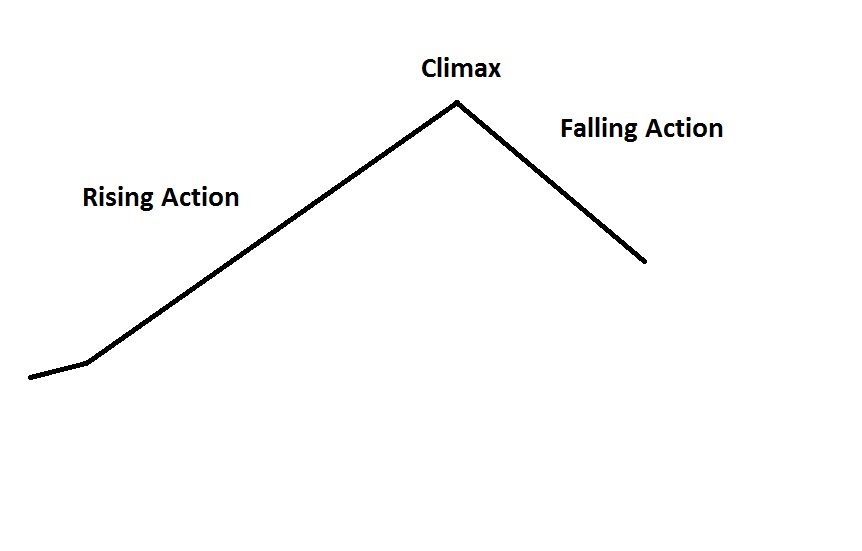
This is the moment where something enters the story and critically changes the protagonist's direction; it's when the story moves from setting up to reaction, from "exposition" to "rising action" if you like Freytag's pyramid, from beginning to middle, from intro to significant conflict. In a Hero's Journey story, this is the "call to action." However you want to think of it, it is the moment that disrupts the established normalcy and sends the protagonist in a new direction.
The inciting incident/plot point one may happen in an instant or it may take place over several scenes.
In Spider-verse
This is the moment where Miles gets bit by the spider. It changes everything. We leave the setup and enter the rising action. He can't go back to the "established normal." And he's going to have to react to all the changes.
In other words, we are leaving the beginning, and starting the middle.
In a lot of ways, I'm an atypical person, but one of the ways I'm atypical is that I actually love prologues, and always have. As a teenager, I would be excited when I opened a book that said "Prologue"--years later I'd learn over and over again that a lot of people in the writing industry actually hate prologues! And the first few times I heard that, I was baffled.
I think some of the hate stems from not understanding how they actually function or when to best use them--two things I'm going to cover today.
First, let's talk about some of the reasons why people have said not to use prologues.
1. Some readers (can't remember the exact stats, but I think it might have been half) skip prologues anyway.
2. Story openings are very difficult to write, and by having a prologue, you are having to essentially write two openings--why would you do that to yourself? And you have to win the audience over--twice!
3. Prologues often contain unnecessary information, so you can just discard them. Start with the beginning of the story--chapter one!
I don't know about you, but all of these explanations left me wanting. And none of them felt like good enough reasons to ax prologues altogether (especially the second--if you want to be a writer, you probably won't make it far if you are scared of difficulty). Furthermore, a couple of years ago I perused bookshelves at a bookstore and found loads of novels that opened with prologues. Huh? Haven't I been advised not to do that?
You mean I don't actually have to hate prologues as much as I've been told?
Let's dig into them.
The Most Important Function of a Prologue
You can look all over online about when and why you should or should not use a prologue, and I'll touch on some of that in the types. But in my opinion at its bare bones--when you strip away all the differences between prologues out there--prologues are about making promises of one kind or another to the audience. That is the main function of a prologue.
Like all writing rules, there may be some exceptions to that once in a while, but I'd argue almost always prologues = promises.
Some might say that prologues only relate to giving out information that the audience can't get otherwise. I think it's fair to use them that way, but not all good prologues actually function that way, and even those that do still simultaneously makes promises. The promise comes from giving that information.
Prologues are also often displaced from the rest of the novel in some way--so one might argue that's what makes a prologue. But when I look at prologues, that doesn't quite hold up either. The only function that seems to, is promises.
Now, there are a lot of different promises you can make.
- You can make an emotional promise by communicating to the audience what kind of emotions this story is going to appeal to.
- You can make a promise about what kind of plot this story is going to have. Does the prologue cover an old unsolved murder case that's gone cold? The reader will assume the plot is going to involve that.
- You can make thematic promises about the theme topic or what sort of takeaway value this story might have.
- You can make promises about a type of character.
- About a relationship.
- About worldbuilding, setting, or a time period.
- Or about any kind of draws that your audience picked up your book or genre for in the first place.
- And you can make promises by foreshadowing
But most of the time, the most important function of a prologue is that it makes promises. For some, that might come strictly by providing information. But if you provide information with no sense of promise, it's probably a lousy prologue.
Some of you might be wondering if the first chapter of the story makes promises anyway, why do you need a prologue?
It's true that many, if not most, stories don't need a prologue at all. There are enough clear promises in the first chapter, and enough information in the actual novel, and adding a prologue would make the story weaker.
But for the stories that would benefit, there are a few different kinds of prologues with different functions that you might want to consider when you are wondering about packaging those additional promises (or critiquing someone else's).
Types of Prologues
Theatrical
I've talked in a previous post that in the film industry, there are two types of movie trailers: the theatrical trailer and the teaser trailer. (And what do trailers do? They make promises to audiences about what kind of movie this is going to be.)
A theatrical trailer is longer than a teaser trailer. It conveys the basic plot of the story. It communicates what the story is about. It gives us the setup. Here is an example of a theatrical trailer. (Notice how the setup is clear and chronological.)
Books are obviously a different format, but you can have a theatrical prologue in the same way.
The prologue promises what the plot is going to be about and clues us into the setup.
It simply introduces an overall plot of the story or series that may not be the main focus in the beginning chapters of the book itself--so it's a prologue.
The Raven Boys by Maggie Stiefvater is a good example of this, and you can read it here.
This is the opening line to give you a good idea:
Blue Sargent had forgotten how many times she'd been told she'd kill her true love.
The prologue goes on to introduce us to the sorts of magic the book includes (psychics and fortune-telling, for example). It introduces us to the setting. It establishes a particular lifestyle, or what's "normal" and ends on something (or someone) that changes that normal.
But the prologue continues to come back to the same topic: If Blue kisses her true love, he will die.
This gives us a sense of what this book series will probably be about. But since this is the first book, it's not going to be the sole focus, so the prologue is a good place for the introduction.
Teaser
In film, teaser trailers are different than theatrical trailers. While theatrical trailers make promises to the audience by conveying the setup and introducing the plot, teaser trailers make promises to the audiences by focusing largely on raw emotional appeals.
Notice how unlike the theatrical trailer, we don't really get a clear setup or plot. Sure, we see and hear snippets of it, but the trailer functions off making promises to the audience about what kinds of emotions they'll experience if they watch this movie.
Teasers lack context--that's one reason why they are so short (and why they are teasers). You can't hold an audience long if you don't give them enough context. But the audience knows that if they go to the movie, they will get the context and plot.
Some prologues are teasers. They promise a certain experience and also promise that if the audience reads the story, they will understand (aka, get the context) the event. I did a whole post on teasers here, so I'm not going to repeat everything.
I know a lot of people don't like Twilight, but I'm actually fine with the series. And I'm aware that technically the opening is a "Preface," but I'm going to grab it because it's an example of opening with a teaser nonetheless:
I'd never given much thought to how I would die — though I'd had reason enough in the last few months — but even if I had, I would not have imagined it like this.
I stared without breathing across the long room, into the dark eyes of the hunter, and he looked pleasantly back at me.
Surely it was a good way to die, in the place of someone else, someone I loved. Noble, even. That ought to count for something.
I knew that if I'd never gone to Forks, I wouldn't be facing death now. But, terrified as I was, I couldn't bring myself to regret the decision. When life offers you a dream so far beyond any of your expectations, it's not reasonable to grieve when it comes to an end.
The hunter smiled in a friendly way as he sauntered forward to kill me.
Notice we don't get a lot of context. We don't know exactly what's happening or how the character got here. But the passage makes emotional (maybe even thematic) promises to the audience of what will be included in the story.
Some opening chapters have quite different draws (or promises) than later chapters. A prologue might be a good way to bridge that and help balance the appeals for the audience.
The Greatest Showman is a perfect example of this.
The story really starts with Barnum being a child. He doesn't even come up with the circus until maybe a third into the movie. Filmmakers understand, though, that one of the film's major appeals is the circus. So what did they do?
They essentially opened with a "prologue"--promising the audience a set of draws that can't fit into the actual beginning--because Barnum hasn't made the circus yet.
It's arguably one of the best film openings today.
This is a case in particular where having two "openings" really is a strength. By having dual openings, you can showcase the story's draws on opposite sides of the spectrum. So, within the first 15 minutes of The Greatest Showman you get a taste of the spectacle and the fantastical of the circus as well as the personal and intimate conflicts and relationships that Barnum has.
Use this prologue when some of the powerful appeals don't appear until later in the story, so that you can promise them to the audience right out of the gate.
Christopher Paolini's Eragon might be a a good example of this. In the prologue, we get a sense of battle and other creatures and magic and even dragons, but the protagonist himself doesn't really encounter those things until later in the story. The prologue promises that those things will come.
Alternative Viewpoint
For some stories, the audience would benefit from information or a perspective that the main viewpoint character or characters can't give. Sometimes prologues are in a different viewpoint to give the audience access to that information.
The characters don't really have access to what the builders of the city knew. So the prologue is used to convey that to the audience.
When the city of Ember was just built and not yet inhabited, the Chief Builder and the Assistant Builder, both of them weary, sat down to speak of the future.
"They must not leave the city for at least two hundred years," said the Chief Builder. "Or perhaps two hundred and twenty."
"Is that long enough?" asked his Assistant.
"It should be. We can't know for sure."
"And when the time comes," said the Assistant, "how will they know what to do?"
"We'll provide them with instructions, of course," the Chief Builder replied.
"But who will keep the instructions? Who can we trust to keep them safe and secret all that time?"
"The mayor of the city will keep the instructions," said the Chief Builder. "We'll put them in a box with a timed lock, set to open on the proper date."
In any case, promises come through the information and context given to the audience (that the main characters don't have and therefore can't give.)
Sometimes the prologue may be different in how viewpoint is actually handled. It might be in second person when the story is in third. In third person with the novel is in first. But the decision should have a point and not be random.
Time Displacement
Use a prologue when you need to include scenes (in order to provide context and promises and/or foreshadowing or information) that take place during a different time than the rest of the novel--when it's out of sequence with the rest of the story. Usually this means that the prologue takes place in the past, but it can also mean future. It may or may not have the same viewpoint character.
Some of you might laugh, but the first chapter of Harry Potter is a good example of this. I'm aware that it's called a first chapter, but go read it again, and you'll realize it's really a prologue in disguise (maybe the people behind it didn't like prologues and thought it would be clever to call it chapter one). The entire chapter takes place about a decade before the rest of the story (also in other viewpoints), when Harry is a baby. It's out of sync with the rest of the novel and we don't meet Harry until the end. It also contains elements of the other prologue types I've outlined here. In fact, like many prologues, you could essentially skip the first chapter of Harry Potter--though that gives you an entirely different opening context since you don't have that information or those promises. (Sort of like starting The Greatest Showman with Barnum as a child.)
Informational
Like some of the others, this one can blend in and overlap with the different types, but just to help us with discernment, and because I have a few things to say about it, I'm making it its own category.
Some people say that a prologue is only good if it contains essential information--but that simply is not the case. You could cut off a lot of teaser prologues, dual draw prologues, and even others and still follow the story. (Besides, if half of readers skip a prologue, then you sometimes have to weave that information in another way anyway.) Like I said, you could cut off the first chapter of Harry Potter and you'll essentially get all the information you missed in other parts of the story. This is why I argue that it's promises, not information, that is the driving force of prologues. You can cut off the opening of The Greatest Showman and you would miss out on zero information (what you miss out on is the promises).
But some prologues are strictly there to provide information to the audience, and in some rare cases a prologue might be the only way to deliver that (skip at your own risk). In order to be good though, that information is going to provide promises too (and not read like an info-dump).
Star Wars movies essentially start with an informational prologue--but remember, books and movies are different, and if you write a prologue like Star Wars does at the front of your story it will not be acceptable by today's standards. Lord of the Rings (both book and movie) has an informational prologue--which once again would actually not be acceptable to write in today's day and age in front of a novel. Why? Because it will come across as an info-dump and probably read kind of boring. (Does anyone actually remember the real book prologue to Lord of the Rings? It's basically a long author note about Hobbits.) The Fellowship's prologue on Hobbits worked in Tolkien's time, but it wouldn't get published today. (Because of film and technology, audiences today don't need that much help and guidance to imagine and understand something that doesn't exist in the real world.)
This is one way that I see prologues go wrong. The prologue should almost never read like an info-dump. Instead, think of the information you need to convey and see if you can convey it in a nice scene. An actual scene, with a character and event.
The City of Ember example doubles as an informational prologue. It's telling the audience the beginnings of the city. Notice that it has the audience focus on actual characters having a conversation, and isn't just a big long paragraph of the narrator giving out information.
Sometimes the information itself isn't essential, but is instead significant in some way. The other night I watched The Prestige (cause you know I love Christopher Nolan's writing and seeing Hugh Jackman performing spectacle shows in the 19th century). The opening works as a prologue, but the information isn't necessarily vital to understanding the story. Instead, it's important because it introduces a theme weaved into the movie. With the prologue the audience can watch the film with the idea that the knowledge will be significant in some way. (Notice how the film example doubles as a teaser.)
I'm sure there are more types you could categorize, and I'll have to keep my eyes out for them. And as I said above, many prologues fit into more than one type. But I still think it's helpful to have the categories, because it helps us understand them.
People often don't understand that because a prologue works differently than the rest of the novel--that's why it's a prologue and not just lumped in with everything else--it can't usually be criticized like the rest of the novel.
And because people don't understand the true core of their function (promises), prologues can draw a lot of (inaccurate) criticism from critique groups and others.
I've been to a number of writing conferences where editors have said they always skip the prologue in a submission. I used to think it was because they didn't like prologues--hated them even. Now that I'm an editor, I find myself doing the same thing--and I like prologues. It's not because it's bad. It's because it functions differently. And I'm geared up to be critical of the first chapter. So often I'll skip or just scan the prologue and come back later to take a closer look--a clearer look--when I have a better idea of how that prologue should be functioning in relation to the rest of the work (and the promises it should be making). For example, if the prologue is a teaser, I'll read through it, but often wait until I get more context to come back and edit it. But whatever the case, you should always be looking at the promises it's making.
Hi, September C. Fawkes here. Sometimes I scare people with my enthusiasm for writing.
I have worked in the fiction-writing industry for 15 years, editing for both award-winning and best-selling authors as well as beginning writers. I'm also penning a YA fantasy series. I'm here to guide you on your own literary adventure. Read about me.
Some may say I need to get a social life. It'd be easier if my fictional one wasn't so interesting.