Showing posts with label beginner. Show all posts

Monday, June 12, 2023

7 (More) Things I Wish I'd Known as a Beginning Writer (Pt. 2)


Last time I shared seven things I wish I'd known as a beginning writer. Unsurprisingly, that wasn't an exhaustive list, and I've been thinking about it some more. So, I present to you, seven more things I wish I'd known as a beginning writer. . . .

Wednesday, May 24, 2023

7 Things I Wish I'd Known as a Beginning Writer


I wish I'd known so many things as a beginning fiction writer. . . . 

Recently, I was teaching and mentoring at the Storymakers Conference, and I got into a conversation with a fellow editor and writer about such things, and I've sort of been thinking about them off and on ever since. Thus, this post. But I'll keep this intro brief. . . . 

Here are seven things I wish I'd known when attempting to write my first novel.

Monday, March 12, 2018

Back to Basics--Imagery


Back when I took my first ever creative writing class in 8th grade, I learned about imagery. Ironically, I actually don't hear people use that term very often, most people seem to simply refer to it as "appealing to the senses."

I usually don't spend a lot of time talking about the basics on my blog. I figure people can learn about them in plenty of other resources. Besides, I've brought up imagery a few times in other articles. But I wanted to revisit it today because there are reasons why the basics are the basics. You need to master them before you can accomplish much else. Once you get more advanced, it's easy to sort of brush them aside as obvious or unimportant, but even for masters it's helpful to revisit them again and again and again. Besides, I do have at least a few things to add.

And then I'm going to tell you about how revisiting the basics saved my butt a couple of years ago when I was trying to write a scene that was one of the most difficult scenes I've ever written.

When you take a creative writing class, one of the first and most important things you learn is imagery, a.k.a. appealing to the senses. These are:

1. Sight

2. Sound

3. Touch

4. Taste

5. Smell

If you want to get more advanced, there are writers who will add others to the list, like a sense of time, a sense of self, or the sixth sense.

But when you learn the basics, it's those five.

Someone somewhere along on your writing journey (or maybe it's me now) told you that in order to write a story well, you need to appeal to those senses throughout.

You need to describe what that ocean sunset looks like.

You need to mention the fresh, sharp smell of an orange being peeled.

You need to have a line about how soft and warm a thick blanket is.

This is because naturally, beginning writers tend to write in abstract ways, focusing on feelings, ideas, and thoughts, instead of rendering the concrete.

The reason we have that tendency, is because as writers, we usually are already experiencing the feeling of our character or whatever it is we want to get on the page. So, we try to label and describe that feeling perfectly instead of writing in a way that evokes or creates that feeling in the audience. Logically, we mistakenly think that if we can just really nail describing that feeling, the audience will feel it powerfully too--they will feel exactly what we are feeling, because we described it so well.

You may indeed describe that feeling perfectly well, but chances are, if you take that approach, the audience will never feel it to the same degree you do.

This is because they are being told about the feeling, instead of experiencing what leads to those feelings. I've talked about this before.

Instead of focusing on describing the feeling, it's more effective to render well what causes those feelings, so that the audience can experience them for themselves.

This works in other areas too. Because the writer imagines perfectly what a park looks like, they don't feel the need to actually describe the park. But the reader could be imagining a park that looks completely different.

Imagery is one of the most important things to learn as a new writer because it teaches how the concrete needs to be on the page in order for the audience to become immersed in your character's story.


When you are first learning how to incorporate imagery, like many writing skills, it can sometimes feel mechanical: "Okay, now I need to put in an appeal to smell . . ." "And it's been two pages since I described a sense of touch anywhere." "I need to take a sentence and describe what this actually looks like . . ."

But through the process it becomes more natural and you eventually learn how to describe things. Some descriptions are better than other descriptions. For example, almost always, the more specific you can be, the better. The more interesting details you can select, the better. If you can expand, deepen, or put in motions those descriptions, it'll be better. If you know how or when to use or not use adverbs and adjectives, it'll be better.

One of the most important principles you are learning here is to incorporate concrete, specific lines rather than to rely on the abstract to write more effectively and ultimately more powerfully.

But it's easy with all the information and components of a good story to forget this basic. I see it every so often in editing. A writer is trying to render an emotional moment very powerfully, but they completely forget to include the concrete elements. There are moments where the abstract is beautiful and powerful in and of itself, by itself--but that's almost always after the audience has been prepped with the concrete. The one case where this may not be true is if the abstract passage is a truly original perspective, in which case, it appeals to the audience's intellect because of the new concepts in it. But when you are trying to appeal powerfully to emotions and feelings, you virtually always need to somehow attach it to the concrete.

It might seem counter-intuitive, but it's the truth.

Here's the thing. A few years ago, I was working on a scene that I knew I needed to nail in order for the audience to experience this part of the story powerfully. The scene related to a magic system of sorts that largely incorporates the abstract, the intangible. It could even be considered a spiritual experience for my character.

I worked and wrote and rewrote and sweated and cried and bled--but the most important paragraphs of the whole scene, the key paragraphs where the audience was meant to feel the most power, weren't working. They worked for me. They perfectly described what I felt the experience would be like for this character. Heck, I even drew from my own experiences that would be most similar. But for readers, they weren't enough. And as I read and read and reworked and reworked, I knew it.

But I was in a bit of a jam. See, this magic system largely works off the abstract--and the fact it does is sort of one of the points of that element. In other places in the story, that isn't that big of a problem. The magic system itself is usually not a major focal point. But here it was. I had to figure this out. I used all the methods I knew of. It really was one of the hardest things I've ever tried to write--but I also felt it was one of the most significant I needed to get right.

My dad has a motto that when things get confusing or seem out of control, you go back to the basics.

That's what you focus on.


The basics weren't going to work though, because I was dealing with an abstract magic system, and the basics I'd already tried to incorporate still weren't enough.

Here's the thing, I could have just written those key paragraphs and called it good. But I didn't. Because when it got down to it, I couldn't. I couldn't get over the fact that they really needed to be as emotionally powerfully charged for the audience as possible.

So utterly frustrated, desperate, and downhearted, I reluctantly went back to the basics.

I mean waaaaay back--back to one of the first things I'd ever learned: appealing to the senses.

Even though my character's experience was utterly abstract, I just sat down and just starting writing paragraphs that my character had experienced in his lifetime that appealed to a particular sense.

I literally sat down and wrote Sight: and then made up a few lines about something specific my character had once seen in a past moment that had an impact on him. Touch was one of the first ones I looked at, because I think it can be powerful. So I wrote a few lines about his first ever kiss (which wasn't really even important to the story).

I wasn't convinced that this was going to help me in this particular situation.

But I kept going.

I was going back to the basics.

I went through all five senses, sometimes coming up with more than one moment for each. Just a few sentences about his past experiences. And believe it or not, as I worked and more ideas came, I suddenly realized I was onto something.

I won't say everything, but I will say that doing that exercise led me to write what I believe to be some of the best, if not the best, material I've ever written.

(And it ended up being highly relevant to my magic system--more so than anything else I'd been coming up with)

It's easy now to read all this in a blog post, boiled down, with hindsight, and feel like that was an obvious and simple solution--but let me tell you, the struggle lasted for two months, and given the story circumstances, it was not obvious and it definitely was not easy. It was the hardest few paragraphs I've ever written!

But here's my point: When I was so sure the basics couldn't help me, let alone the barest of the basics, for something so abstract, they did.

It didn't mean that what I ultimately wrote was simplistic or easy. It wasn't.

But the basics gave me the tools to build the effect I had been searching weeks for. I've never been more pleased with the outcome of a passage I've written.

That's the thing about the basics. There is a reason they are the first things you learn. There is a reason they are the basics. Because you build off them to reach higher ground.

Without them, you have no access to that. Without them, I'd never have been able to reach the high-emotional impact I was searching for.

Never underestimate the power of the basics.

Using them doesn't naturally make you the next great American author.

But you'll never get there without them.


Monday, August 7, 2017

Fixing the Mary Sue Character in Your Story


The term "Mary Sue" started in fanfiction, back when someone wrote a Star Trek story that had a character with that name, but a Mary Sue can pop up in original fiction too. Really, she can pop up anywhere. But she hardly ever pops up in published fiction or professional fiction--because she often bars those works from those markets. So if you've only ever read books you can buy off a bookshelf, you may have never meet her.

"Mary Sue" is a derogatory term for a particular (yet reoccurring) character type that many beginning writers write about. But she's a problematic and poor character for several reasons. A lot of people may have different definitions for what "Mary Sue" means, and there are different subcategories for different types.

Probably the most common Mary Sue is the one that is inexplicably talented at everything, falls in love with a hunky guy or is related to a significant person, gorgeous, and embodies pure wish fulfillment. This sort of Mary Sue is what usually crops up in fanfiction, because she's inserted into an existing universe that the author already knows and loves.

However, as someone who edits unpublished, original fiction, the Mary Sue I often run into is a different type.

Does your female character embody these?


Is Your Character a Mary Sue?

  • - Often she contributes almost nothing to the story or plot--and yet, everyone adores her. (Alternatively, she's insanely talented and every problem is ultimately solved easily by her--more common in fanfiction.)

  • - At some point, she might eventually be considered very valuable, by others or to the plot, but often it's a passive value. Something she just *is* instead of anything she does.

  • - She's probably clumsy. Sometimes ridiculously so, as in, she can't even walk down the sidewalk or go down a couple of stairs without worrying she's going to fall. Bonus Mary Sue points if a male (usually a love interest or family member) comments on how klutzy she is and has to have her hold onto him just to walk somewhere. Extra bonus Mary Sue points if she falls in front of a cute guy or the love interest or when it would be most embarrassing (which, of course, is in front of a cute guy). 

  • - She doesn't see herself as beautiful, but somehow the author finds a way to convey to the audience that she is drop dead gorgeous without even trying.

  • - She does nothing, but yet people feel sorry for her and her problems. These are often problems she makes little to no effort to fix, or problems she doesn't even consciously think about fixing or improving.

  • - She needs a lot of saving--either from these problems, or because she's a helpless [insert character trait (hint: probably has to do with being a klutz)]

  • - Often other characters (usually male) go out of their way to help her with her problems--and sometimes really out of their way, like they might miss the most important meeting of their career, a prestigious performance opportunity, their mom's birthday party, or work. Whatever they miss, one thing often holds true--it was more important than whatever the female character needed help with. It might be an injury she got while being clumsy or maybe she's just sad about school and how "hard" (hint: she has one of the easiest lives of all the characters) her life is, or maybe it's just that perennial problem that she has and has made zero effort to try to solve and/or would not have even been in to begin with if she weren't so darn passive. Whatever it is, people (friends, males, family, males (whoops, did I say "males" twice?)) inexplicably bend over backwards for her. Usually people--plural, not singular.

  • - She probably cries more than any other character, even though many of the other characters have more significant things they could cry about. She cries sometimes over day-to-day challenges that the average person faces anyway. It might be over a problem she hasn't tried to fix or that she puts herself in (though the author never points those things out). For example, she might cry repeatedly over a school club she's a part of but hasn't bothered to leave. She probably cries on the behalf of other people too--people who don't even cry about their own problems.

  • - She'll likely trip in the first 50 pages, but in a way that highlights and exaggerates her beauty.

  • - If you took her out of the context of the story, you might realize she's actually kind of pathetic and passive, and yet, inexplicably, everyone STILL adores her.

  • - Often she feels stupid or foolish, but the hottest guys fight over her (heaven knows why).

  • - She's more romantically or sexually inexperienced than the love interest and worries about not knowing what she's doing and what he'll think. (Bonus points if she somehow ends up being the best thing he's ever had regardless.)

  • - All in all, she just attracts a lot of male attention, whether it's romantic or brotherly or just male strangers in the street.

  • - A lot of the time she's a wish-fulfillment character (traditionally, the author's wish fulfillment). This is why she's adored and hailed as the most important person in other people's lives and considered very special, even though she feels stupid, uncoordinated, and helpless; this is why she's actually gorgeous when she feels ugly; this is why people drop the most important moments of their personal lives to save or nurse her back to health.

  • - The flaws she has are meant to be endearing and don't actually contribute to the main problems of the plot. They may exist, but are unimportant beyond the very surface of the story

  • - She tends to be in "parent-child" relationships. This relationship can be exaggerated with her parents, but it often crops up in other relationships--whether it's from the best friend, love interest, or brother. Whatever the case, she's usually the "child" while the other person is her "parent" in the relationship. The "parent" is taking care of her, warning her, helping her, praising her, directing her--even though she's 16, 17, 18, 19, 20, 21, 22, or 23 years old. Whether or not she obeys, she listens to them and maintains her role of "child" in that relationship. In fact, she often seems utterly accepting of her "child" role.


Bonus Round (yes, there is more) 


  • - She has a unique hair or eye color (in a story with fantasy or sci-fi elements, the colors may change or be unnatural compared to ordinary humans) and it's described in "I'm-trying-to-be-poetic" language (a.k.a. "purple prose"). Extra, extra bonus points if it takes at least five words to describe.

  • - She has an unusual or rare name.

  • - She's a stand-in for the author (an extended version of wish fulfillment), so that the author can live in this fictive universe. This is especially true for fanfiction. ("I wish I could go to Hogwarts and be in a relationship with Draco Malfoy")

  • - She's a half-breed of some sort. Half-blood, half witch, half alien, half elf, half animal, were-dragon, (again, this is something that makes her special based on what she *is* and not what she does).

  • - She discovers she has a familial bond with another character or discovers a family secret. Extra points if there is a tragic (often cliche) backstory.

  • - While she might be uncoordinated or pathetic, in other versions she's unusually and unrealistically talented at just about everything--more things to further extents than anyone could realistically be that good at.

  • - In the opening of the story, she's late to somewhere important. Extra points if it's her own fault, negligence, or because she slept in.

  • - She may have over emotional reactions to things that don't merit such an emotional reaction. For example, she might yell at someone who is trying to help her or cry because her (ordinary) school day is "hard."


If you are sweating it out now, don't. I'm going to give you some tips that will help.

First off, an important point. Can a male character be a Mary Sue? Yes, but they are called a "Marty Stu" or a "Gary Stu." They may be a little different than a Mary Sue, particularly in the fact that they don't necessarily need a ton of female attention or a romantic plot line (though it's not uncommon to have a million girls falling all over him either). Just as a version of Mary Sue is that she is good at everything and that her flaws are meant to be endearing rather than real flaws, Marty Stu is often insanely good at everything too, and any flaws he might have might actually be cool or tough or likeable (like being overly arrogant). Marty Stu is not as common as Mary Sue though, and he's usually more tolerated in today's society, as his attributes are still often praised as the epitome of male-ness, while today's society finds many of the traits of Mary Sue to be offensive to women.


Not all of the Mary Sue Traits are Terrible


There are reasons this character type reappears over and over and over again--hundreds or thousands of times a year (most of them don't make it to the bookshelf or big screen, though both Bella from Twilight and Rey from The Force Awakens have been accused of each being a Mary Sue). It's because there are people who are attracted to those character traits. Not all the Mary Sue traits are bad, but together, they cause problems. Look at what kind of person those outlined features created. And yet everyone and their dog adores them? Love interests fight over them? It doesn't make sense. Look at how unrealistic that person is.

Many of these traits would be fine added to a more realistic, rounded character:

  • - She's beautiful, but doesn't know it.
  • - She has innate or inborn value
  • - She's half human
  • - She discovers a family secret
  • - She's inexperienced
  • - She's clumsy

None of these are inherently bad (though most of them are overused--especially the first and last in the list).

Wish fulfillment isn't innately bad either. There are loads of successful wish fulfillment characters and wish fulfillment stories. In fact, most if not all successful stories feed into some sort of wish fulfillment (that's usually why people pick up the book).


The Problems of the Mary Sue


One of the main and common problems with the Mary Sue is that the relationship between her traits and how others treat and react to her, don't make a lot of sense.

If you knew a person in real life who cried regularly about her problems but did next to nothing about them, are you really going to miss your chance to break into a big acting career to go nurse her pathetic, fragile emotions? Probably not. (And if you are, aren't you just enabling that kind of mentality?)

If you knew someone who acted as the "child" in all her significant relationships, would you really look up to her?

If you were a love interest, would you really fight over a girl who is so passive she gives Bella Swan a run for her money?

If there was a girl who got scratched up from watching Aragon take on armies of orcs and Frodo almost die destroying the Ring, would we later compliment how brave she was?

No!

Sometimes what's unrealistic are the character traits themselves. In some cases they may even be contradictory. For example, she's incredibly clumsy but later in the scene she wins an athletic competition. Everyone tells her how beautiful she is, and she acts like she's hearing it for the first time . . . . every time. All the guys in the story have crushes on her, but she's shocked when the hot guy actually asks her out, and we learn she has no experience with guys (even though she's always wanted a boyfriend and every guy in the story ogles her). The other characters have lived through more trauma, but she subconsciously expects or hopes that they will nurse her insignificant problems.

If she has any flaws, they are portrayed as endearing or acceptable. As a society, do we really want to portray passivity and incompetence and uncoordination and child-like dependence as endearing? Acceptable? Now, I'm not saying you can't have a character who has these traits, but it's important to watch how they are handled, and the ideas that have already been established and perpetuated in entertainment (especially outdated entertainment).

By the way, it's completely possible to make your character endearing through other traits. In Harry Potter, in Harry's viewpoint in the sixth book, Hermione is described as endearing in passing because of her loyalty and faith in libraries and books. Intelligence and tenacity can be endearing, not passivity. Endearing comes from other characters knowing and appreciating a character's traits or personality.


Nursing the Mary Sue Back to Reality


The Mary Sue character isn't some gross, obscene character that only the most incompetent people write. She has a name because so many passionate writers have written her at some point. If you have a Mary Sue character, you're probably normal.

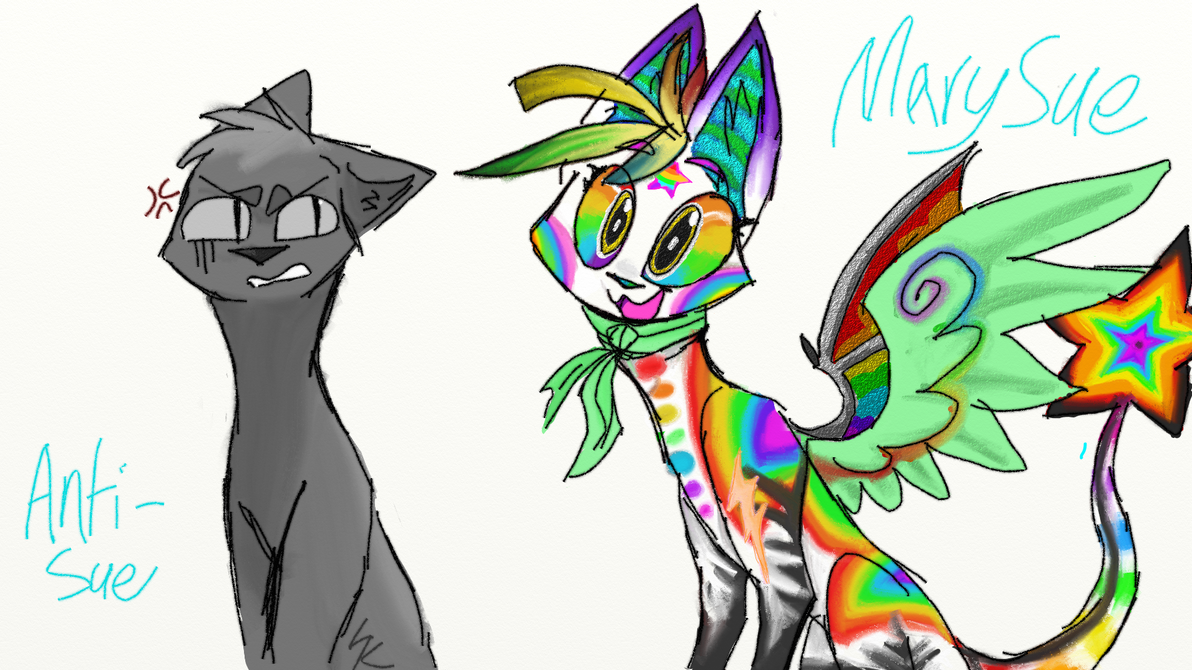
In an effort to fix the Mary Sue, some writers try to take her traits (some or all) to the far opposite, creating what is called an "Anti-Sue," which really isn't much better. I talked about this similar thing happening in my post The "Twins as Clones" Writing Epidemic, where in an effort to differentiate twin characters, the author tries to make them extreme opposites. This can be just as cartoony and unrealistic.
http://pre04.deviantart.net/036b/th/pre/f/2015/096/e/1/the_mary_sue_and_the_anti_sue_by_sketchykreeture-d8oksqk.png
Source

If you really love your Mary Sue character and can't part with her, you are free to keep some of her traits and abilities. But in order to create a more rounded, likeable, believable character, you need to be her best friend, brother, love interest, or mysterious stranger that nurses her back to the real world--or at the least the real fiction world.

Some of these things may seem straightforward when you start looking at them. If she's crying a lot, cut the crying. Excessive crying often happens in stories when the author is trying too hard to create sympathy for the character, instead of empathy. But true empathetic emotional power often comes from focusing on and rendering what causes those feelings rather than only on the feelings themselves.

If everyone loves her inexplicably, change it. However, be careful not to make the only people who don't like her rude, unlikeable, and unsympathetic, which is another telltale of a Mary Sue in a story.

Cut the clumsiness and give her a flaw that is more unusual.

If she's passive, make her more active in the story and in solving problems. She can fail, fail, and fail again, but in her sphere of power, she should at least be trying, and if she's not, show us a clever reason why. For example, in M. Night Shyalaman's most recent movie, Split, the protagonist is a very passive, young female. But not only do we learn multiple reasons why she is so passive (and they're legitimate), but we see that in reality, she does have a plan, but it's quiet, subtle, and requires waiting for the perfect moment.

If everyone bends over backwards for her, give the secondary and side characters their own lives, and moments where they chose their own lives over hers.

Ultimately, though, perhaps the most effective way to nurse a Mary Sue is to brainstorm not broader, but deeper. Don't make her more broad by adding more and more things to her; instead, dig deeper and deeper into her psychologically and explore interesting inner thoughts, motivations, fears, and contradictions, and how those things manifest themselves outwardly and in the story. Brainstorm and brainstorm and brainstorm some more, because the cliches are always what come to mind first, and if there is one thing about nursing a Mary Sue to reality, it's moving beyond cliches.


Monday, April 25, 2016

To the Unpublished Writer: You're Doing Okay.


I see a lot of unpublished work. A lot. In some stories, I can tell that the writer needs to work on mastering a few elements: voice, or arcs, or style, or viewpoint. Others I can tell still have a very long road ahead of them. Once in a while, when I come across a story that shows that the writer still has a lot of growing to do, I think about the kind of harsh, even cruel, criticism they could potentially get from others. Once in a while, I might imagine the kind of damage that might do to that writer. They may feel emotionally wounded, even betrayed. They have poured their heart into their work, only to have it get shredded. They may quit writing altogether, thinking they don't have what it takes. Maybe it will paralyze them so that they feel mentally blocked every time they sit down and try to write. Maybe it will make them bitter.

Monday, February 15, 2016

When to Stop Being a Beginner


Over the last year or so, I've done a few posts on breaking writing rules, and how and when to break them right. I want to emphasize that these writing rules are very important for beginners, and if not a complete beginner, someone who hasn't mastered the writing technique yet. But there is a point where you need to realize,

you aren't a beginner anymore. 


Monday, January 25, 2016

Breaking Writing Rules Right: "Show, don't Tell"


It's one of the first rules of creative writing you'll hear. It may be the rule you hear the most: "Show, don't tell." Today I'll explain what that rule means, why it's in place, and then why following it too closely can actually harm rather than help your writing. There are places in writing where telling is just frankly better, and even more powerful.

What's the Rule?


The Rule:
Show, don't tell.


Why it's a Rule


Honestly, almost any beginning writer who is getting into writing needs to hear this advice, and probably several times. When I was in college, this was like scripture. I heard it every week, if not every day. This is because naturally, we are wired to "tell" a story rather than "show" one. Telling is easier, and if we don't know the difference, we just do what's natural and easy.

Friday, October 10, 2014

The Difference Between Being a "Beginning" Writer and a "Bad" Writer

First, I'd like to announce that Sesshyowl won my Attack on Titan giveaway. Yay! Thanks to everyone who entered. We had 1,673 entries! Don't forget about our Dr. Who giveaway happening now. Second, I saw this post about the difference between being a beginning writer and a bad writer on Shallee McArthur's blog and knew I wanted to use as a guest post on mine. So here you go.

I've been thinking a lot about writing, publishing, and how it all "works." For me, personally, I've been writing for years. And I'm going to be honest: it took a while for me to write anything that could be considered a good story. But here's the thing. That doesn't mean I was a "bad" writer when I started out. I was a BEGINNING writer.


Nobody listens to an eight-year-old slaughter Twinkle Twinkle Little Star on the piano and says they're a bad pianist. They're learning. They're figuring out which notes are which keys, and which fingers go where, and how to play them smoothly, and quickly, and correctly. And that's wonderful.

Writing takes time. We start off slaughtering a semi-decent idea. And that's wonderful. Sure, it's no masterpiece. It's our first, or third, or seventeenth attempt, and we managed some words on paper that resemble a story. We learn about character development, and which plot points go where, and how to pace things and add emotion. When I look back on my early writing, I smile at myself-- not because I'm laughing, but because I'm proud of my beginning-writer-self.